Showing posts with label Metallic Thread. Show all posts

Sunday, January 15, 2023

Tallit Commission: A Time for Machine Embroidery

Here's my latest commission, and although I live in California, and the client lives in the southeast USA, it was made with help from one of the best Judaica machine embroiderers on the planet, Marilyn Levy of Ontario, Canada. It's a tallit (prayer shawl) for a young man's bar mitzvah. 

Like all my commissions, this one started out with a  discussion with the young man's family. They wanted cotton, with a leafy design, in blue and grey, so I drew up choices.


They liked #1 best, the simple vines. What was most unusual - and why they needed a custom tallit instead of one off the rack - was that they wanted Ecclesiastes 3:1-8 on the atarah, the long rectangular band that marks the collar.

You know this verse: it begins, "To everything there is a season, a time for every purpose under heaven." 

An atarah is optional - store-bought shawls sometimes carry the embroidered prayer for donning it. But I've never seen one with this particular verse. 

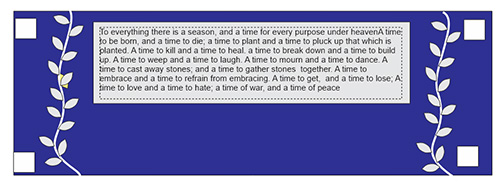
Initially, the family hoped we could fit in the entire verse, which is a long paragraph. They wanted the letters big enough to read from a distance. I make a sketch to show them what this might look like. 

That convinced them that just the first line might be better. They wanted it in Hebrew and English. I told them I could only do this job if I brought in a subcontractor. I contacted my friend Marilyn Levy, a.k.a. "the TALLITmaaven," who graciously agreed to help. So now we had a three-way, international collaboration, with the family telling us what they wanted, Marilyn showing us what's possible in embroidery, and me getting everyone on the same page and doing the construction.

After much back and forth, here's a printout of Marilyn's design; the family was happy with the size and fonts she chose. (The straight lines help with placement; it's not part of the design.) Full size it was about 22" long.

I printed it out onto paper, cut out the lettering area and taped the two pieces together. I used that long paper strip to block out the area of the tallit where it would lie, and started sewing the other elements in place around it, while waiting for Marilyn to finish the fabric version. 

Marilyn did a gorgeous, flawless job with the atarah, as I knew she would. 


A little closer: 

She also embroidered the boy's name a few times, so I was able to cut those out and place them inside the tallit, inside a kippah (hat), and inside the quilted tallit case I made to hold everything. Here's the front of the case. The secret to quilting those lines so straight....
....was that I used my walking foot to quilt it from the reverse side, a star print, following the lines of the stars in three directions. Below you can see the print under the top flap. Lower down, the silver thread that shows against the blue was in the bobbin. One of the name tags is on the lower left (I blurred the name for this post.) 
I also made a pair of kippot with the same blue fabric, with grey binding.
The one on the left is reversible, but the other one, not so much, because of where the name tag went, as you can see below. (I didn't want to set the name lower, fearing it would interfere with the fit.) The hat pattern is from my book, The Uncommon Yarmulke (sold in my etsy shop at https://www.etsy.com/shop/CathyPStudio.) I used the "large, 4-panel" pattern on p. 19, which fits most teens and adults.
On the tallit, I freehand machine stitched veins on the leaves, and 6-pointed stars on the "pinot" (corner squares), with silver metallic thread. The leaves contain Decor Bond, a midweight fusible interfacing, which  gave them a bit of depth and stabilized them for embroidery. There's also Decor Bond backing the corner squares, which makes them strong for their duties holding a satin stitched buttonhole to surround the tzitzit, the ritual macrame strands, in place.

Like so many commissions, this one was not without its moment of terror. Marilyn put the package with the atarah and name labels into the mail, and headed off on vacation. After a week, the package vanished from the tracking system. I couldn't find it in the Canadian or the US mail. It didn't turn up on its due date, a Friday. My incoming US mail alerts showed no sign of it.

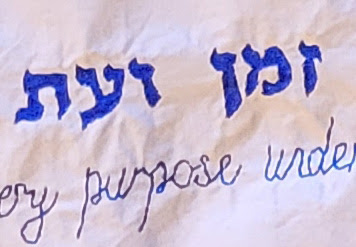
I lay awake that night, imagining the worst. What if it never showed? What if I had to do the embroidery myself, by hand? I decided to give hand embroidery a shot, just for my peace of mind. I spent the weekend doing the best hand embroidery I could possibly do, using Marilyn's paper printout as my model. Here's the result.


The closer you get, the messier it looks. This: 

Versus this: 
The handmade version is charming and might work for a compassionate blood relative; but it's not a job for a client. 

Thankfully, on Monday, Marilyn's atarah appeared, seemingly out of nowhere (according to two country's tracking systems).  I was thrilled with it.
The tallit and its accessories reached the family with plenty of time to spare. But you know how you sometimes find yourself buying fabric for the last quilt you finished? That's what sort of happened to me after this project. 

In this case, I started looking at embroidery machines, thinking, "Wouldn't it be nice if I could do this?" 

And then I answered myself. Machine embroidery is a complicated hobby and/or business. The cost and complexity of an embroidery machine is just the beginning. 

Then there's the knowledge, skill, time, and money required for acquiring and understanding lots of software; designing, sizing, adjusting, stabilizing, hooping and rehooping required for large, complicated designs including bilingual Bible verses on atarahs; not to mention mountains of threads you have to buy, and thread changes you must perform. Most of these things are so clearly not my strengths. But partnering with Marilyn who loves all this and does it so well - that was my idea of fun! 

I also vowed to learn a little more about hand-embroidery. I enjoyed doing it, even if the results were not suitable for formal occasions. I do wonder if flawless hand-embroidered  lettering - especially Hebrew lettering - in a reasonable amount of time is possible. If you've done it, I'd love to see and hear about your approach! 

To learn more about Marilyn's gorgeous Judaica, go to her website, http://www.tallitmaaven.com/. More examples of my (mostly not machine embroidered) tallitot and their backstories are on my Judaiquilt.com website, at http://judaiquilt.com/Tallit_Gallery.html


Monday, July 9, 2018

Judaica, Old and New, With and Without Charlton Heston

Judaic studies professor Jodi Eichler-Levine wrote a beautiful essay about Judaica and "riffing on tradition," published in the Association of Jewish Studies' magazine, here. I'm beyond honored to be mentioned. Here's he full matzoh cover that she discusses.
And the detail that caught her eye:
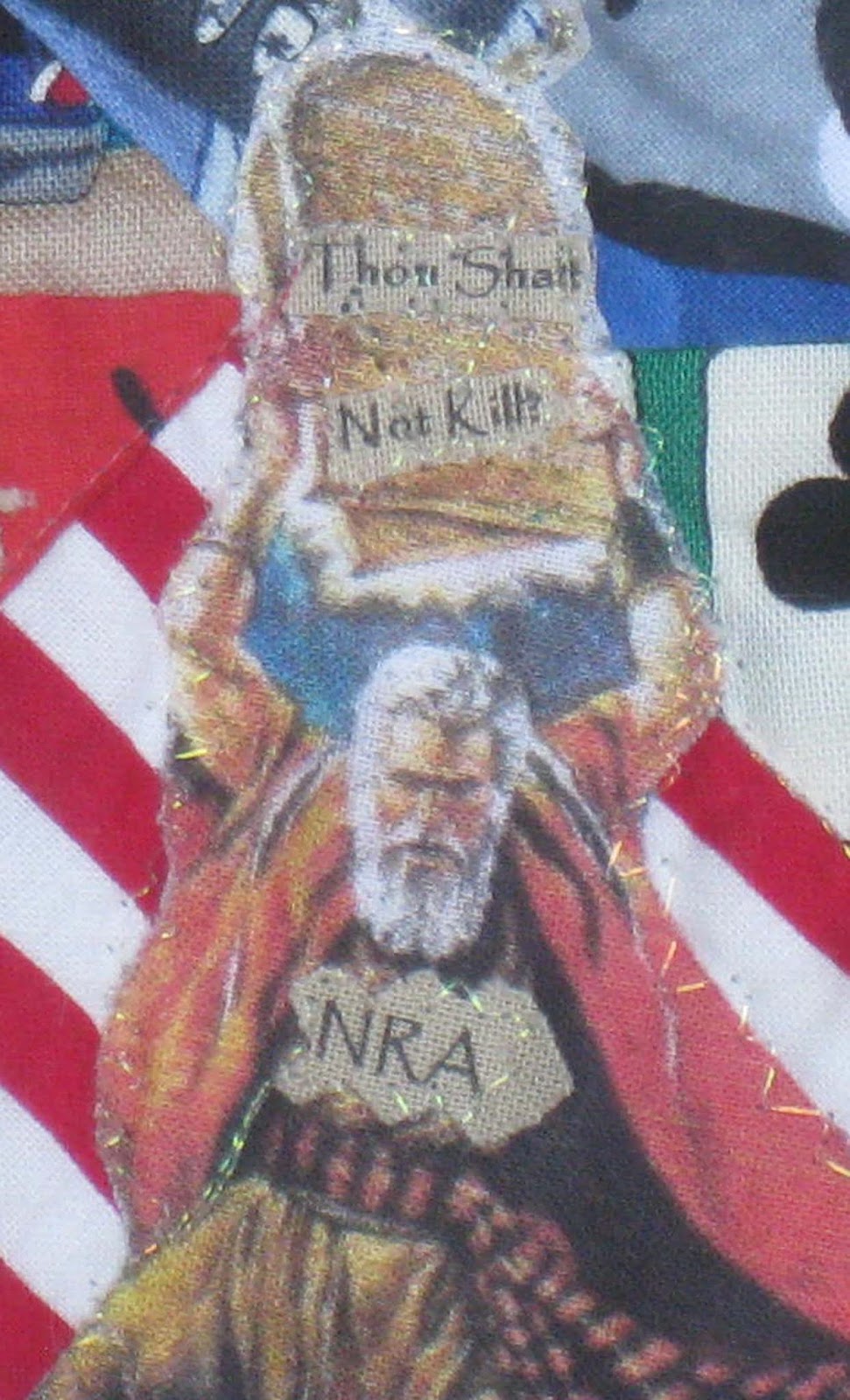
Doesn't everyone put Charlton Heston on their matzoh covers? I blogged about it several years back, halfway down the page. Thank you, Jodi. It's amazing to be understood
 +++
In tallit news: One disadvantage of being an empty nester is that my kids, who used to serve as fresh, unpaid supermodels, are no longer available. Fortunately, my fresh, unpaid supermodel husband steps in, if I plead and promise to maintain his anonymity. So here is an anonymous person modelling a tallit for a girl who chose the colors. the batik fabric, and the design, specifying that the stripes be uneven widths and uneven distances from each other. 
And here it is a few weeks later, on the actual gorgeous girl! (With her gorgeous family, also unevenly distributed.)
It's much more difficult to make stripes uneven than the same size. Closeup:
I outlined the letters with silver metallic thread, using freemotion techniques. The method is explained toward the bottom of this page. The Hebrew blessing for donning the tallit is made easily with my "atarah on a roll" pdf pattern, which you can download for free here. The quilted case, with the bat mitzvah's Hebrew name, is below.
Opened, from the back:

The matching kippah is very simple....
...and reversible....

(My not-quite-free book on how to make plain as well as complicated reversible kippot is here. )

+++

And speaking of complicated: Tallit-and-kippah maker extraordinaire Marilyn Levy used a pattern from my book to make this kippah, with the extensive machine embroidery that she does so beautifully: 
Find more of Marilyn's exquisite creations, including kippot and tallitot, at her website, here.

+++

And finally, moving from the sublime to the ridiculous, I must sheepishly admit that I do occasionally get commissions for bark mitzvah hats - yep, canine kippot. Meet Cody (and a feline photobomber): 
(What kind of a Jewish name is Cody? I forgot to ask his Hebrew name). I got a little fancy with fussy-cutting the four panels of Cody's headgear, for a kaleidoscopic effect: 
And the inside: 

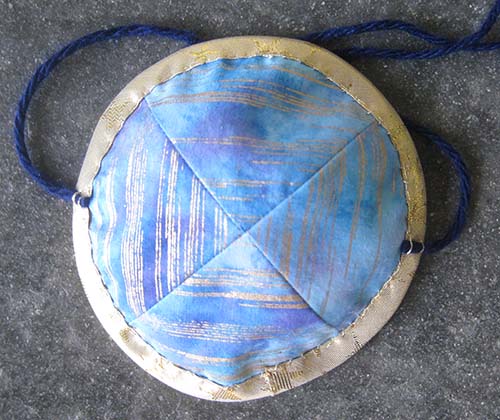
It has a gold lame binding - what dog doesn't love bling? - and can double as an eyepatch. Not recommended for cats. The pattern is also in my book, here.

Sunday, April 8, 2018

Freemotion Quilted Hebrew Alphabet Postcard Tutorial

How's your Hebrew? Mine could be much better, but that didn't stop me from making thirteen 4" x 6" quilted Hebrew alphabet postcards for a recent exchange.
A little closer: 


One example: This is the first letter of the Hebrew alphabet, 'aleph.' 
Mystics saw its structure as a ladder between heaven and earth (Can you see the ladder on the far left?) The rest of the background is freemotion quilted with objects that begin with aleph, including pears, pineapple, ears, fire, and lion. OK, they're very sketchy, but they're there! 

These cards were made for my Jewish quilting group's "People of the Book"-themed postcard exchange. I was particularly excited about this theme because of my fondness for fonts. New, old, I can't get enough, in any language. The Hebrew alphabet is particularly gorgeous, whether ancient Torah calligraphy, or art-deco influenced mid-20th century. A favorite book on my shelf is this 1950 tome called "Hebrew Alphabets," by 20th century Judaic graphic designer Reuben Leaf. The book offers dozens, and even the cover is a treat: 
For the postcard exchange, I paged through it for ideas, and was stopped in my tracks by this: 
At the bottom, it says it was designed by Siegmund Forst, a groundbreaking mid-20th century artist and graphic designer from Vienna; and the letters were based on the Kafra Haggadah, a lavish 1947 illuminated Haggadah.

The first thing I did was scan the page; then in a graphics program, I resized the letters to about 2" x 3", so they would fit comfortably on a 4" x 6" postcard. 


Since I was swapping with 12 people (plus one more card for me), I cut 13 pieces of stiff double-sided fusible interfacing to 4" x 6". I cut a long strip of a mottled batik fabric and pressed each rectangle onto the fabric (using a non-stick press sheet on bottom to prevent the other side of the fusible from sticking to the ironing board.) 
 Cut back the excess fabric to the same size as the interfacing.
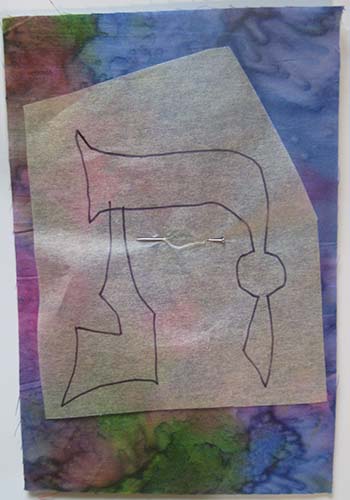
I used Golden Threads tracing paper to trace the outline of the 13 letters I selected for this project. 
 Then I pinned the outline to the center of each postcard.
 Next, I stitched along the edges with gold metallic thread and an open-toe freemotion quilting foot.
After stitching:
 Tearing away the tracing paper was next. First I ripped away the outside.
I liked how it looked with the paper inside, but obviously that's not a long-term solution.  I ripped away the inside, and then went after the little bits. With Golden paper, they're easy to dislodge. (That's not the case for other kinds of paper.)
I wasn't wild about the lack of contrast when the letter outlines were empty - so I filled them in with gold metallic paint. They are all painted by hand, with a small brush, and of course I always wear my magnifying headgear to do this as neatly as I can. 

Next came the research part: I dug up my Hebrew-English dictionary, and also opened a translator online. I looked up Hebrew words that began with that particular letter, that would be relatively easy to freemotion quilt.

I grabbed my tracing paper again, and pinned fresh 4" x 6" pieces of it to each card again. This time, I focused on doodling designs representing Hebrew words that begin with that letter, in the space around the letter. 

For example, the card below shows the letter peh. The sketch shows my brainstorms for the surroundings. Peh has a numerical value of 80, and peh words depicted include bell, skeleton key, unlock, brook, mouth, face, mushrooms, flower, coffee pot, and fruit. 
In order to get the design onto the card, I did NOT stitch through the tracing paper. I needed to see exactly where I was gong, and the tracing paper would obstruct the view.  So I put the sketch next to my sewing machine, and referred to it when freemotioning on the actual card. I ended up doing many things differently from the original! 

Next, the letter 'bet', the second letter of the alphabet, is associated with the number two, and it’s said to be pointing to heaven. Bet nouns on this card include egg; home; banana; peanuts; thumb; and balloons.
This one's 'ayin'. The words I depicted include tree, grass, eye, grapes, clouds, and maybe cookies. 
 And so forth.


After the quilting was finished, the reverse side of these cards was still blank - just fusible interfacing. In my graphics program, I wrote a little essay for each card, explaining each letters and its words, plus the address of each recipient. I could fit three custom 4" x 6" labels like these per page. 
I ironed five 8 1/2" x 11" pieces of plain white fabric onto freezer paper. Then I printed the labels onto the fabric. I cut each one out, fused it to the back of each card, and did a zigzag stitch with invisible thread around the edges to hold the three layers together. They were ready to go! 

If you love fonts - in any language - you can easily do a project like this. Quilted postcards are a great way to exercise creative muscles between large projects, plus they work as fun group activity for farflung people. They're also good mini-presents for all occasions - the recipients can hang them on the wall, or use them as bookmarks or coasters. For much more fun with fiber art postcards, click "Postcards" in the word cloud on the right.