Showing posts with label triangle. Show all posts

Tuesday, October 13, 2020

Pandemic Porch Quilt Show, Days 11- 12: A Batik Chandelier and a Millenium Quilt

Day #11: "Chandelier, Shaken"

This quilt is improv paper pieced, using batik fabrics.

Closer: 

Much closer:

A little to the left: 

Finally, from the back - I like the way the light creates a stained glass effect!

It was pure fun, with minimal measuring. The techniques I used (though not this actual pattern) are in my booklet, "Modern Paper Piece Log Cabin Triangles," in my etsy shop, CathyPstudio, here.

UPDATE: This quilt was just awarded Best Use of Color in the Innovative category, in Mancuso's Visuals #2 Pacific International Quilt Festival. All the winners are here.

Day #12: A Millenium Quilt

This large quilt (74" x 93", it almost hit the ceiling) is made of 2,000 squares, cut 2.5".

A little closer:

Center: 

Backstory: In the late 90s, a huge fad emerged among online quilters: Millenium quilts, to be made from 2000 different pieces of fabric. People set up swaps, and packs of squares were also sold online. 

When I first read about this fad, I thought, "What a terrible idea!" But after a couple of days, possessed by the audacity and community of it, I jumped in. 

I'd been quilting for almost a decade, so I had a significant fabric stash. I chopped 2.5" squares out of everything. Then I went to my upholstery sample books; old clothing; and basically, any fabric I could scrounge anywhere. 

Even then, I was still about 500 fabrics short. So I gave up on my dream of not repeating fabrics, and filled the corners in with squares cut from two different fabrics that were printed with millenium-related words in different languages. These are the mostly black fabric and the white-and-black fabric below. 

I was well into the project when I started reading that some quilters were using this project to affirm their Christian faith, which makes a great deal of sense. But since I'm not Christian, and I didn't want to leave my descendants wondering, I put the Hebrew calendar year - 5760 - along the bottom, and stitched into it an essay explaining the quilt and the millennium mishegoss that was taking place at that time! 

You can't lay out 2000 squares this size on any design wall smaller than the side of a barn. So I (and pretty much everyone who made one of these), constructed the quilt in blocks. Each of my blocks are 5 squares x 5 squares, totaling about 10 inches after stitching. Within each block, I placed the lightest square in one corner, moving to the darkest in the diagonally-opposite corner. To honor the traditional log cabin arrangement, I placed a red square in every center. I set the blocks in rows of 8 across, and columns 10 down -  that's 80 blocks, times 25 squares, gives you a 2000-square quilt that measured 72" x 93"!

The back features a whole lot of weird stuff, including this inexplicable M&M millenium fabric....

...which posed the profound question, "Is it Over Yet?" There are also a couple of delightful commemorative tea towels, from a trip we'd recently taken to London:


...and a tea towel from a sweet little amusement park we'd brought our little boy to in England, Paulton's Park. 
Plus this flea market find, curtains showing movie stars of the mid-20th century.
Until my pandemic porch quilt show, I had never photographed  this quilt flat before. The most I've ever seen of it at one time is on a full-size bed. Seeing the entire thing gave me a completely different sense of what it looks like! That's one more reason you should consider hosting your own porch quilt show! 

[The first installment of my porch quilt show, Days 1-5 is here. 

Days 6-10 are here.

The next installment is here

If you'd like to keep up with the show in real time, I'm posting it on Instagram, at https://www.instagram.com/cathy.perlmutter/


Monday, August 12, 2019

Scrappy Kitchen Art, Part 3: A Pear Pyramid

For the last couple of weeks, I've been showing off easy triangle-based potholders culinary art. In Part 1, there's a tutorial for strawberry-themed pieces.  In Part 2, I expanded to apples. And the other night - Eureka! - it occurred to me that pears are upside down strawberries! It didn't take long to drag out my yellow print scraps and create this pair of pears! (The hanging loop is rick-rack.)


See how they're an upside-down strawberry shape? 


 Instead of sticking with yellows, I added  bits of gold, orange and pink.
After making these tops on Sunday, my DH and I went on our weekly supermarket run. Of course, I went over to the pear department - and all I saw there were green pears! So I went home and made this:

Now that I have three of them,  I can create a pear pyramid! 
That would be a cute wallhanging, no? The triangles are approximately 4" on a side, 3.75 high,  cut with my handy equilateral triangle ruler. Again, a tutorial is in the first blog post of this series. 

Sunday, August 4, 2019

Scrappy Kitchen Art, Part 2: From Strawberries to Apples

In our last installment (click here) I made a series of scrappy potholders that started off with squares, graduated to triangles, and wound up with something like this: 
(This one is new, made after finishing that blog post.) A reader had suggested using rick-rack for the hanging loop, so I tried that, too - what's not to love?

Next I put green prairie points on top of the quilt top (along with a rickrack loop), to form 3-D leaves. Here they are pinned in position, ready to be basted, then sewn into the quilt sandwich (illustrated in last week's tutorial.)
Once stitched and turned right side out, the leaves stood up straight. 
They needed tacking. 
I tacked them down with some back-and-forth stitching in the center of each leaf, holding the folds apart. This was awkward; in hindsight, I don't think I'd do this again unless I'm sure the giftee will never use it as a potholder - without batting, it feels like these prairie points won't wear well. 

If you've never made prairie points, here's a mini tutorial. Cut a 4" square. Fold the top half down, wrong sides together. 
Then fold the upper corners down to meet in the center. You've done it right if all the raw edges are along the bottom. 

By now I was tired of strawberries, so I set a new goal: Apples. The round shape would clearly would require more triangles than strawberries. To avoid making it humongous, I brought the triangle size down - to 3 1/4" (uncut) from tip to base (instead of the 3 3/4" used in all the previous pieces.) I wound up using 24 triangles, two of them green. I was delighted with the results - an outer hexagon with an unexpected six-pointed star flashing around inside! 
I liked it so much I made another one! 
Eureka! I stumbled on the perfect gift/kitchen decor for Rosh Hashanah, the Jewish New Year, which involves dipping apples in honey! Start sewing now, it's coming up soon! 

A word from our sponsor: My Etsy shop has many more of my patterns, including Judaica and non-denominational kitchen art.


Friday, July 26, 2019

Scrappy Quilted Kitchen Art Tutorial

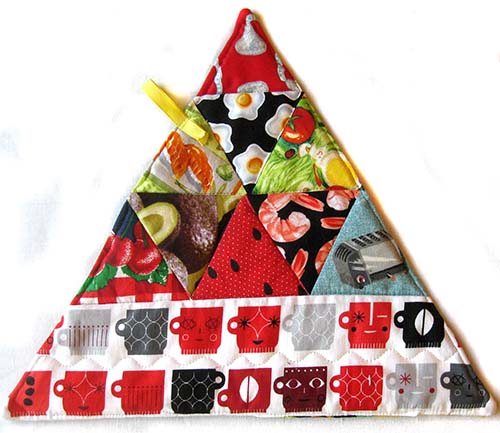
Ever since I became a quilter 20+ years ago, my all-occasion favorite gift to make for friends and family are potholders kitchen art made from 4" squares of the most outrageous/tempting/weird food fabrics I can find. Here are two recent examples: 
These are pure psychotherapy, easy, fast, and they make me laugh. I use a double-layer of cotton batting,* in case people actually use them. A couple of weeks ago, after I made the two above, I changed the rules of my game, and 6 potholders later, wound up with something dramatically different:
The evolution was logical. I was making gifts for summer visits with friends and family. After the first two above, I dared to do something different - cut triangles instead of squares.
They came out about 12" high, and each contained 9 food triangles, plus a strip fabric on the lower level. Below, triangle potholder #2....
...and next is #3, with a citrus print on bottom that's also on the back of all three of them.
I leaned the three of them against each other, and accidentally reinvented the food pyramid! What if I sewed the edges together, stitched a fourth triangle to the bottom, and stuffed it? It would make a fine centerpiece for the wedding of a nutritionist to an Egyptian chef! Or, a useless but decorative pyramid-shaped throw pillow!
The primary problem with triangles as potholders, I then realized, is that the corners are narrow - with no hand/arm coverage. So I made this...
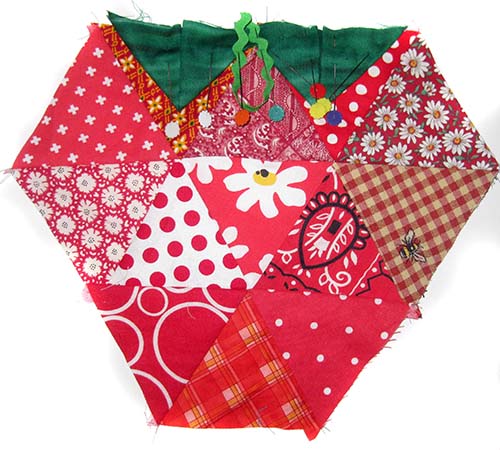
Eureka! It looked like a strawberry! So I made another one, this time not from food scraps, but red scraps.  (The bow/hangar is rainbow-colored rat tail.)  
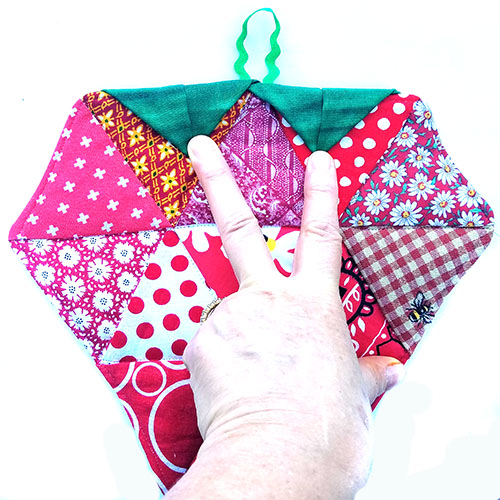
To drive home the strawberry message, I put this print on back: 
I happen to be allergic to strawberries, so this was super-exciting. I embarked on another one - with the addition of three green prints to serve as leaves.
Back: 
It's longer than the others, therefore better for hand/arm protection. But I feared it had lost that strawberry feeling, (apologies to the Righteous Brothers.)

For my last experiment, I used 13 triangles; two at the top are green. I think this is the most strawberry-ish of all, although it may be having an existential crisis, because I slipped in an apple-themed fabric.  
Want to make your own? The tutorial follows. My best advice: Sew triangles in horizontal rows, not concentric hexagons, because the latter gets very confusing, very fast. 

TUTORIAL: 13-Piece Strawberry Potholder/Kitchen Art
Cut 11 triangles from red scraps, plus two more from green scraps. Choose a variety of shades to create highlights and dark areas. 
An equilateral triangle acrylic rotary cutting template makes cutting easy and fast. There are many brands and price points; mine, below, is the “Equilateral 60 Degree Triangle by Darlene Zimmerman from EZ quilting by Wrights,” under $10.00 
I used the template line that measures 3.75” from tip to the center of the base (I marked it with painters' tape so I don't have to keep looking for it), but you can go to 4" if that's easier. 

Arrange the triangles.  
Sew together in horizontal rows. After you add each piece, press the seam allowance to one side. In the top row in the photo below, the seam allowances are all pressed to the right; in the middle row, they're pressed to the left...
...and on the bottom row, they're pressed to the right again. Here's the back:
Match tips and pin the top row face down onto the middle row, face up. Pin at each intersection, halfway across each triangle, and at both ends. 
Use a quarter inch seam allowance, and remove pins just before the presser foot reaches them. 

Open and press seam allowances upward, so the leaf tips are slightly elevated over the row below.
Add the bottom strip to the middle strip the same way. Press that horizontal seam allowance upward. 
Stack two layers of cotton batting - put the stitched unit on top and cut the batting a half-inch or so beyond it. 
Use your top unit, face down, to cut out backing fabric, face up.  Pin three layers together: Batting on bottom, backing (good side up) in the middle; and top, good side down. 
Create a loop - a 4.5" piece of ribbon, rattail, or fabric. Here, I started with a 4.5" x 1.25" piece of green fabric, folded both long edges inward to the center (good side out), pressed, then stitched along the open edge. 
 Bend. 
Insert it loop down, into the top center, with just about a half-inch of the two ends, side by side, sticking upward. 
Stitch around with a quarter-inch seam allowance, starting at the bottom triangle, on the left, going up and around and ending at the far right of the bottom piece. 
Trim all the batting and backing fabric in the seam allowances to a scant quarter-inch, and cut flat across the corners to a quarter inch.
The gap, directly above, is the width of the base triangle. Press the top edge of the opening down flat.

If you now lift the backing fabric, you'll see a bit of batting sticking out under it. Carefully cut it away. I suggest you do it with scissors, not a rotary cutter....
It's cut away - because I used a rotary cutter, I accidentally cut into the backing fabric on the left edge - don't do that at home! 
Press the backing fabric over the back of the batting to create a nice crease.
Now both edges of the opening are neatly pressed back.
Reach into the opening, where the two good sides face each other, and gently, pull right sides out. 
Use a chopstick to extrude all the corners, and press well. 
You can use a glue stick to shut the opening; press with a hot iron to dry the glue. Topstitch all the way around the potholder, 1/8th inch from the edge. Straight stitch in the ditch along all the diagonal and horizontal lines (I used invisible monofilament thread). My last step was to add "v" shaped quilting to the leaves. 
The back: 
Have fun! Send pictures! For more ideas, click "potholder" in the word cloud on the right. My very different food fabric potholder and quilt pattern is here.
*A layer of Insul-Brite may be safer for potholders, and I sometimes use it, but I do find that the double layer of cotton batting plus fabric on both sides, works well for most situations...unless confronted with a searing-hot, heavy pan; in those cases I trust my giftees will use their heavy-duty oversized potholder gloves, and not this kitchen art!

UPDATE: Part 2 of this series, with apples replacing strawberries, is now posted here.