Showing posts with label tallit. Show all posts

Sunday, January 15, 2023

Tallit Commission: A Time for Machine Embroidery

Here's my latest commission, and although I live in California, and the client lives in the southeast USA, it was made with help from one of the best Judaica machine embroiderers on the planet, Marilyn Levy of Ontario, Canada. It's a tallit (prayer shawl) for a young man's bar mitzvah. 

Like all my commissions, this one started out with a  discussion with the young man's family. They wanted cotton, with a leafy design, in blue and grey, so I drew up choices.


They liked #1 best, the simple vines. What was most unusual - and why they needed a custom tallit instead of one off the rack - was that they wanted Ecclesiastes 3:1-8 on the atarah, the long rectangular band that marks the collar.

You know this verse: it begins, "To everything there is a season, a time for every purpose under heaven." 

An atarah is optional - store-bought shawls sometimes carry the embroidered prayer for donning it. But I've never seen one with this particular verse. 

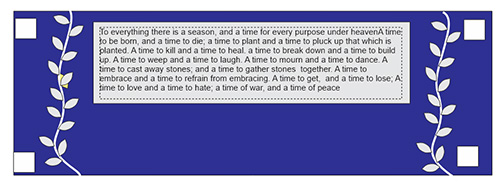
Initially, the family hoped we could fit in the entire verse, which is a long paragraph. They wanted the letters big enough to read from a distance. I make a sketch to show them what this might look like. 

That convinced them that just the first line might be better. They wanted it in Hebrew and English. I told them I could only do this job if I brought in a subcontractor. I contacted my friend Marilyn Levy, a.k.a. "the TALLITmaaven," who graciously agreed to help. So now we had a three-way, international collaboration, with the family telling us what they wanted, Marilyn showing us what's possible in embroidery, and me getting everyone on the same page and doing the construction.

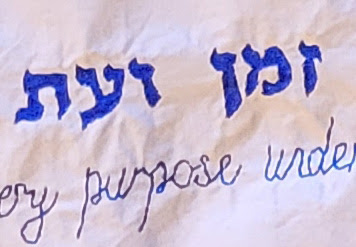
After much back and forth, here's a printout of Marilyn's design; the family was happy with the size and fonts she chose. (The straight lines help with placement; it's not part of the design.) Full size it was about 22" long.

I printed it out onto paper, cut out the lettering area and taped the two pieces together. I used that long paper strip to block out the area of the tallit where it would lie, and started sewing the other elements in place around it, while waiting for Marilyn to finish the fabric version. 

Marilyn did a gorgeous, flawless job with the atarah, as I knew she would. 


A little closer: 

She also embroidered the boy's name a few times, so I was able to cut those out and place them inside the tallit, inside a kippah (hat), and inside the quilted tallit case I made to hold everything. Here's the front of the case. The secret to quilting those lines so straight....
....was that I used my walking foot to quilt it from the reverse side, a star print, following the lines of the stars in three directions. Below you can see the print under the top flap. Lower down, the silver thread that shows against the blue was in the bobbin. One of the name tags is on the lower left (I blurred the name for this post.) 
I also made a pair of kippot with the same blue fabric, with grey binding.
The one on the left is reversible, but the other one, not so much, because of where the name tag went, as you can see below. (I didn't want to set the name lower, fearing it would interfere with the fit.) The hat pattern is from my book, The Uncommon Yarmulke (sold in my etsy shop at https://www.etsy.com/shop/CathyPStudio.) I used the "large, 4-panel" pattern on p. 19, which fits most teens and adults.
On the tallit, I freehand machine stitched veins on the leaves, and 6-pointed stars on the "pinot" (corner squares), with silver metallic thread. The leaves contain Decor Bond, a midweight fusible interfacing, which  gave them a bit of depth and stabilized them for embroidery. There's also Decor Bond backing the corner squares, which makes them strong for their duties holding a satin stitched buttonhole to surround the tzitzit, the ritual macrame strands, in place.

Like so many commissions, this one was not without its moment of terror. Marilyn put the package with the atarah and name labels into the mail, and headed off on vacation. After a week, the package vanished from the tracking system. I couldn't find it in the Canadian or the US mail. It didn't turn up on its due date, a Friday. My incoming US mail alerts showed no sign of it.

I lay awake that night, imagining the worst. What if it never showed? What if I had to do the embroidery myself, by hand? I decided to give hand embroidery a shot, just for my peace of mind. I spent the weekend doing the best hand embroidery I could possibly do, using Marilyn's paper printout as my model. Here's the result.


The closer you get, the messier it looks. This: 

Versus this: 
The handmade version is charming and might work for a compassionate blood relative; but it's not a job for a client. 

Thankfully, on Monday, Marilyn's atarah appeared, seemingly out of nowhere (according to two country's tracking systems).  I was thrilled with it.
The tallit and its accessories reached the family with plenty of time to spare. But you know how you sometimes find yourself buying fabric for the last quilt you finished? That's what sort of happened to me after this project. 

In this case, I started looking at embroidery machines, thinking, "Wouldn't it be nice if I could do this?" 

And then I answered myself. Machine embroidery is a complicated hobby and/or business. The cost and complexity of an embroidery machine is just the beginning. 

Then there's the knowledge, skill, time, and money required for acquiring and understanding lots of software; designing, sizing, adjusting, stabilizing, hooping and rehooping required for large, complicated designs including bilingual Bible verses on atarahs; not to mention mountains of threads you have to buy, and thread changes you must perform. Most of these things are so clearly not my strengths. But partnering with Marilyn who loves all this and does it so well - that was my idea of fun! 

I also vowed to learn a little more about hand-embroidery. I enjoyed doing it, even if the results were not suitable for formal occasions. I do wonder if flawless hand-embroidered  lettering - especially Hebrew lettering - in a reasonable amount of time is possible. If you've done it, I'd love to see and hear about your approach! 

To learn more about Marilyn's gorgeous Judaica, go to her website, http://www.tallitmaaven.com/. More examples of my (mostly not machine embroidered) tallitot and their backstories are on my Judaiquilt.com website, at http://judaiquilt.com/Tallit_Gallery.html


Monday, July 9, 2018

Judaica, Old and New, With and Without Charlton Heston

Judaic studies professor Jodi Eichler-Levine wrote a beautiful essay about Judaica and "riffing on tradition," published in the Association of Jewish Studies' magazine, here. I'm beyond honored to be mentioned. Here's he full matzoh cover that she discusses.
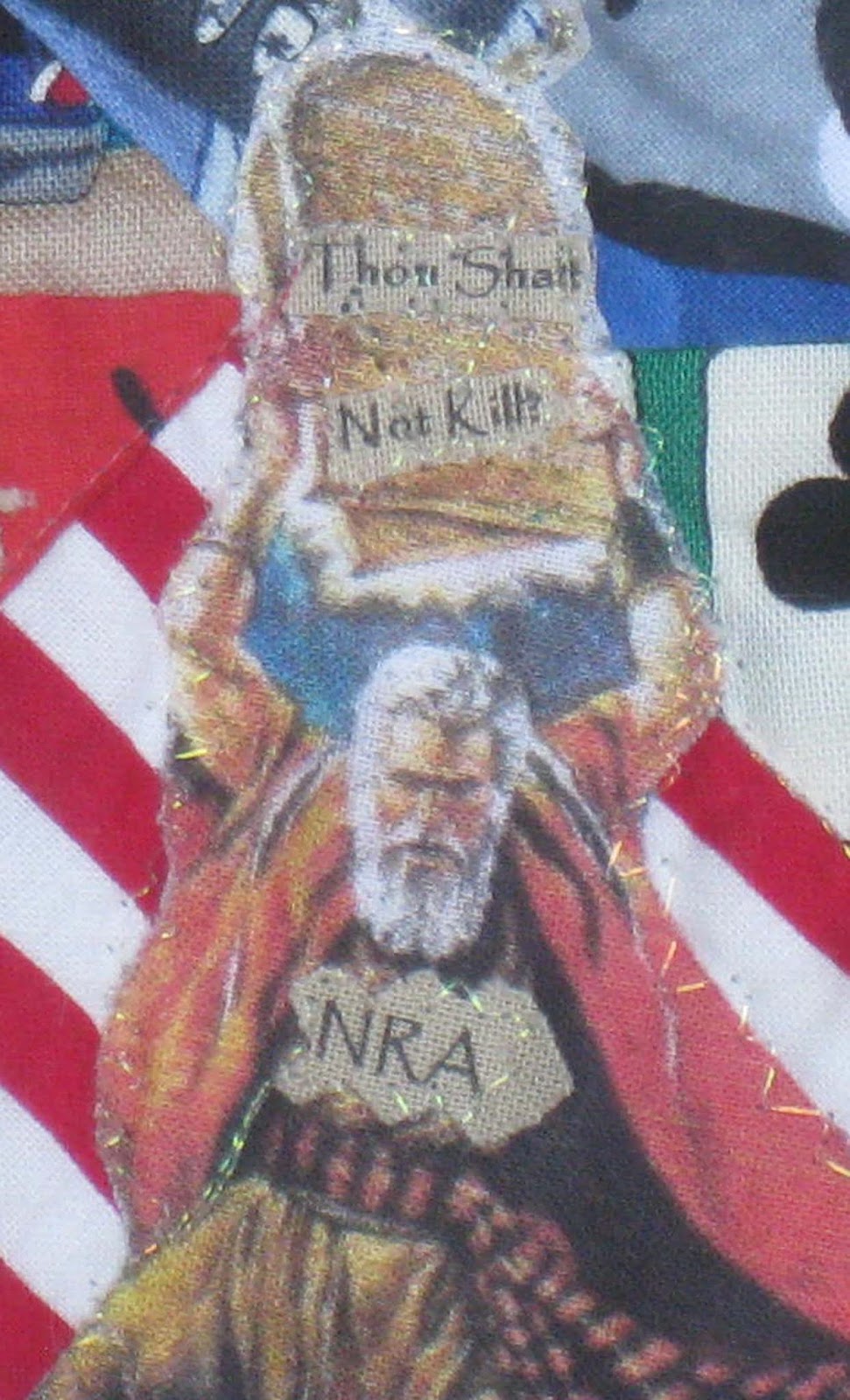
And the detail that caught her eye:
Doesn't everyone put Charlton Heston on their matzoh covers? I blogged about it several years back, halfway down the page. Thank you, Jodi. It's amazing to be understood
 +++
In tallit news: One disadvantage of being an empty nester is that my kids, who used to serve as fresh, unpaid supermodels, are no longer available. Fortunately, my fresh, unpaid supermodel husband steps in, if I plead and promise to maintain his anonymity. So here is an anonymous person modelling a tallit for a girl who chose the colors. the batik fabric, and the design, specifying that the stripes be uneven widths and uneven distances from each other. 
And here it is a few weeks later, on the actual gorgeous girl! (With her gorgeous family, also unevenly distributed.)
It's much more difficult to make stripes uneven than the same size. Closeup:
I outlined the letters with silver metallic thread, using freemotion techniques. The method is explained toward the bottom of this page. The Hebrew blessing for donning the tallit is made easily with my "atarah on a roll" pdf pattern, which you can download for free here. The quilted case, with the bat mitzvah's Hebrew name, is below.
Opened, from the back:

The matching kippah is very simple....
...and reversible....

(My not-quite-free book on how to make plain as well as complicated reversible kippot is here. )

+++

And speaking of complicated: Tallit-and-kippah maker extraordinaire Marilyn Levy used a pattern from my book to make this kippah, with the extensive machine embroidery that she does so beautifully: 
Find more of Marilyn's exquisite creations, including kippot and tallitot, at her website, here.

+++

And finally, moving from the sublime to the ridiculous, I must sheepishly admit that I do occasionally get commissions for bark mitzvah hats - yep, canine kippot. Meet Cody (and a feline photobomber): 
(What kind of a Jewish name is Cody? I forgot to ask his Hebrew name). I got a little fancy with fussy-cutting the four panels of Cody's headgear, for a kaleidoscopic effect: 
And the inside: 

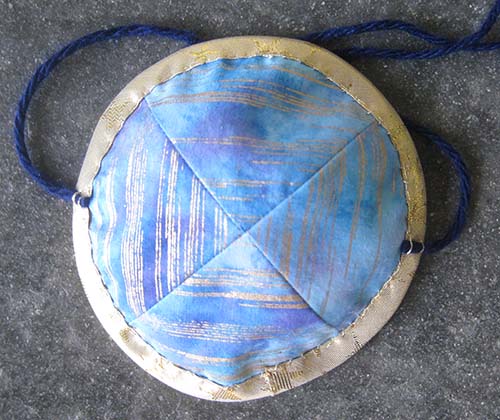
It has a gold lame binding - what dog doesn't love bling? - and can double as an eyepatch. Not recommended for cats. The pattern is also in my book, here.

Sunday, October 8, 2017

A Pieced Prayer Scarf by Any Other Name (Quilt, Tallit, Stole) is Just As Sweet

I've made many Jewish prayer shawls (aka tallit) during my time as a quilter. Prayer shawls are usually what quilters would classify as applique projects: Stitch a design to the front (or not), decide whether you want a lining, a collar rectangle, stripes, or corner squares, and you're almost done. (Few people want batting). They can be as simple as one  piece of fabric (like the spectacular hand-painted fabric below, made by quilter Ricky Tims, modelled by my DH, with my Mom looking on:)

...to a simple background white background with the stripe and lining fabric selected by the client:

...to a more intricate cutout - this one's made from six shades of hand-dyed cotton....

...and this one's in dupioni silk...

...to something really complex involving photographs and piecing, like this tallit for my son, with NASA space photography...
...and this one for another young man, a Beatles and rock guitarist, modeled by my DD...
....guitar photos served as stripes. (The whole story).
Once you've done the appliqueing/piecing/stitching, all that remains is tying a fringe - called tzittzit- in the corners.

I've made so many tallitot (the plural), that you can imagine how excited I was to get an assignment from a different religion!

My friend Marian Sunabe attends the historic Evergreen Baptist Church in Los Angeles, founded by the  Japanese-American community in 1925. After the attack on Pearl Harbor, a notice of eviction was posted by the government on the church's door - and many of their members were shipped to internment camps in remote, harsh locations. Sensitivity to this shameful episode made this church outspoken during the Civil Rights era and to this day, as it serves a diverse Asian-American community.

A happy occasion was coming up this summer: installation of their new pastor Jason, a delightful person, who is also one of my Artist Trading Card swap partners. (He made me a lovely woodburned tree ATC a couple of years ago, here.)

Marian asked me if I would help her make what she called a "stole" - a word I always associated with last-century mink neck wraps worn by my elderly relatives! But as it turned out, a stole is just a variation of a tallit!

The downside was that they needed it soon, I was about to go on vacation. I would be returning home on Friday, and the installation was Sunday. Marian was rightfully anxious, but I wasn't - barring flight delays, and with a little preparation, I knew that we could churn it out in an afternoon.

Jason wanted historic photos on his tallit, er, stole, and I was out of pretreated photo fabric sheets (my favorites are favorite EQ Printables Cotton Satin sheets), so I asked Marian to buy a bunch. I was expecting her to come back with a pack of flat sheets, but she bought this:
It's an 8.5" x 100" roll of Blumenthal Crafter's Images PhotoFabric, cotton poplin. It runs about $25. I'd never used this product, but it worked out very well. You have to cut the 120" roll down to the size you need - in this case, 8.5" x 11" sheets to feed into the printer.

The stole would need to be 92" long - far longer than my longest tallit (they usually run about 70") - and merely 5" wide - way narrower than any tallit I'd ever made. So I sized the photos to 4.75" square (to fit two on a page), and printed them onto the fabric sheets. Here are some of the historic images Jason wanted on the scarf. First, the civil order removing Japanese Americans from their homes.
Next, a harrowing image of the Japanese community lining up for trains to the camps, an image which resonates so deeply with me as the daughter of a Holocaust survivor, 
This picture of Sunday School at an internment camp,
 The American flag flying high over the Manzanar camp, an iconic Federal government photo:
 A Christmas image from an internment camp:
Having lived in Tokyo, I've always felt the Japanese and the Jews had a great deal in common - but this project, and specifically the photos - really brought home how much, in America, a history of discrimination unites us.

I arranged the photos two to a page in my graphic design program (CorelDraw, but you could do it in Word), and then printed them out onto the Blumenthal sheets, before I left on vacation. Marian also brought over a stack of  glorious Japanese fabrics - most from vintage kimono - that one of the congregants donated to the project. OMG I was in love. We made a tentative plan.
The trip went fine, we returned Friday night, and Saturday afternoon we set to work. We had already cut one piece of grey/blue kimono fabric to serve as the lining - 93" x 5 1/2". We lay that on the floor as our template. Then we arranged the images and fabric strips on top of it. Marian is a gifted artist with an incredible eye - her medium of choice is usually collage, paint and paper - so I put her in charge of deciding which fabrics to use where. She was the art director, I was the technical consultant.


Marian came up with the color scheme, dark navy with shots of burgundy-reddish-purple - so elegant in subdued, spectacular Japanese prints and wovens.

It probably took us about 4 hours. Once the top strip was stitched together, we pinned it right sides  together against the backing, sewed all the way around with a quarter-inch seam allowance, leaving a turning hole of 5" along one edge.

Then we turned the whole thing to the right side, pressed it, and did a topstitch all the way around the edges. The sun was still up when Marian modeled the results. 
She sent me pictures from the installation ceremony the next day: 
What could be sweeter?
Joy-wise, it's not a whit different from what I see in bar and bat mitzvah pictures, when children are presented with their prayer shawls, we all think deeply about tradition and history....


   Good heavens, I love my life!