Showing posts with label quiltlet. Show all posts

Sunday, March 16, 2014

Wrist Candy: Denim Seam Bracelets

How fun are these? (A: Very fun, to make and wear.)
They are, of course, jeans seams, embellished with a lot of things: Embroidery thread, leather, vintage watch face, vintage buttons....

This shows all five before a final round of embellishments. Below you'll see I added a bit more to some.

1. Cross stitch with colorful thread (sorry that's hard to see), leather wrapped and glued ends, hook and loop twisted from wire.

2. Vintage brass/gold metal buttons, new chain attached at ends and in center, hook and loop from twisted wire at the ends.

3. Scrap leather wrapped ends (from a cut up old leather jacket), vintage watch face, wire hook and loop.

4. Vintage rhinestone buttons over a broken rhinestone necklace. Toggle and lobster clasp with ribbon ends. I used ribbon crimp ends on either side and they worked well for me, but you've got to get the height of the crimp ends just right.

5. Vintage silver-colored metal buttons, new chain, lobster clasp and jump ring at ends.

Other than stabbing myself multiple times with large, sharp needles (this activity is not for the thin-of-blood), making these is seriously satisfying. You should know a little about opening and closing jump rings and attaching findings (so you need a couple of jewelry pliers). Use an extra strong thread, like button and carpet thread or some other version of "heavy." If you want to form your own wire hook and loop, practice with scrap wire. After making the first several by bending wire (not particularly expertly), I vowed to make future bracelets using jump rings and clasps - I think they'll last longer, and stay on better. 

UPDATE, 5-24-14: You can make matching rings, too! Go to http://gefiltequilt.blogspot.com/2014/05/denim-rings-upcycling-tiny-bits-of-jeans.html

Above all, have fun! (And send me links to what you make!)

Sunday, September 15, 2013

Quick, Potentially Modern, Double-Sided Quiltlet #10 Tutorial


Here's a quick, relaxing, and potentially modern scrap project. It's a quiltlet that works as a bracelet, bookmark, wallhanging, and more. The fewer appliqued squares you put on top, the more modern it will look. (Maximum modernity: one off-kilter orange square on vast sea of blue).

The front side is blue batik fabric with wonky orange batik squares fused on top.

The other side is a solid lavender quilter’s cotton. The squares on the front and back align, back to back.

So how do you line things up on the front and back? The easiest way (IMHO) is with applique and quilting lines, plus a wee bit of acrylic paint. Here are the details, in tutorial form:

Orange Windows Scrappy Potentially Modern Quiltlet #10

Materials
  • Featured side background fabric (blue batik), 3.75" x 10.25"
  • Reverse side background fabric (purple solid), a little bigger than the featured strip above
  • Window fabric for front appliques (orange), small scraps or a strip approx. 3" x 9"
  • Paint, acrylic craft or fabric paint (gold). Color should contrast well with your reverse side fabric.
  • Paper-backed fusible web, same amount as window fabric. I like HTC Trans-Web, or Wonder Under. (No financial affiliation)
  • Thin cotton quilt batting strip (I use Warm'n'Natural), 4" x 10.5"
  • Thread to coordinate with the window fabric, and with the fabric/paint color on the back side.
  • Two buttons, one for each side.
1. Cut the featured background fabric (blue) to 3.75" x 10.25"

2. Cut the  reverse-side background fabric (purple) slightly larger than the featured side. (Don't measure - simply lay the featured side on the reverse side, and cut around.)

3.  Apply paper-backed fusible web to the back of  your window fabric (orange), about 9" x 3".

4. Hand-cut squares and rectangles from the window fabric and arrange them as you want on the featured side. Don't measure, wonky is good! Keep them at least 3/4" from the edges. Fuse in place, but don't stitch  yet.

5. Lay the batting on a table, cut slightly larger than the reverse side strip. Place the reverse side on top of the batting, centered and face up. Finally, place the featured side, face DOWN, centered on the reverse side. Pin the three layers together around the edges of the featured side.

6. Working from the back of the featured side, do a straight stitch most of the way around the edges (maintaining a 1/4" seam allowance on the back of the featured side.) Leave a 2.5" unsewn area along one long side. Backstitch for a few stitches at both ends.


7. Remove from machine, trim seam allowances to a scant 1/4" through all three layers, and snip off corners diagonally, but don't cut through threads.

8. Pull the right sides out of the gap. Use a chopstick and/or pin to fully extrude corners. Press. Neatly press the gap area and either stitch it shut with a few hand stitches, or insert a strip of fusible web and carefully press the gap closed.

9. Machine topstitch all the way around the rectangle, using a straight stitch, approximately 1/8" in from the edges.

10. Choose the threads you want to outline the squares, front and back. (I used a sparkly clear holographic thread on top, and gold metallic on the bottom.). Working from the applique side, do a machine zig-zag around each little square.

11. Machine quilt to fill in the areas around the squares. (I used a rectangle-type continuous freemotion design).

12. Turn it over to the reverse side. With acrylic craft paint or fabric paint, and a small brush, carefully paint inside the zig-zag outlined squares. (As you can see, I did the painting before the quilting, but it doesn't matter much either way.)
13. Stitch a buttonhole in the middle of one short end, and sew two matching buttons, back to back, on the opposite ends. 

Although it's usable as a wrist cuff,

I think it's even better as a coffee cup wrap: 
Done on the square instead of as a long rectangle, it would make for excellent coasters/mug rugs. The technique would also be great for small cases and purses. 

So that's the easiest possible way to coordinate fronts and backs. I'd love to hear how  you've done it! 

Sunday, September 1, 2013

Quick Project for Quilters Who Love Fonts Too Much.


A bunch of years ago, I took an excellent class on the Adobe InDesign program, which I use to self-publish my patterns. Typography, of course, was an essential part of the class. The teacher told us that his personal font collection ran into the thousands - that's thousands of alphabet styles, and dollars, too, since the good and the new ones tend not to be free. He explained: "I'm a font whore!"

 I'd never heard the term before (although it's been around), but oh my gosh, me, too! Well, wait a sec, that term is pretty rude, since persons who sell their bodies are usually not so enthusiastic about it. So I'll edit that to "font groupie," to reflect the enthusiasm factor. There have been many times that I loved fonts too much and threw them about promiscuously on my pages!

Then I read Walter Isaacson's excellent biography of Steve Jobs. After dropping out of college formally, Jobs nonetheless audited a college calligraphy class. When he developed his first mass market computer, he was determined to give civilians the ability to select fonts, a word that most people didn't even know. Thus Jobs turned typography from an obscure field for graphic designers and printers, to a steamy pleasure for the masses. Jobs was the personal computer age's first f.g.

The other relevant pop culture influence here is the Mary Tyler Moore show. Remember that giant "M" hanging in her living room? I thought it was the coolest thing. [Here's a lovely blogpost by a retired designer, with a picture of Mary's 'M', plus the bloggers' own fab artistic alphabetic wall letter collection: http://goodlifeofdesign.blogspot.com/2011/02/letter-letter-on-wall.html] Just as Jobs launched the font-loving trend, Mary (or her show's set designers) almost certainly launched the wall-alphabet trend.

So what we have at the top of the post are three quiltlets that celebrate font symbols and letters, aka "glyphs." These make excellent wall hangings - solo or in groups - as well as bookmarks, and even, sometimes, bracelets. It's the perfect gift for a literary friend. I trundled through the dozens of fonts on my computer to find suitable glyphs. My main criteria was that they had to be relatively wide - no thin, narrow stretches, or they wouldn't support their weight and would be a big pain to cut out and stitch.

The ampersand is a manipulated version from the font Blackadder. I smoothed it and stretched it. It's about 10" high and 4" at its widest.

It really does work as a bracelet. Here's the ampersand on (petite) Local Teen's tiny wrist.


And then there's the exclamation point.

 I can't figure out if I got it from the Binner D font, or from Gloucester MT Extra Cond - they're similar.  It's 8" high not counting the loop. The black cord loop secures the top to the stacked buttons in the bottom dot. The loop also serves as a wallhanger.

The question mark started out in either Harrington or Poor Richards. Aren't those font names enticing? They REEK of ink, of the Gutenberg Bible, Thomas Paine, and Benjamin Franklin.

Want to make your own quilted glyphs? I used a combination of black felt and solid quilters cottons. Here's the approach I used:

1. Choose a letter or character you like, and size it up in a graphic design or word program.* (see below)
2. Print it out (not mirror image). Trace the printout onto freezer paper (or print directly onto freezer paper, if you know how).
3. Press the freezer paper pattern onto your first contrasting color - for the ampersand, I used a red quilters cotton.
4. Don't cut into the red cotton yet - instead, press the wrong side to fusible web, so it is fully backed with fusible, with the freezer paper still on top.
5. Cut out the red cotton letter close around the freezer paper pattern. Remove the pattern
6. Press red cotton symbol to another contrasting color, in this case a dark blue-green cotton.
7. Press the blue's back to more paper-backed fusible web.
8. Cut around the blue-green fabric so a sliver of it shows beyond the red areas.
9. Press the red/blue combination to felt of your choice. (I chose black acrylic felt.) Use a press cloth, and a moderate temperature, so you don't melt the felt. Decide which areas of the felt to cut away, and which to leave in place. Trying it on a wrist will help you engineer a closure.
10. Stitch around each color with a zig-zag. I used a gold metallic thread from Superior, which goes well through sewing machines.
11. Optional: Stitch around the outer edge of the felt, if you want.

* Wondering how to resize and manipulate characters? Here's what I did. First, I typed the glyph into my favorite graphics program, CorelDraw, where I can easily convert it to curves and play with it. If you don't have a graphics program, you can resize in MSWord. Type the letter in the font you like. Select it. Bold it if you want it all a little wider. Select it again - you'll get a menu that allows you to enter the size. My MSW 2010 lets me size the glyphs from 1 to 1638 points, the latter being so huge it takes up about 8 sheets of paper. Size it around 600 points - it should take up most of a standard sized page. If it cuts off the image, try going to to 'page layout' and doing away with the margins. I don't have an Apple, but I'm betting that, thanks to Steve J., it's much easier to play with fonts in their system. Or, resizing on a copy machine may be easier than wrassling with MSW. Sigh! If only Bill Gates were a f.g!

Would love to hear about your passion for fonts!

Sunday, August 25, 2013

Scrap Strip Therapy: A Recipe for Relaxation

Sometimes you just need to sew scraps. Not think. Not drink. Just sew.

1. Cut or buy a standard-sized sheet of felt (close to 8 1/2" x 11"). I used black acrylic felt for this project. (If you need to press it, keep your iron  temperature low, and use a press sheet.)

2. Go through your scrap bin and find strips, from about 1/4" to 1 1/2" wide, 8" or so long. Unevenness and fraying are just fine! Selvages rock! Interesting yarns, cords, and threads count, too. If the fabric strips are wider than 3/4", cut gentle curves into them.
3. Lay the widest ones down first, slightly overlapping so no felt shows between. Then lay down the thin, thinner, and thinnest strips. Finally, add any yarns or cords. Strategic smears with a temporary glue stick can hold things down.

4. When the glue is dry (press to speed that up, at a not-too-hot temp, with a press sheet), stitch everything in place with a wide zig-zag. You can use one stitch/one thread, or many. Couch in the fibers (couch = stitch over the top with a wide long zig-zag, so the cord still shows).

I mostly used gold metallic thread in my machine and a plain vanilla zig-zag.


5. Now find that Christmas/Chanukah/Kwanza gift list and start cutting! Here are five different bracelets/bookmarks/wall hangings (aka quiltlets) made from this strip set. All serve as excellent gifts!

Sample One: Cut out a rectangle the long way, to about 7".

 If you used naturey colors, you've got something that looks like an abstract landscape. It's a soothing wallhanging for someone's work station.

A mother of pearl button glows like a moon. Stitch a buttonhole in the other end, and you've made a cuff bracelet.


Cut strata into 1” x 1” squares, on the diagonal. Artistic one inch squares are known as ‘inchies.’ (Which, like Artist Trading Cards, are tradeable works of art! Believe it or not, there are onetwo entire books about inchies!)
Once you've cut all the inchies you want, zigzag stitch the squares together, butting raw edges. The stitches act as hinges. Here I arranged them like the central sliver of a  traditional "Log Cabin Barn Raising" quilt pattern. 

The kinds of people who love inchies are also tremendously fond of 'betwinchies', cut to 1 1/2” square. (And guess what Twinchies are?)


Or, cut out a wavy cross-wise section: 

Results look something like this: 

The gold 'sewing machine cord' was created on the machine, with water soluble stabilizer. It was then  couched to the background. and a loop was created at at the left end. A vintage gold metal button is added on the right.

And finally, with the leftovers from all of the above,  there's the  following amalgamation. I arranged inchies and wedges of black felt on water soluble stabilizer. Sandwiched the whole thing between another layer of the stabilizer, and then using gold metallic threads,stitched everything in place and added little thread curlicue protuberances coming off the top and bottom. 
 
There's a buttonhole on the far Western inchie, and a button on the far East.


Just remembering how I made these things causes my blood pressure to plummet (in a good way). If you've read this far, I suspect you feel the same way! 


Sunday, June 30, 2013

Loving Linen, Zoning Out on Zakka

My LQS (local quilt shop) has a few linen bolts, which called to me for a long time. A couple of years ago, I finally broke down, bought myself a quarter-yard of a delightful off-white, and decided to use it for small quilted cuffs (which I call quiltlets, and can be used as bracelets, wall art, bookmarks, and more).

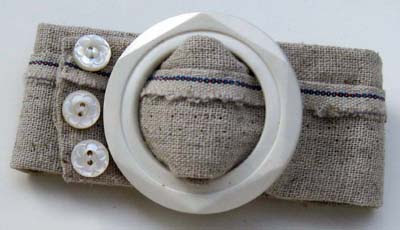
I fell deeply in love with the linen's selvage, which featured an inexplicable navy-blue line of stitching. (Can one of you selvage gurus explain that?) So I displayed it prominently in the first wrist cuff below. That's a vintage mother-of-pearl buckle, along with vintage m-o-p carved buttons.

That one's not quilted, but the next one is. It has a pillowcase finish, low-loft cotton batting inside, and is machine quilted. It turns out that linen takes machine quilting beautifully! 
 The khaki rick-rack is extra-fat (also new from my LQS), and I found an old belt-buckle to stitch to one end.. The metal iron-on triangular embellishments came new from my LQS. 
It has a bit of a steampunk feel. The polka dot yo-yo is green vintage satin, and the brown  tortoise-shell-plastic-and-metal button on top is vintage. 

Finally, I used the linen as a base for a quiltlet that includes a neutral-colored new polka-dot cotton fabric, a large grey m-o-p button, and grey grosgrain ribbons (along the bottom). There are two horizontal lines of quilting along the top.
None of these things look even remotely like what I usually make - too little color, too clean lines!

I made them because I was having a zakka moment. Zakka is a Japanese aesthetic, which, in turn was influenced by modern Scandinavian design. It's all about simplicity and muted (if any) colors. It's one of those things that, when I first saw it, struck me as incredibly boring...but about three minutes later, once it had sunk in, I needed to make some RIGHT NOW. Zakka projects are often precious little objects for the home. Although I now love it, I couldn't take a steady diet of it.

Want to try it but not sure what to make? Do an Amazon search for "zakka sewing" and you'll turn up a half-dozen project books. I own Rashida Coleman-Hales "I Love Patchwork; 21 Irresistible Zakka Projects to Sew;' you can browse inside that book as well as the others on Amazon to find a project that inspires you.

My friend Karen, who alas, is not a quilter, is the queen of linen. She buys linen garments at thrift shops, dyes them, and the results are earthily, mutedly, magnificent. Do a search for "upcycling linen" on Pinterest to see many different ideas for using linen from former garments, or from the LQS.

What have you made from linen?

Sunday, June 16, 2013

Why a Chicken? No-Mistake Hand Embroidery for Quilts and Beyond

Did you hear a  contented humming sound coming from the Left Coast last Sunday morning? That was my fellow Los Angeles stitchers and me, sewing flowers, chickens, African baskets, and other things, in a very  happy class.
We were attending a Southern California meeting of the awesome Pomegranate Guild of Judaic Needlework; the class was African Folklore Embroidery, taught by Leora Raikin, an extraordinary young artist who was raised in South Africa

Everyone in the class received a kit, which is to say a 16" square piece of  black  fabric, with a simple outline sketched in white and a few sparse details. We could choose from designs depicting flora, fauna, Africana, Americana, or, unlikeliest of all, Judaica, which, it turns out, reflects Leora's heritage. (Choices here.)

I'd been reading a book about the lives of industrial chickens, so, perhaps out of guilt, perhaps as a tribute to my grandmother's soup, perhaps just because roosters are awesome, I chose the chicken; I picked the poultry.

The stitches Leora taught us just couldn't be simpler - mostly chain stitch, plus some interesting wrapping of threads around those chain stitches, easily creating complex-looking effects.

The embroidery threads that came with our kit were absolutely gorgeous - variegated threads dyed by South African women using environmentally friendly methods. As a result of Leora's enterprise, "All the women involved in the thread dying process have been able to move from shack housing to formal housing with running water and electricity," she notes.

So we're helping needy people while we sew! Especially with perilously ill Nelson Mandela in our thoughts, what could be better? Leora is dedicated to supporting African folk art, and to battling AIDS in her homeland. Read more about this remarkable woman here.

Quilts made from her designs have also won prizes at quilt shows - see the far right column on this page.

My rooster struck a perfect balance between relaxing-because-you're-following-instructions (i.e. the outlines), and exciting-because-you're-choosing-colors-and-stitches. It also helped that Leora prohibited us from ripping things out. "There are no mistakes!" she insisted. "No matter what you do, it will be gorgeous!" And she was right! What could be better?

And so, despite my unfortunate choice of a mohawk coiffure for the bird (no ripping!)...
.
...I couldn't put him/her down. After the conference, and into the night, I stitched until s/he was more or less done.  (I'm a little vague about ascertaining hen/rooster gender. No wattle?)

More! I needed to embroider more! So, (not quite finished with my denim creation spasm) I cut two leg segments from a pair of denim jeans, and turned them into wrist/coffee cup cuffs/quiltlets, embellished with useful reminders/affirmations.

First, Imagine
That's an amazing yarn called Sashay on the bottom. My Local Teen wants me to take that part off.
There are three vintage plastic buttons down the right side, and three hand-stitched buttonholes horizontally down the left side (look closely).

Second,  "I (heart) Green."
The top and bottom edging are crocheted. Three more vintage buttons run down the right side. I haven't yet put buttonholes down the left. The outline of the leaf below shows more clearly what a chain stitch looks like when it's wrapped with another color, as Leora had taught us. It started as  a light green outline, and both sides of each stitch were wrapped with dark green. Pretty cool, eh?
The small light green stitches on the leaf seemed like a good idea at the time, but eventually I realized they kind of look like an egg infestation...but no ripping! This cuff serves as a reminder to eat a lot of organic salad, disregarding any vermin; and/or to purchase fair-trade environmentally-friendly coffee, as well as embroidery threads.

Want to give it a shot? One of Leora's kits or classes will definitely put you directly into the happy zone. There are also lots of simple embroidery stitch tutorials on the web, including  those from Sublime Stitching and Sarah's Hand Embroidery Tutorials.

To make a denim coffee/wrist cuff:

1. Cut a loop from a jeans leg. I cut mine to about  3" high (for 'Imagine') or 3 1/2" high (for 'Green').

2. Make the cut down along the right side of the less obvious vertical seam. When you open it up, the strip should be in a gentle arch, with the center a bit higher than both outer ends.

3. Measure it and cut it back to about 9" long, with one of those inches extending to the right, past the thick seam.

4. Pin it onto your wrist with the button end going under the other end. (Or pin it around a cardboard coffee cup). Figure out and mark an area to the right of the thick seam where the buttons should go. Mark where the buttonholes should go on the upper flap. Don't cut the holes out yet. You may want to cut the cuff shorter, as needed.

5. Sew the buttons in position.

6. If you want lettering or a drawing, it's probably a good idea to write it out on the denim first. I used a white chalk pencil. The longest side should be the top (in order to work with flared coffee cups).

7. Go to town with embroidery threads. (You can even order Leora's beautiful do-good threads, with or  without the kits.) Stitch yourself into the happy zone.

8. Optional: If you want to cover the stitching on the back, use fusible web to attach a layer of fabric cut to the same size as the denim strip onto the back. I'm liking my thready backs, so I haven't done this yet.

9. Do a blanket stitch all the way around (Edge Perfect blade can help).

10. Cut buttonholes. Add a few drops of fray-stopping fluid to each and let dry. Whip stitch around each opening.

10. Place on arm and/or coffee cup and wear with pride!
 Yes, I would like to hear about your favorite hand-embroidery experiences!

Oh, and one more thing: What should I do with my funky chicken? Bed quilt bird? Framed fowl? Poultry purse?

UPDATE: A reader told me about Canadian quilter Valerie Hearder, whose website sells quilt squares, textiles, jewelry and other items made by South African women, which helps them support their families in difficult conditions. Read her story and shop here: http://www.africanthreads.ca/textiles/?sort=featured&page=1.

Sunday, April 7, 2013

Beyond Charming - Embellished Hoarder's Bracelet from Jeans


I wore this bracelet yesterday to a crochet gathering. It was my first visit to the group, and, though not crocheted, it immediately became a conversation piece. One person who examined it proclaimed, "Now that's a charm bracelet!"
Before her declaration I would have described it as an extreme embellishment wearable mini-quilt. I became fascinated by 'encrustation' four years ago after reading an article by quilter Frances Holliday Alford titled 'Outrageous Embellishment,' in the 12/07/1/08 issue of Quilting Arts magazine. 

Alford piles objects on top of objects - charms, toys, buttons - in strange and fascinating ways. You can't stop looking. She lays them down so close that it's difficult to see the background. Compared to her encrustation, my project is restrained!

As a base, I used a strip of aged denim, starting at about 4" wide by about 11" long. It's folded the long way in thirds, so it's only about  2" wide finished, and there's a 2" strip of interfacing inserted inside. All the pieces are stitched on with grey pre-waxed Silamide (size A), through a layer of denim and interfacing, before the sides and ends were folded in to the middle back.

I added not just beads, buttons and sequins, but also snap halves, hardware washers and nuts, a ball chain lamp pull, single earrings, broken vintage rhinestone shoe buckles, and, of course, a piece of a bobbin [bobbins = best embellishments ever]. Old and new, as long as it was mostly silver in color, it qualified. 
(Come to think of it, the silveryness gives it a shot of steampunk). That sandal in the center of the shot below is a scrapbooking tchotchke. The oval above it is a sew-on beveled mirror. There's an alphabet cube bead next to the sandal.
In keeping with the upcycling theme, I finished the inside with a strip from a blue patterned men's necktie, fused in place. It covers the seams. 

As I was working on it, I thought not only about Alford's work, but also about "folk art memory vessels." (Google it, you'll be glad you did.) Renowned quilt artist Terrie Mangat made some amazing quilts inspired by memory jars, including this one.  I saw a genuine memory jar in person, a decade ago at a flea market, and still haven't recovered from its greatness. 

So try some extreme embellishment! You'll not only have a ton of fun, but it will take a significant bite out of your junk drawer!

I admired Terrie's fabric in an earlier post.
Update II: Shared on Nina Marie Sayre's Off the Wall Friday. Check it out for creative quilt art!