Showing posts with label Ann Brauer. Show all posts

Sunday, October 14, 2018

From Tree to Shining Tree (With 3 Tips)

In our last installment, I showed off a commissioned tree-themed quilt. Sending it to its new owner broke my heart! It also lacked buttons. So I rapidly made the following three quilts, each about 15" square. A winter tree:

An autumnal tree (or maybe a summer citrus?)
Can you find the bra clip?
 Next: Winter again? The trunk is white.
But the leaves are green, so let's call it early spring!
The trunk is Jane Austen text so I added a metal heart charm (the text below it says "heart is really attached")...
...and a squirrel from the cake-decorating store.
Want to make your own tree quilt? Two tips:
1. Practice is important, but I like my designs better if I don't draw them first - use scissors to cut trunks from paper. I grab every bit of junk mail and scrap paper in the vicinity to cut out practice trees. Below is a draft for last week's tree quilt, cut from the paper that comes with batting.
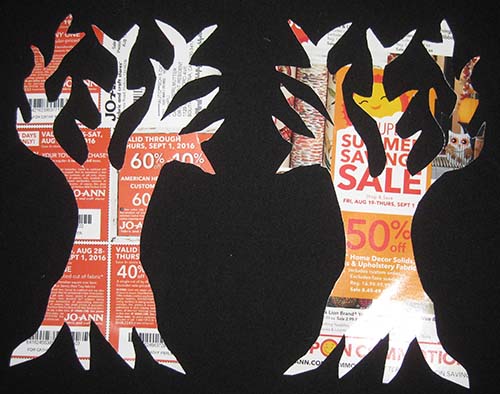
And here are two smaller trees cut from a double layer of an old Jo-Ann Fabrics fliers. 
2. To give fabric tree trunks extra dimension, back them with Decor Bond, a medium-weight fusible interfacing. A layer of DB isn't strong enough for, say, a fabric box, but it is thicker than interfacing you'd use for most garments. I pencil-traced my papercut trees onto DB's non-fusible side, rough cut it out (beyond the pencil borders), then pressed the fusible side to the back of the trunk fabric and cut out the two layers together along the pencil line. DB also controls fraying. I then used a glue stick to lightly attach the non-fusible DB side to the background fabric. In the squirrel picture above, you can see the slight but satisfying ridge that raises the trunk above the background. (No financial affiliation with DB.)

3. Combining batiks with prints is always a gamble. The immediate background for two of these tree quilt is a bunch of batik strips I sewed together a couple of years ago, in my Ann Brauer phase
If you want to combine batiks with prints, it's often better to choose prints that have a watery near-batik quality. The postage stamp print below was pretty watery. The button print and text print, not so much. 
As with almost every other decision in quilting, combining batiks and prints means auditioning things next to each other to see if they work!

Monday, July 16, 2018

Quel Fromage! This Quilt Is Cheesy!

There are many stacks in my sewing room, and one is comprised of potential handmade gifts: small quilts, brooches, fiber necklaces, and of course, UFO's - unfinished objects.

When planning a visit with an old (or new) friend who has admired my creations, I go through the pile, searching for something they might like; if necessary, I finish and personalize it for them.

It's a challenge if I don't know the person well and/or have never seen their home. What's their style? Minimalist? Flea market clutter? Black-and-white? Rainbow?

So I often bring choices. We recently headed for a week in the French Alps - my DH to teach, while I would be gloriously free all day to do this:
...Plus, on one day, have lunch with a friend from grad school who I hadn't seen in 30+ years. He's an American expat living in France, a writer, erudite, sophisticated and kind, all of which I detected from being Facebook friends with him for several years now.

I pondered what quilt to bring him and his wife. I had this small striped quilt from my Ann Brauer experiment days.
Sophisticated, but perhaps lacking personality.  I have a natural horor vacui, an allergy to unoccupied space. So I sewed a button on it. One button led to another and I sewed 13 on it. (Some are stacked.)
I may have overdone it. As a counter-offer, I brought this small eclipse quilt, mundanely named Eclipse #4.
(In real life, the colors are more muted than in this photo). I would let my friend decide.

The first clue to his taste was his suggestion from the menu items. He recommended the tartiflete.

What, you may ask, is a tartiflete? The word, which rhymes with "hearty PET," trips poetically off the tongue, sounding to me like someone who is a combination of a tart and flirt: O Tartiflete, ma petit chou, tu me tuer! ("Oh Tartiflete, my little cabbage, you are killing me!" according to my high school French.)

But a tartiflete is no cabbage - it is a Savoy regional food made with potatoes, onions, cream, butter, and a whole lot of, OMG, Internet recipes are showing me massive hunks of bacon LARD being chopped into little bits and thrown in! Now I have to apologize to my doctor AND my rabbi!

(Here's a public domain picture from Wikipedia:
Ours wasn't quite as bumpy.)

What makes the dish fabulous is its crusty brown goo of reblochon, a French cheese that Wikipedia says is "smear-ripened," which is not only something that happens on Twitter; in cheese the smearing is done with bacteria or fungi "which...gives them a stronger flavor as the cheese matures," says Wikipedia.

And if that's not intense enough, "reblochon" comes from the French verb "reblocher," which means "to pinch a cow's udder again..." Ouch?
"This refers to the practice of holding back some of the milk from the first milking. During the 14th century, the landowners would tax the mountain farmers according to the amount of milk their herds produced. The farmers would therefore not fully milk the cows until after the landowner had measured the yield. The milk that remains is much richer, and was traditionally used by the dairymaids to make their own cheese." 
The US government considers reblechon too dangerously unpasteurized to permit into the national arteries -  but, Wikipedia comforts us, there's a tasty and legal substitute for it called Delice du Jura.

Back to our luncheon - as you might expect, the tartiflette was delicious - how could it not be? Only my friend's fine continental manners kept me from licking my plate clean.


On top of that, he presented me and my husband with a weighty hunk of a DIFFERENT delightful cheese, tomme crayeuse, also unpasteurized, similarly covered in white mold with tantalizing fungal smears. Here it is (after I'd downed a few slabs):

So, back to our choices: now that you know him a bit, which quilt do you think my friend choose after our luncheon?
Yup, he immediately went for the quilt on the left, the quilt that displays what I had intended as a sunny slice of the sky with forebodings of eclipse, but which I now recognize as cheese. It even has moldy golden veins.
(Disregard that the orange is closer to the color of Cheez Whiz.)

The circles surrounding the cheese on that quilt are no longer moons and planets  - they're mold spores whizzing around in excited adoration. I am even giving this quilt a new name: "Tartiflete," bien sur.

Remaining questions that burn in my newly-smear-ripened soul: 

1. Shall I now make an intentional cheese quilt?

2. Shall I include the wrapper from my amazing gift cheese, so my cheese quilt can have a scratch-and-sniff component?

3. Or should I forget cheese and just make quilts about the amazing Alpine view?
(...which is not cheesy at all.)

P.S. I just discovered many textile artists inspired by cheese at Spoonflower, the custom fabric printing company (no financial affiliation). They sent me a notice for a BOGO fat quarter sale this weekend (through Monday), so just for the heck of it, I entered "cheese" in their search engine. Lots of choices came up, including this tasty design by Charlotte Winter here:
...More from Becka Griffen, here:
And finally, because woman cannot live by tartiflete alone,"Happy Macarons," by youdesignme, sold here.
Yum!

Sunday, January 3, 2016

I spent New Year's getting Insanely Thin and Stripping

This New Year's, I made calorie-free Vegan Rainbow Bacon!

It all started four days ago, when I decided to reread old issues of Quilting Arts magazine for fun. I came across an article by Ann Brauer in the December 2012/January 2013 issue. Ann's quilts are museum pieces and I've long admired them.  One type, which she sells on her Etsy site, involves long, thin strips. Check out, for example, one of her beautiful bags, here.

The QA article explains how she does it. I was astonished to read that her strips are crazy-thin! They're cut at 3/4" and  finish at 1/4"! I only make strips that skinny by accident! Plus she sews with utter precision and consistency. Each quarter-inch is dead-straight.

It sounded like the perfect New Year's activity. If I can't be vanishingly thin, at least my strips can be! So I threw a party, in this sense:
I cut several batches of 3/4" strips, one batch from batiks, one from solids, and a third from prints. (Here are some of the solids).
(I had yellow-and-purple on my mind because the Lakers' garish Rose Parade float got stuck in my head.)

The QA article includes Ann's step-by-step directions and tips, which are not mine to divulge. In a nutshell, it involves stitching the strips directly onto a batting and backing. Here's the extent of my precision.
 Ha! I wasn't even drinking. This is how I always sew when I'm trying to go straight. 
Now you know why I can't be permitted to make garments. 
I deeply regret the orange. Let's pretend I was drinking alcohol-positive eggnog. I wish. 

(For Ann's complete how-to, a link to buy the QA issue is at the bottom of this post.) 

Ann's technique is an excellent way to start on New Year's fitness resolutions. Every strip, or every two strips at most, you MUST run (because you're so eager to see how it looks) from the sewing machine to the ironing board, and back. That means you'll be standing up and sitting down, and zipping back and forth, getting almost as much exercise as dangerously young Star Wars actors

My rainbow bacon slab is made from solids, and measures 31" x 6". It has 27 strips, i.e. approximately 14 round trips between the iron and the sewing machine. 
The same piece also works as a basket (need a base),

 or a double basket:
They remind me of  coil pots. Or the washout canyons of Utah.
 Here's a wave experiment I did before finishing the top and bottom edges.

Next, the piece I made mostly from batiks:
It measures 18" x 9" and includes 37 strips packed into those 9"! 
What photos can't convey is how wonderfully bumpy-textural and hefty these pieces feel, much more than a regular quilt. I think it's because they're 5 layers. There's the back, batting, front, as in a regular quilt; plus there's the seam allowance of the strip you're attaching; the seam allowance of the strip underneath it. Those two seam allowances back everything.

This gives them gravity. Like a dog with a new toy, I have been literally carrying them around the house for two days (but not in my mouth), placing them upright on coffee tables. drizzling them down to the floor like waterfalls, arranging them like screens and sculptures and ocean waves, bending, folding, stroking and petting. I don't want to be separated from them, even for meals. 

So what does Ann Brauer do with her pieces? Along with hanging them as art, she also makes them into placemats - no mealtime separation anxiety - as well as pillows - so you can sleep with them - plus purses, cellphone cases, tea cozies, and more.  

I also tested the batik piece as a tray....
 Or a purse,
Or a basket that could conceivably hold this 9" pinecone. 
I made another batik strip set that I turned into a little box (3 1/2" on a side).  
I do have one tip for stitching a foundation-sewn project like this: Before you add each new strip, cut away all dangling threads from the previous strips, and check the back. These long, thick pieces act like a magnet for all the scraps, lint, threads, and small pets in a three-foot radius of your sewing machine. It picks them up, silently carries them along, without you feeling them because the sandwich is so thick. Then you (well, I) stitch them securely in place to the back. I am not showing you the results, because the whole point of this blog is to pretend that I am a competent quilter. OK, I'll show you. 
Yup, I managed to stitch four long rows before detecting that the thread ends from previous rows, plus a massive, foldy scrap, had adhered to reverse side. If I were a surgeon, I would have just lost my license for accidentally stitching my forceps to someone's kidney.

Want to make your own?
  • Learn about Ann's technique by ordering a digital edition ($8 cheap!) of the Quilting Arts issue here. No financial affiliation.
  • An article she wrote about how she makes more uneven strips is here
  • From Ann's blog, here's how she joins sections: http://annbrauer.blogspot.com/2016/01/finishing-quilt.html
  • More of her stunning pillows and purses: http://annbrauer.blogspot.com/p/small-works.html
  • A nice article about Ann and her work is online, here.
By sheer coincidence, I learned that one of Ann's quilts is on the cover this month of Art Quilting Studio magazine (the Winter 2016 issue). The article is about a different series of her quilts, which involve curved piecing with uneven widths, Since uneven is more in my aptitude range, I immediately ordered a copy, here.  No financial affiliation. It's my first purchase of 2016!  I can't wait!