Showing posts with label Farmer's Market Fabric. Show all posts

Sunday, August 23, 2015

Double Jeopardy: Quilt the Seven Species

A couple of weeks ago, I wept buckets at the marriage of two young people who dedicate their lives to helping Los Angeles' neediest. One uses his artistic genius to help at-risk youth; the other brings affordable farmer's markets to low-income communities.

I gave them a quilt that I made a while ago, mostly from Fabri-Quilt's Farmer John fabric prints. (pattern.) This quilt had been waiting for a forever home - as soon as I learned about the bride's job supporting urban farmer's markets, I knew this quilt was for her. I blogged about it here.
Plus, since they are religious, I made them a small botanical wallhanging/potholder. Pop quiz:  Can you name the seven species of the Bible? (Dum Da Dum Da Dum Da DUM. Dum Da Dum Da DEEP dum dum de dum de= Jeopardy music). Not sure? Here's a hint:
Top row: figs, olives, pomegranates. Middle row: grapes, wheat, dates. Bottom: barley!?

Admittedly, the "barley" looks more like my Southern California lawn (pre-drought), but I'm declaring it green barley (a potentially bogus nutritional supplement). Commercial barley-themed fabric does not abound at my local quilt shop or online.

The fig and the date fabric are realistic prints.The olives and barley are batiks. Usually I don't mix batiks and prints, but the Bible made me do it? I was in a big hurry. In the borders, the Hebrew letters' font is similar to Torah calligraphy.

To see some truly spectacular seven species fiber art, made by people who were not in a big hurry, check out:
  • Deborah Schwartzman's (here and here)
  • Adina Gatt of Efod Art Embroidery (here). 
  • Deborah Kembell's quilt here
  • Marilyn Levy's seven species inspired work here
  • Elana Schachter's incredible ark curtain and table cover, here
If you have an embroidery machine and want to make a relatively fast Seven Species project, an elegant way to go is this set from Stitches by Sue Warshell, here (no financial affiliation). A different machine embroidery set is here.

Sunday, December 7, 2014

Holiday Giftmaking by the Creatively Blocked

I'm insanely creatively blocked. What to do? Make potholders. So over Thanksgiving, I stitched up these fruit-and-veggie potholders, accented with un frisson de junk food:
 The first one is all healthy (except the back, as you'll see):
Number two sticks its toe in the waters of non-produce with a grilled cheese sandwich top row, and some pretzels, 2nd row. (The less-healthy food fabrics were purchased for use in a commissioned wedding canopy/chuppah - really!)
 
And finally, we get wild with a Hostess cupcake in the center and some fortune cookies,
They are intended to be used,  so they have two layers inside: One of Insul-Bright, against the bottom, and one of Warm'n'Natural, right behind the top.
I like to use buttons to hold on the loops in the corners. 
This is is a piece of vintage twill tape.
And for the back, I went calorie-crazy:
The fruit and vegetable fabrics in these projects mostly come from Fabri-Quilt's Farmer John's line. To see more projects from this fabric go to http://gefiltequilt.blogspot.com/2013/11/beyond-bacon-fun-with-fruit-and.html.  A free pattern I designed for a different potholder is on the Fabri-quilt website, at http://inspiredbyfabric.blogspot.com/2013/11/an-antidote-to-all-that-halloween-candy.html

Sunday, July 27, 2014

Almost Vegan Quilted Gifts

In our last installment, I was heading for a summer reunion AND needed a creative jolt, so I made some coffee-themed potholders to give as gifts.

Since I do have friends whose lives, enigmatically, don't revolve around caffeine opportunities, I also made a couple of fruit-vegetable-and-egg-themed potholders. Why eggs? They're elongated polka dots, and polka dots make everything better! The only downside to adding the eggs is, of course, that you can't give these to vegans. Here's # 1:
 And # 2.
I know. It's a little wonky. I'm not sure what happened over on the left. What can I say, I was working fast.
The back:
The egg fabric has been in my stash for a while, but all of the luscious fruit and vegetable fabrics are from the Farmer's Market collection by Fabri-Quilt. Previously, I made a large quilt from these fabrics, which you can see here. Click on the "Farmer's Market Fabric" in the word cloud to the right to see many more. There's a quilt and free potholder pattern on my pattern page that uses fabric like this (scroll down on this page). 

You don't need a pattern for today's potholders, because it's stunningly obvious, right? Cut nine 3"squares, plus a border of however wide you need to show off the eggs!  

I put a double layer of Warm'n'Natural inside my potholders, but one of these days I'm going to buy Insul-brite, which presumably protects hands better. 

Sunday, November 24, 2013

Antioxidants and More Fresh Kitchen Art

With the holidays looming I'm in full friend-gift production mode. Fortunately, I have lots of delicious leftovers from my recent Fabri-Quilt project. So I'm making holiday wall hangings/potholders.

The first series I call the Antioxidant Line. As we all know, the antioxidants in fruits and vegetables are good for us, for various scientific reasons. So here's the front:
 Another one:
A third: 
The words are free-motion quilted in. 

Did you know that chocolate is also rich in antioxidants! Or so the Internets allege, and they are always right. So here's what the backs of the three above look like: 
I know, bon-bons are probably not the healthiest form of chocolate, but I have yet to locate 93% cacao chocolate-bar fabric. (Are you listening, fabric companies?)

 This next one is titled (and inscribed) 'Eat some plants.'
 But the back trends carnivorous.
Chicken soup fabric discussed earlier, here
And finally, for modern quilt fans, we have the Grey Line. Grey chevrons:
Plus the grey triangle wallhanging at the top of this post. The back of that one isn't grey:
It's Kaffe Fassett chard. No one does leafy vegetables like Kaffe Fassett did in this gorgeous, out-of-print fabric. Alas, I put the backing on upside-down - note the loop is now on the lower left - so if you hang it with the back showing, the chard stands on its head. Hmmm. Perhaps chard stays fresher longer stored that way (I'm starting the rumor, anyway).

Want a tutorial? Most of these project are extrapolations from my free asterisk potholder pattern, available here, and my quilt pattern on the same page.

I hope this will give you ideas that you can execute with time to spare for Christmas! (And maybe by the first night of Chanukah, which starts next Wednesday, oy!)

Sunday, August 18, 2013

Fresh Veggie Fabric + Vintage Linens = Colorful, Healthy Life!?

Maybe because of Michele Obama, or maybe because our whole society is eyeing the fresh produce aisle (if not yet doing most of our shopping there), there are a lot of hyper-realistic fruit and vegetable print fabrics right now (for example, from Fabri-Quilt and Robert Kaufman).

Beyond the most obvious project idea  - tote bags  for farmers' or supermarket - there's this: Combine the prints with vintage linens to make a fiber-filled food pyramid pep talk reference wall hanging!

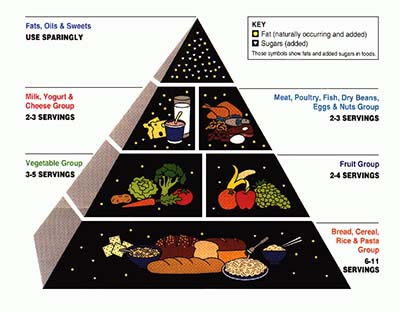
Why a food pyramid? To recap my earlier article and quilt, it all started in 1992, when the U.S. Department of Agriculture (USDA) issued a graphic to guide Americans' food choices. The stuff we were supposed to eat the most of was grain, which were therefore placed at the bottom.
Moving up, produce was in second place, dairy and meat third, and oils and sweets at the top, meaning eat the least. It was a bit confusing (shouldn't the top be the best?)

As it turned out, those amber waves of grain were inspired more by agribusiness than human health - they were giving Americans ample waves of cellulite. In 2011, the USDA and many nutritionists declared that, whoops, vegetables, not grains, should be the stars! And fresh fruits should costar! The new graphic: 

In response, in the real world (ie not at the sewing machine), I've tried to make over our family dinner plates. The plains of grains have shrunk to small puddles. Salad and fruit take up most of the room, with a little space for  meat or beans. Local Husband and I have lost weight since our towering grainery days, and feel much better.

Then, a couple of months ago, Quilts Inc. announced a "What's for Dinner" challenge. The requirements were to depict a plate full of food, plus napkins, silverware, and a placemat. That  was exactly the incentive I needed to update ye olde food pyramid.

This wallhanging includes two specific pieces of nutritional advice that have helped me: 
  1. Make vegetables and fruits the stars of your meals  (I think nutrition guru Joel Fuhrman put it that way), and
  2. Eat only foods your great-grandmother would recognize as foods. (i.e. she would not know what to do with a gummi bear.) (This one came from noted food writer  Michael Pollan). I hung that wisdom from a fridge-button:

The background is a rectangular vintage linen table runner (or maybe a dish towel?). I was moving too fast to apply fusible interfacing to the rear side, which I regret - like many linens, this piece rolled around defiantly; thus my rectangle came out somewhat off kilter. I'm not sure if the vintage powder blue floral trim around the edges make it more or less obvious that the corners aren't quite square.

The napkin is another vintage linen, which came with that very cool curlicued turquoise border. (I still have four more identical napkins searching for a purpose). I appliqued a Kaffe Fassett chard bouquet on top of  the napkin, and stitched the whole thing down with  layered buttons to serve as napkin ring.

Down along the right side of the pyramid , I free-motion quilted advice for each level – at the top, by the sweets, red meat and tortilla chips, it says “Eat Little”


By the nuts, avocados, chicken, fish, and grains, it says “Eat Moderately”; 
[That's supposed to be a chicken, not Tweetie Bird.]
and at the bottom, by the fruits and vegetables, I stitched “Eat Lots and Lots.”.

Isn't this tossed salad fabric amazing? 
(It includes lettuce red onions, mushrooms, cucumbers and cherry tomatoes). 

There's also silverware (made from small-scale produce fabrics, plus a millenium fabric).
Alas, my piece was not juried into the show. The rejection email specifically stated, "Don't be discouraged," but of course, I was. Since then, I've cheered up. That challenge spurred me to make something that I'm now quite liking! Anything that combines excellent novelty fabrics with vintage table linens and (currently) sound nutritional advice, is a winner in my book! 

How are YOU using produce fabric?
UPDATE (8/19/13): Fabulous article on the history of US food pyramids, and best nutritional guidelines: http://www.hsph.harvard.edu/nutritionsource/pyramid-full-story/. Thanks, Linda!

Sunday, April 28, 2013

Polka Dot Fabric: the New Sugar, Salt, Fat

For many years now, my first-resort host or hostess gift has been 9-patch quilted 'potholders' (or 'wall art', depending on how uppity I'm feeling).
The slightly wonky example above was stitched by my daughter - I led her Girl Scout troop in making them last year. They're easy, fun, and I always enjoyed using a wild variety of 4" novelty fabric squares, ranging. in the case above, from the sublime (raspberries) to the ridiculous (Reese's). 

They're always welcome - everyone needs a new and entertaining potholder. My friends use them for pots, hang them as art, or both.
My friend Petra mounted this one on a stretched canvas that she had splashed with paint, a la Jackson Pollock, but less, discussed earlier. Note that Petra does not eat kosher.
But last month, while continuing to wrestle mightily with my lifelong sugar jones, I splurged on a copy of the new bestseller, 'Salt Sugar Fat: How the Food Giants Hooked Us.'  The main point is right there in the title, but this book, by New York Times reporter Michael Moss, fills in the details with fascinating, horrifying anecdotes about the scientists, the business people, the research, and the money. I laughed, I cried, I read sections out loud to my husband, Just like junk food, I couldn't put that book down. 

On quilts, junk food is fun. In bodies, not so much. That's not news. But the book led me to a quilt-related revelation: There are more than enough paid advertisements for crappy (excuse my French) processed pseudo-foods out there. The world certainly doesn't need me to make even more, quilted, complementary advertisements for junk.

After all, I would never give a recovering alcoholic anything that featured this fabric (however delightful): 
On the other hand, I don't want to make a solemn potholder. Can good health, entertainment, and art be reconciled in the quilt world? (let alone the real world?)

I needed a fast answer, because a few days after reading the book, we were heading out on a 5-day-trip, staying at friends' houses. Normally I'd make more nine-patch hostess gifts, but this time, enough was enough. I craved something fresh. 

Fortunately, just as today's supermarkets offer better produce than ever before, there are also now many more excellent produce fabrics. Lifelike, mouthwatering, 100% vegan fabrics, like this garlic (used earlier).
Check out RJR's Farmer's Market line for a huge collection. Similarly, Fabri-Quilt has 'Farmer John's Marketplace'.  Timeless Treasures has 'Farm Fresh.' Equilter carries an awesome number of produce fabrics by various manufacturers. I happened to have some 6" circles of high-quality quilters' food fabrics leftover from a completely different quilt project. I dug them out. Here's one. 
I put the circle on another virtuous food - in this case, brussels sprouts (The selvage says it's cabbage, but I feel strongly that it's brussels sprouts.)
Better, but not yet thrilling. 

Fortunately, I had recently purchased a bundle of assorted polka dot 'charms' - 5" squares - in a variety of color combinations.
I decided to make them into rectangular accents, symbolizing nothing really. Just to spice things up. 
Now we're talking!  Extrapolating from the work of Freddie Moran, I long ago decided that polka dots are the new black - they go with everything. Or should I say, polka dots are the new sugar/fat/salt? Like sweet, fatty, high-sodium processed cheeze sauce on frozen broccoli, polka dots make everything more delicious - but unlike the sauce, they can't cause weight gain. 

Here's the back of the potholder above:  
Fresh figs. My mouth waters every time I look at this awesome fabric. 

Next, bananas on collard greens/chard. OK, maybe not the tastiest combination in the real world, but the fabric for both involves yellow crescents. The yellow polka dots speak to them. 
The back: 
Next: Mixed nuts on pretzels. I know pretzels aren't healthy....but they could be worse.... and gosh, the color went so well with the nuts.
OK, my willpower lapsed. The back atones for the sins of the front:
I had a Chinese food fabric circle so I surrounded it with my favorite chopstick fabric. In this one, the polka dot accent is a long isosceles triangle. 
Pretend the rice is brown.
The back: 
Bags'o'rice. Continue to pretend it's brown rice.

It occurred to me that these shapes might make interesting quilt blocks too. Here's how the potholders  look laid out in a four patch:
Whatcha think? Is there an entire quilt in these shapes? (Maybe a lollipop quilt?)

I finished the four potholders in time, we went on our trip, and they were very well received by our  hosts and hostesses. I felt good about leaving them with a useful item that is also a subliminal pep talk to eat (mostly) clean.  Everyone lived happier and healthier ever after!

Or did they? 

That was SUPPOSED to be the happy ending, but while writing this up, and making a few more, I had a headslapper of an idea: The polka dot band can be a handle! For the one below, I fused the polka dot band to another piece on the inside, then stitched it to the potholder only at the ends. 


Ta daaaa! Next is one I made with lime green polka dots on lavender. 
 
The other new and different thing about this project is that my friend Linda gave me a big strip of Insul-brite to use as batting. (Normally I used 2-3 layers of cotton batting for a potholder). Along with the promise of better heat protection, I like that Insul-brite is very stiff, yet thinner than 3 layers of cotton batting. So if you do hang these up, the corners won't flop. Thank you, Linda, for saving me from floppy corners!

All this leaves me wondering about you, Dear Reader: Do you make quilts that have helped you adopt healthy habits or discourage bad ones? If so, I'd love to hear about it.