Showing posts with label bat mitzvah. Show all posts

Sunday, October 8, 2017

A Pieced Prayer Scarf by Any Other Name (Quilt, Tallit, Stole) is Just As Sweet

I've made many Jewish prayer shawls (aka tallit) during my time as a quilter. Prayer shawls are usually what quilters would classify as applique projects: Stitch a design to the front (or not), decide whether you want a lining, a collar rectangle, stripes, or corner squares, and you're almost done. (Few people want batting). They can be as simple as one  piece of fabric (like the spectacular hand-painted fabric below, made by quilter Ricky Tims, modelled by my DH, with my Mom looking on:)

...to a simple background white background with the stripe and lining fabric selected by the client:

...to a more intricate cutout - this one's made from six shades of hand-dyed cotton....

...and this one's in dupioni silk...
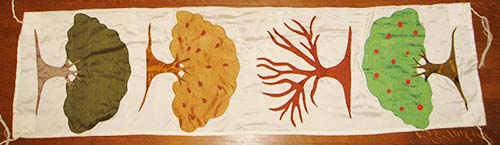
...to something really complex involving photographs and piecing, like this tallit for my son, with NASA space photography...
...and this one for another young man, a Beatles and rock guitarist, modeled by my DD...
....guitar photos served as stripes. (The whole story).
Once you've done the appliqueing/piecing/stitching, all that remains is tying a fringe - called tzittzit- in the corners.

I've made so many tallitot (the plural), that you can imagine how excited I was to get an assignment from a different religion!

My friend Marian Sunabe attends the historic Evergreen Baptist Church in Los Angeles, founded by the  Japanese-American community in 1925. After the attack on Pearl Harbor, a notice of eviction was posted by the government on the church's door - and many of their members were shipped to internment camps in remote, harsh locations. Sensitivity to this shameful episode made this church outspoken during the Civil Rights era and to this day, as it serves a diverse Asian-American community.

A happy occasion was coming up this summer: installation of their new pastor Jason, a delightful person, who is also one of my Artist Trading Card swap partners. (He made me a lovely woodburned tree ATC a couple of years ago, here.)

Marian asked me if I would help her make what she called a "stole" - a word I always associated with last-century mink neck wraps worn by my elderly relatives! But as it turned out, a stole is just a variation of a tallit!

The downside was that they needed it soon, I was about to go on vacation. I would be returning home on Friday, and the installation was Sunday. Marian was rightfully anxious, but I wasn't - barring flight delays, and with a little preparation, I knew that we could churn it out in an afternoon.

Jason wanted historic photos on his tallit, er, stole, and I was out of pretreated photo fabric sheets (my favorites are favorite EQ Printables Cotton Satin sheets), so I asked Marian to buy a bunch. I was expecting her to come back with a pack of flat sheets, but she bought this:
It's an 8.5" x 100" roll of Blumenthal Crafter's Images PhotoFabric, cotton poplin. It runs about $25. I'd never used this product, but it worked out very well. You have to cut the 120" roll down to the size you need - in this case, 8.5" x 11" sheets to feed into the printer.

The stole would need to be 92" long - far longer than my longest tallit (they usually run about 70") - and merely 5" wide - way narrower than any tallit I'd ever made. So I sized the photos to 4.75" square (to fit two on a page), and printed them onto the fabric sheets. Here are some of the historic images Jason wanted on the scarf. First, the civil order removing Japanese Americans from their homes.
Next, a harrowing image of the Japanese community lining up for trains to the camps, an image which resonates so deeply with me as the daughter of a Holocaust survivor, 
This picture of Sunday School at an internment camp,
 The American flag flying high over the Manzanar camp, an iconic Federal government photo:
 A Christmas image from an internment camp:
Having lived in Tokyo, I've always felt the Japanese and the Jews had a great deal in common - but this project, and specifically the photos - really brought home how much, in America, a history of discrimination unites us.

I arranged the photos two to a page in my graphic design program (CorelDraw, but you could do it in Word), and then printed them out onto the Blumenthal sheets, before I left on vacation. Marian also brought over a stack of  glorious Japanese fabrics - most from vintage kimono - that one of the congregants donated to the project. OMG I was in love. We made a tentative plan.
The trip went fine, we returned Friday night, and Saturday afternoon we set to work. We had already cut one piece of grey/blue kimono fabric to serve as the lining - 93" x 5 1/2". We lay that on the floor as our template. Then we arranged the images and fabric strips on top of it. Marian is a gifted artist with an incredible eye - her medium of choice is usually collage, paint and paper - so I put her in charge of deciding which fabrics to use where. She was the art director, I was the technical consultant.


Marian came up with the color scheme, dark navy with shots of burgundy-reddish-purple - so elegant in subdued, spectacular Japanese prints and wovens.

It probably took us about 4 hours. Once the top strip was stitched together, we pinned it right sides  together against the backing, sewed all the way around with a quarter-inch seam allowance, leaving a turning hole of 5" along one edge.

Then we turned the whole thing to the right side, pressed it, and did a topstitch all the way around the edges. The sun was still up when Marian modeled the results. 
She sent me pictures from the installation ceremony the next day: 
What could be sweeter?
Joy-wise, it's not a whit different from what I see in bar and bat mitzvah pictures, when children are presented with their prayer shawls, we all think deeply about tradition and history....


   Good heavens, I love my life!

Sunday, September 11, 2016

"Sew Jewish" Book Review

One thing I love about Jewish tradition is that it requires plenty of textiles. Important occasions are marked not only with prayer, gratitude, and (usually) food, but also fabric creations. These include:
  •      Marriage - the ceremony requires a chuppah, a wedding canopy, 
  •      Bar or Bat Mitzvah - the child needs a tallit, a prayer shawl; people need kippot, headcoverings,
  •       Sabbath, aka Shabbat, which comes every week - the challah bread wants its own little bedcover,
  •      Passover - The ceremonial matzoh cracker needs a cover; the people need theme pillows and kippot,
...And much, much more! I won't even describe here the fibrous imperatives of  Rosh Hashanah,  Purim, Sukkoth or Chanukah - but  they are surprisingly compelling once you start thinking this way!

Today, one of the most significant gathering places for like-minded people is the Pomegranate Guild of Judaic Needlework, a nonprofit organization approaching its 40th year. Members include quilters, needlepointers, embroiderers, knitters, weavers, beadworkers - you name it. All skill levels are welcome. (Learn more here.)

And one of the most exciting new voices in the world of fibrous Judaica design is Maria Bywater of Hudson Valley, N.Y. Maria is a professional huppah-maker, who rents out wedding canopies at huppahs.com, and blogs at SewJewish.com. She recently sent me a complementary copy of her book, "Sew Jewish."
The book is geared to beginners on up. Most of the 18 projects are not quilts, but they draw on the same basic sewing techniques. They cover the Jewish lifecycle and calendar: 
  • For weddings, she offers not only simple chuppah directions, but also a bridal veil, kippot, tallit, tallit bag, and teffilin bag.
  • For Shabbat, there's a challah cover, and, when Shabbat ends, a havdalah ritual spice pouch. 
  • For Chanukah, there are directions for a dreidel (spinning top) game kit, complete with cut-out labels that explain how the game works. 
  • For Purim, there are bright and cheerful mishloach manot gift containers.
  • For Passover, a matzoh cover, and handwashing towel.
  • I especially like her detailed prayer shawl pattern/instructions, which answers all the questions beginners and beyond have been asking me for years about construction. 
  • For the home, there's a pattern for a mezuzah case; a tzedakah (charity) jar wrap; a mizrah (which marks the Eastern wall); a "Shalom" pillow; and an aleph-bet (Hebrew alphabet) cuddle blanket, and this lovely, whimsical hamsa (a hand-shaped good luck wall hanging): 
The book is clear and beautifully illustrated, There's an entire chapter that covers the most basic stitching concepts. 

Find it  on Maria's Etsy shop or Amazon,  in paperback or downloadable PDF.  The Etsy site also sells more tallit collar patterns, and a different hamsa wall hanging than the one in the book. (No financial affiliation with any of this!)

I am thinking that this book would be a terrific present for a teen, especially a bar or bat mitzvah who is interested in sewing; for newlyweds; for people who are celebrating conversion; for new retirees; and for anyone who wants to sew and is interested in Jewish heritage and ritual. I also think it's a must-have for synagogue and Jewish school libraries. Maria, yasher koach, well done! 

Interested in seeing more Judaica? Go to Pomegranateguild.org, and also check out my own Judaiquilt.com website. 
           

Sunday, May 17, 2015

Applique Tallit Making for a Bar or Bat Mitzvah

Extreme excitement! This week's Jewish Journal has an article about making a tallit (prayer shawl, a.k.a. tallis) for bat and bar mitzvah, and they include an interview with me, and a picture of one of my favorite projects, a rock-n-roll theme tallit for a dream client. The Journal article is here.

I wrote a longer article about that particular tallit in a blog post here. There are lots more pictures there, including this one:
(That black-and-white electric guitar fabric is from Spoonflower.com.) More of my custom tallitot are on my Judaiquilt website, here.

Interested in making one yourself? It's not difficult, and is one of the most meaningful projects you'll ever do. If you're a quilter, think of it this way: it's an easy appliqué project, without batting, and a backing is optional. My how-to page is here.

That page also has a free downloadable pattern for the blessing said before putting on the tallit. Some people like to sew this strip (called an "atarah", along one edge of the tallit, although it is not mandated by Jewish law.

I call my pattern 'Atarah on a Roll,' because you cut and paste the strips together. On the bottom third of the how-to page, you'll find an explanation of ways to get this pattern from paper to fabric.
Did I say the pattern is free? Use it good health, and send me a picture! Questions? Reach me at cathy(dot)perlmutter(at)gmail(dot)com.

And if you need to make a kippah to go with the tallit, consider these!