Showing posts with label raw edge applique. Show all posts

Friday, June 27, 2025

Art Lessons from the Beyond (and the Louvre): Homage to Eustache LeSueur

Do you take loads of photos of museum art? And then they sit forever in your computer?
They make wonderful palette cleansers -- fast projects, low on stress, high on learning, as you study the art, figure out what the artist was doing, and what makes the piece so compelling. 

In a December blog post I showed a bejeweled tribute to a 1763 painting by Fragonard that I photographed in the Louvre five years ago. (Find that article here.) 

Here's the next piece of art I tackled, from the same Louvre visit, and more than 100 years older. It's called "St. Bruno being Carried Up to Heaven," by Eustache LeSueur, circa 1645. (This was one of 22 paintings that LeSueur, a celebrated painter and art professor(!), made about the life of St. Bruno.) (Who was St. Bruno? Born in 1030, he too was also celebrated, for rejecting worldly pleasures, and establishing a monastery in the Chartreuse Mountains of France.)

I was just taken with it -- first, the luminous blue and gold, and second, the drama, beauty, and optimism of his ascent, not to mention the weirdness of the underdressed rotund angels. 

The first thing I did was trace the drawing, which I do in my CorelDraw graphics design program, but could have done by hand with my lightbox.

With a painting that's out of copyright, and a photo taken by me, there shouldn't be any issues about using, tracing, or interpreting it. (It would be a different story if it were modern art and/or still under copyright, and/or I was using someone else's photo -- then I would have to seek permission.) Here's what my tracing looked like. 


Hmmm. That's a heckuva confusing clump. To understand it better, I cut everyone apart. Below is the saint, minus the arm of one angel under his arm on the right, and minus the front of another angel peeking out between his legs.

All of them were cut up here: 

Those two angels entwined with him were problematic -- especially since the top one is headless!

So I decided to banish them, fill out the saint to close those gaps, and then bring the two lowest angels inward, to just touch him. 


I did it all with raw-edge applique, and it's only about 7" square, so this was a one-evening project. I zigzagged everyone in place, surrounded them with quilted gold energy lines, crammed in two clouds, and all in all, had a wonderful time reveling in, learning from, and celebrating an intriguing work of art. Professor LeSueur is still teaching! 

Monday, December 16, 2024

Homage to Fragonard, or, Fun & Learning with your Favorite Museum Snapshots

Need a fast holiday gift? How about turning your favorite museum art photos into mini-quilts?

 Before:

After: 

UPDATE!


Backstory:

Do you take a ton of photos at art museums? I sure do, because I see so many art lessons, about color, composition, creativity, and courage.

These photos are fun to revisit from time to time, but not much happens with them. 

Until a couple of  weeks ago, when the Notre Dame Cathedral was reopened, five years after the horrific fire. 

Days before that fire, we were visiting Paris, including Notre Dame. (I blogged about it here.)  

We also went to the Louvre. We had no plan, but wound up spending a lot of time in the 15th-19th century French painting galleries (blogged here.)

One of the dozens of photos I took was this. Titled "Rinaldo in the Garden of the Palace of Armida," it was painted by Rococo artist Jean-Honore Fragonard, circa 1763. 


It's an over-the-top decadent scene, which is the point of Rococo. On the right, nubile, pale women are escorting a soldier (You can tell by his massive golden helmet, adorned with...feathers? Do the feathers make the enemy laugh so hard that they're immobilized?)

On the far left, another tantalizing pale  women emerges from a cave to look on. 

    At first sight, I admired the pastel palette, which I almost always avoid. Pinks! Yellows! So not my thing, but, WOW! I also loved the  fluffiness. And the artistic skill here is fantastic; so few strokes convey so much, especially semi-transparent drapery. Fragonard is the man! 

    So thinking about Notre Dame two weeks ago got me looking at my photo of this painting, and that got me doing a little research. 

    The soldier -- Rinaldo -- was a Crusader, and his troops were about to invade Jerusalem. But a witch named Armida (I assume that's the gal on the far left?) wanted to stop the invasion, so she kidnapped him. She took him -- in her magic chariot -- to her magic garden, where she planned to kill him. Instead, she fell in love with him; he never returned to war and they lived happily ever after.

    This ostensible history was told in an epic poem called "Jerusalem Delivered," by Italian writer Torquato Tasso, published in 1581. 

    The story was performed as an opera in Paris in 1761. Historians postulate that Fragonard either attended or heard about it there. 

    I decided to celebrate this piece, and learn from it, without stressing myself out. I did a cross between copying and riffing. 

    Step 1. I started out with a 9" x 7" piece of stiff interfacing (I like Peltex) with the fusible side up (or use two-sided fusible interfacing and put parchment paper on bottom when pressing). 

    Step 2. Start cutting triangle-ish pieces -- I was going for a "low poly" look so I picked triangles. (You could choose rectangles, ovals, hexagons, or anything). I used batiks for a painterly effect, and tried to approximate colors and shades, and location. Studying the painting closely to do this is where I learned the most, including understanding the artist's composition and how he created the two focal points, with the white-skinned people and Rinaldo's sash. 

    Step 3. Keep adding fabric until all the interfacing is covered. Fabric pieces will overlap. If the fabric isn't touching the fusible on the interfacing, use a glue stick to adhere it.

    Step 4. Press everything in place. The hot iron will also dry any glue. 

    Step 5. I first machine-stitched about 13 diagonal straight lines across the scene, at 3/4" intervals. This held everything in place a little better than just glue and fusible. These are light-colored lines of stitching that you can barely see in the photos.

    Step 6.  The most fun part: hand stitching. I used embroidery floss and added long stitches to mirror the implied or actual detail lines and brush strokes of the original. Since this is a small piece, I think I did all the stitching in about 2-3 hours while watching tv. 

    I used a lot of variegated embroidery thread skeins. On Rinaldo's gold sash, the browns and golds are from just one thread. (The white thread on the pale people is not variegated). 


    Step 7. I glued/fused a piece of fabric to cover the back. 
    Step 8. Trim all the edges even and straight. Then I did a corded edging, something close to a satin stitch all the way around, with metallic gold thread on top and in the bobbin, enclosing a gold embroidery thread as "cord". (If you look up "corded edging" you'll find it's easy to do and helps make raw edges like this neater than just doing a satin stitch without a "cord.")
    Then I went back to my original picture to study the frame. The painting's golden frame is almost as over-the-top as the painting. I figured I could get that effect with lace.  First I auditioned white lace....


    Definitely not -- the frame is now competing with the white figures, who are the focus of the painting. So I decided to paint that lace gold, same as the actual frame. 

    I used acrylic Lumiere paint, mixed with a bit of fabric medium. (Any acrylic paint should work, and if you add fabric medium it will thin it a bit.) I first let it dry bumpy like this, and basted it in place, but I didn't like the look; The ruffles drew too much attention. 

    So I undid the basting, pressed the lace as flat as I could, and resewed it in place. I like it much better this way. 

    And that's my happy-ish ending! True, now I think my figures look like Halloween ghosts (or, much worse, KKK refugees? Oh no!!! Too late for me to fix that!) But it's still a relatively happy ending, compared to that of Fragonard, who, in hindsight, had picked the wrong clientele. Along came the French Revolution, and most of them were executed. His work was ignored for years, before he was rediscovered. I hope he's looking on and forgives me for my lazy, yet respectful tribute to his work. He opened my eyes to new composition, focus, and color ideas! Merci, Jean-Honore! 


    UPDATE (12/27/24): My kid (who is an artist) saw this piece and decided it needed something more. So they added jewelry! That's the photo you see at the top of this page! Now we're talking serious Rococo! 


    Sunday, April 7, 2024

    Four Windmills, 55 Years

    Ever since moving to Southern California 30 years ago, I have marveled at the region's windmills, especially the miles of them between my Los Angeles home, and the "Road to California" quilt show in Ontario, CA, that I visit annually. They look like this:

    Sometimes they spin in unison, sometimes out of sync, but they always make me happy, a majestic miracle of alternative energy. 
    In February, when I was playing with a raw-edge fabric-covered-with-tulle technique to make Valentines, I thought of those windmills and decided to make some. I pulled all the pieces from my batik scrap bag.
    The highest scrap was a failed experiment with stamping circles of gold paint on fabric. (below, left). The planet on the far right is a different piece of batik. 

    For the centers, I used decorative buttons, because: Why not?

    A friend saw this on my Facebook page, and bought it for a friend of hers who works in alternative energy. I was thrilled, but sad, because now, I thought I didn't have a windmill quilt!

    So I made another one. This has fewer windmills, and instead of buttons, I sewed hex nuts to the centers. 
    Then it occurred to me that hex nuts are probably the last thing you want holding rotating blades, because they will unwind eventually, right? But I didn't want to take those nuts off, because they're so darn cute! 

    And it wasn't until after I'd finished the piece, that I remembered I'd made windmill-themed fiber art more than 50 years ago. This thing has been lying on a bureau in my bedroom for so long that I almost never notice or think about it.  (Note what's happening in the upper right corner when I tried to photograph it.) 

    It's felt and embroidery thread, made from a kit, in the 60s, when I was in elementary school. I cut the pre-marked shapes out of the felt, and followed the stitching directions, which included zigzagging leaf veins, and square stitches for the windmill blades. It's clever and adorable, and none of this was my idea -- I just followed  directions, which is how so many of us begin our fiber art adventures!

    After I finished it, it followed me around. I found it in a box and laid it out in my bedroom a couple of decades ago.  

    So after making the quiltets above, I noticed it again, with new eyes, and decided to take its picture. My grandcat loves when I get laser-focused on taking a decent photo, and as you can see, she wants to help. 

    So not only is this piece worn by age, sun, and never having been washed, but now it's also embedded with cat fur.

    And now, I thought, I own TWO windmill fiber art pieces. But wait, there's more! Writing this blog post I remembered I had  another windmill, in my quilt "Nonsense Town," which is only about year old.

    It's in the top row, center. 

    It's sort of a cross between the Dutch technology in my Sixties sampler, and the sleek newfangled California model. Newsflash: This windmill, on this quilt, is now a puzzle on The Quilt Show, because of my recent episode! Find the puzzle here

    So now, if any one happens to ask me, "What is the recurring lifelong theme of your quilts?" instead of answering, "Um, I'm not sure, probably nuthin'," I  have a concrete answer: "Windmills!"

    Was a sampler your first fiber art? Do you still have it? Have you taken its picture?

    For more about the relaxing confetti-raw edge applique technique, go to https://gefiltequilt.blogspot.com/2024/02/stress-relief-with-confetti-valentines.html

    Saturday, March 20, 2021

    Pandemic Porch Quilt Show, Days 54 - 55: Hands for Grandma, Grandma's Hands

    On Day 55, I hung two baby-related quilts that date back to the 1990s - and the one on the right was inspired by a quilt 140 years older than that! 
    First, a nap quilt I made for my son, when I'd done very little applique, and wanted to dip my toe in the water. The flowers are raw-edge appliqued, with zigzag stitches to contain the fraying. The leaves were straight-stitch machine-appliqued, so their edges are nicely frayed.
    Amazingly, the flowers and even their hand-embroidered centers have held up well over the years.  


    The second quilt was made from my son's handprint, when he was about 3. It was a gift for his grandparents, who hung this quilt proudly in their home. 
    The next photo shows the simple quilting. 
    Don't credit me for the striking design - it was inspired by a red-and-white hand-print quilt I saw at a 1997 exhibit at Los Angeles' Gene Autry Museum, called, "Quilts in the Machine Age." That quilt, made in Kansas circa 1878, was an early machine-quilted masterpiece. Find a photo at the Kansas Historical Society archives, HERE. Warning: You will probably want to make your own version! My 2013 blog post with more info about this quilt is HERE.

    DAY 55 I didn't make this quilt - it was one of my greatest thrift shop finds! I'm guessing it was made in the 40s. It's been well used-  there are threadbare spots - but it is still charming. 
    The fabrics are faded but still fascinating. 
    In the next photo, note that the pink/white/orange checkerboard hexagon (with puffy white flowers), just right of center, is made of two pieces of fabric joined! She must have been working from very small scraps!

    The back is just as impressive, thanks to the exquisite hand quilting. (By the way, the big light splotches below are sunspots, not necessarily worn spots, though the quilt does have those, too.) 

    Next installment: A lot more color! 

    Sunday, June 30, 2019

    Not Prizewinning Quilts - Quilts that ARE the Prize!

    Do you belong to an organization that gives out awards? If so,  please consider hiring a quilter to make them! 

    OK, it's a selfish idea - I'm seeking full employment for myself and quilters everywhere - but I'm also thinking of the well-being of the awardees. A wall quilt makes a room cozier than a cold, hard  plaque. Plus in case of earthquake, quilts falling off the walls are significantly less of a concussion risk. (I'm not paranoid, I live in California!) 

    To tell the truth, I never thought about making awards - until early this year, when a friend asked me to make a pair of quilts for her temple's Couple of Valor honorees. Two couples would be honored at the celebratory dinner.  I was delighted at the unusual request.  If you're a quilter wondering how a commission like this might work for you (OR if you're a potential quilt-commissioner), my process is outlined below, but to make a long story short, here are the two quilts I made, with full input all throughout the process from the event committee and the rabbi. 

    The top line reads "Couple of Valor," and the bottom is the name of the temple. My inspiration for the colorful blocks was the dinner invitations that a talented graphic designer at the synagogue had created. The invitations' borders included this watery design:
    I loved them and immediately saw the potential for recreating the mood in batiks. The dinner committee was also very specific that they wanted the synagogue's lamp logo on front. 

    They hadn't yet settled on the wording, so in my proposal, I winged it, drawing up ideas in my favorite graphics program (CorelDraw). Below is a page from my submission.  Idea #1 suggested a beautiful blue/multicolored sunrise streaks in the background - that was my favorite. Idea #2 proposed a pure white background, quilted with gold metallic thread. 
    Idea #3 would have been more labor intensive (and expensive), with a mosaic background. And idea #4 would be a little bigger and more symmetrical.

    The committee went for #2, the white background; I gave them a good price; and we were off! 

    The most fun part came first. From my batik box, I pulled colorful pieces at least 2 1/2" square. I cut 144 to that size and turned those into 36 four-patches - 18 per  quilt - because 18 is a significant number in Jewish numerology (it stands for "chai"/life). 

    I imported the lamp logo into my graphics program, sized it, turned it into just a black outline (saving ink), and printed it out backwards.
    I traced the backwards version onto the non-glue side of Decor Bond, my current favorite fusible interfacing (made by Pellon). I pressed the top part of the logo (which is the Hebrew letter "shin," backwards) onto a beautiful yellow batik, and the lamp base onto a deep red/brown. 

    By this time the committee knew what it wanted on the front of the quilt - just two Hebrew phrases, no English. What font to use? I have a bunch on my computer, so I went through them and selected a handful that I liked. I typed the phrases into a document in several fonts, and sent back to the committee. (I know they all look alike, but they're not quite the same.)
    They picked one. I estimated how big the letters needed to be, sized them, and printed them out backwards. I traced each onto another sheet of Decor Bond. 
    Those letters were ironed to the back of dark purple batik fabric. After cutting and glue-sticking them in position, I didn't start sewing yet - I sent the wording BACK to the rabbi to make absolutely sure that I wasn't making any spelling mistakes. (My Hebrew is pathetic.)

    Once spellchecked, all that remained was to sew everything together. I used a tiny zigzag to raw-edge applique the lettering and lamp . Because it's impossible for me to make the exact same thing twice, they two quilts are slightly different. The one on the left came out a bit bigger . They're quilted in gold metallic thread, with diagonal lines. 
    On the backs, I used a Star-of-David themed print fabrics. The rectangle along the top is the hanging sleeve, and you can see it's holding a dowel, sanded and cut to extend beyond the sleeve, just shy of the quilt width. (Hang it on the wall by resting the dowel ends on two nails).

    The last thing I did was add a label on back with the information the committee requested: A statement of thanks, the couples' name and the year. I typed all this into my computer, then printed it onto fabric backed with freezer paper. My printer is an Epson, and uses DURAbrite ink, which is theoretically waterproof, although I hope this quilt won't need washing.

    When it was over, I heard the awardees liked their awards. I felt like I'd won something, too - the honor and the fun of making them!

    Sunday, June 9, 2019

    Wear Your Quilt Show on Your Head (or Your Kids' Heads)

    Last week, I taught a class in making small Jewish caps at a fabulous Canadian needlework conference. That got me thinking about a different style of hat that I haven't made in a while - quilted pillbox hats.

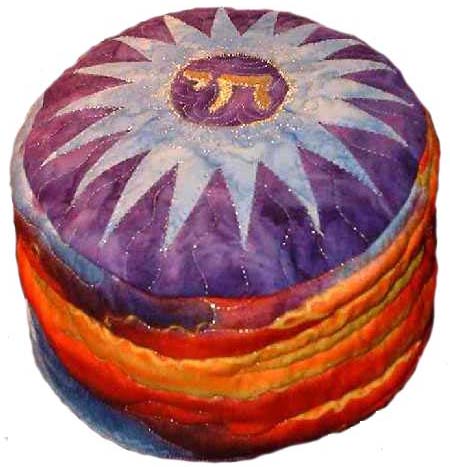
    I originally designed them as "Bukharan"-style yarmulkes, but they turned into a canvas for fiber art creativity, including quilting and applique. Thinking about them again, a couple of weeks ago inspired me to look up my old photos on the computer. The photos were bad - cameras weren't as good and/or I had no idea what I was doing?! So then I decided to photograph them again.

    Along with a better camera and more experience, I had another new advantage - my beautiful, wise, artistic, newly-adult daughter, home from college. When I asked her to be my model - rather than rolling her eyes and fleeing (which is what I would have done if my mother had made a similar request) - she cheerfully agreed! Yet she's still young enough that she let me pay her in ice cream.

    I photographed her with my all-time favorite tree-of-life themed quilted hat.


    I also took fresh pictures of it on a white background. 


    She modeled this pomegranate hat, too, but it was too small for her, so it's perched precariously.
    I didn't want to take up too much of her time - she has her own art to tend to (her awesome web comic is here), so I took tabletop photos of others. Like this, made from a gorgeous ferny batik, with a wooden button embellishing the overlap.

    In keeping with the forest theme, here's a hat made from a fiery wood grain batik. It needs a bit of steaming. 

    The next one was made from a shiny but strange cotton-nylon blends (aka "what was I thinking when I bought it," fabrics). 

    The band has rows of decorative stitching with silver metallic thread. 

    The hat below on the same design, but is entirely quilted, not appliqued, and has the Hebrew word "chai" - "life!" in the center. 


    Flipped over, this hat also makes a good yarn holder! 

    In fact, all these hats make nice baskets for holding soft stuff, like yarn or fabric scraps or faux flowers. Because the sides aren't rigid, I wouldn't keep wrenches or crowbars or rulers in them.


    My son owns the next hat, and he's on the opposite coast, so I couldn't take a new picture. 


    Below is a hat made from a gorgeous grape print. I machine quilted around the grapes, leaves, and leaf veins in shiny thread. 

    One the side overlap, I set a bead-embroidered pin that I'd made long before the hat. 


    Choosing the button, pin, or other embellishment is the most fun part.


    Finally, a rock-and-roll hat, with flying CD's and inexplicable bubbles. I quilted stars into the bubbles. 
    During my trip down memory lane, I reread the pattern I wrote back in 2011. That led me to spend last week in front of the computer, revising and simplifying it.  So - a word from our sponsor - if you want to try your hand at making a quilted pillbox-style fiber art hat/basket/yarmulke - or an unquilted one - my revised digital pattern is available for a modest price in my Etsy shop.

    I love wearing these hats, and so do the people I've given or sold them to. They're uniquely cozy.  They're faster to make than a bed quilt. They let you show off gorgeous fabric. And they fit. My pattern has three sizes, and, because of the overlap on the band, can be adjusted to a custom fit. It's like wearing a quilt show on your head!