Showing posts with label Selvages. Show all posts

Sunday, May 8, 2016

Blue Cross Jeans Quilt, (Part II): Quilting Tips, Suspense, Fluffy Pets and a Baby Mid Arm

In last week's episode, the name of a health insurance company got stuck in my head, so I was compelled to make a quilt out of it. The name, of course, is "Blue Cross, Blue Shield." The tutorial  shows how I pieced the blocks and attached the pockets. 

When you last saw it, it wasn't quilted. But now it is: 
 I like the way the white thread comes into and out of view, depending on the shade of denim. Blue and white is so soothing. 


This was a historic quilt for me, because it's the first largish quilt (37" x 57") that I've done on my new baby, ie, my Babylock Tiara III (which, incidentally, is the same as the Handi Quilter Sweet Sixteen). When I  my DH bought it a couple of months ago for my birthday, and the nice people from Kingdom Sewing set it up, it looked like this:
While quilting the Blue Cross quilt, it looked like this:

You may be asking: What the (bleep) are those purple poles? Aha! I deduce that you don't show dogs or cats! Neither do I! But those, I learned, are pet grooming arms. I bought them because - one never knows - one might someday adopt a pair of fluffy pets which - one never knows -  one might wish to blow-dry while freemotion quilting!

Just kidding! I added the grooming arms because Katie of Katie's Quilting Corner wrote a persuasive blog post stating that they could be used to reduce the weight of the quilt while freemotion quilting! [2021 update: Katie's post has vanished. On her recommendation, I purchased two Master Equipment Dog Grooming arms very much like the ones sold here. To place on the ends of the cord, I purchased heavy duty muslin clamps - you only need two, but I had to buy extra, here; and two  aluminum caribiner clip hooks to attach the clamps to the cord, here. My total cost was just under $100.)

In fact, overhead suspenders of some kind are all the rage in the quilt world, I learned from my new Handi Quilter Sweet Sixteen Yahoo discussion group.

I'm pretty sure that quilting legend Caryl Bryer Fallert-Gentry is responsible for this trend - she has a fascinating DIY system hanging from her ceiling - her instructions (in PDF form) are here. More suspension ideas include:
  • The Jennoop system. (2021 update: I can't find this product for sale anywhere, and the website seems to be down - let me know if you find it!)
  • A repurposed garment hanging rack, here.
  • Leah Day's permanent ceiling system, which costs less than one grooming arm: See it here.
  • If you or a family members is good with PVC piping, you can figure something out, cheap.
  • 2021 UPDATE: A new product is the DIME Weightless Quilter Frame, which sits on the ground but extends above the table Sold various places including here, but I haven't tried it.)
We are not very hardware-handy in our home, so I sprung for the grooming arms (about $36 each). Although I was a skeptical, they worked beautifully. Clipping and unclipping the quilt for major position changes turns out to be MUCH easier than shlepping around the dead weight of a quilt on a table. Suspension also eliminated the need for me to surround my sewing table with vast mesas of similar-height tables.

If you don't have a mid arm like my new baby, you can still benefit from suspension. The systems work equally well with regular (aka 'domestic') sewing machines. If you have a different approach to suspension, I'd love to hear about it. And most importantly, if you use the same brand of dog arms that I did (from Master Aluminum, no financial affiliation), you can choose hot pink instead of purple. Hey, I didn't think of it til just now - I could have bought one in each color!

Back to the quilting details:  I cut the vines out of folded kraft paper, then adjusted them to fit the available spaces....
Once pinned in place, just because I'm lazy, I tried freemotion quilting around one - but, of course, the brown paper lifted up when the foot hit it. So I traced around the vine onto three more sheets of freezer paper - then cut out the shape, ironed those into position, and stitched around.
I would have much preferred to mark the quilt, but I have yet to find a marking pencils that shows up on denim. The blue washout pens are virtually invisible on denim, and my half-dozen motley crew of white marking pencils don't make a strong enough line. (Suggestions welcomed!)

For the back, I used a cotton sarong purchased in Thailand in the 1980s. .

I hated to trim off its lovely selvege, but it was too big for the back. So I  appliquéd a piece with identifying information to a lower corner. Thai is such a beautiful language! (Does anyone know if Emchit is the name of the company?)

Disregard the sausagey binding. Argh! Doubled denim, I learned, is heavy, thick, and hard like concrete, 2 1/2"  was not wide enough, and the handstiching was a lack of fun. I used strong buttonhole thread, but it may well break over time, given how ferociously it's straining towards freedom. In hindsight I should have bound the quilt with a regular quilters' cotton, or maybe just one layer of denim.

Although I love to kvetch, by the time I finished my quilt, I was counting my blessings. First, that I now have a mid arm - a luxury item for sure. Second, that I found lots of information about suspension systems. I think the suspension  made as much or even more of a difference in ease of quilting than the new machine (at a tiny fraction of the cost of a mid arm.)  And finally, gratitude to whoever invented pet grooming arms. Now all I need a pair of smallish fluffy pets who don't mind being groomed practically on top of a sewing machine.

The piecing and appliqué tutorial for this quilt, in Part I, is here.

UPDATE: My quilting friend Roz in Montreal just told me about a friend who quilts next to a set of bunk beds. When quilting a heavy quilt, she suspends bungee cords from the top bed's coils to hold up the quilt! Gotta love it!


Monday, February 22, 2016

18 Surprises from Modern Quilts: Gaping and Shopping at QuiltCon 2016

Are you into Modern quilting? It's a new movement with roots in 20th century modern abstract art; in African-American quilting (especially Gee's Bend), and in art quilting.

Just because a quilt was made recently doesn't mean it's Modern-with-a-capital-M. Modern quilts often have one or more of the following traits:
  •  A sparse appliqué or pieced design
  •  Dense quilting, often in straight lines, usually by machine
  •  Abstraction
  •  Solid fabrics, and/or trendy prints, often large-scale prints
  •  Low contrast
  •  Lots of neutrals: greys, whites, beiges, etc.
  •  Improvisational
  •  Assymetrical
  • Conceptual. A Modern quilt can be much more than the sum of its (relatively few) parts. 
  • None of the above! 
Yes, some Modern quilts break most or all of the preceeding "rules". It was fascinating to see the  assortment last weekend at The Modern Quilt Guild's annual show, QuiltCon West, 2016, in Pasadena, California.

My friend Saraj joined me for the show, flying down from Northern California. We gawked and shopped for two days, knocking ourselves out. Here are some of the delightful surpises we encountered, from the juried show and the vendor booths.

1. The movement is hugeSince the founding of the Modern Quilt Guild (MQG) in 2009, the Guild has grown to 10,000 members!


2. The enthusiasts are diverse 
- The show was thronged with people of all ages, from tattooed young women with piercings and assymetric haircuts, to new mothers (and fathers) pushing newborns in strollers, to not-visibly-tattooed mature women with symmetrical coiffures (such as moi). The mix of ages (and hair) created a fantastic vibe.

3. There are Modern groups around the world -
 The show featured dozens of twin-size group challenge quilts, made by MQG chapters not just from the US, but also Australia, Brazil, Canada, even South Africa. There are more than 150 MQG member guilds!  Here's a locator. Learn more movement history here.  Below is the Pittsburgh guild's submission:
(Read about it here.)
Next,  Calgary's  teepee-themed quilt, with its makers before quilting...
Below, how it appeared at the show.
Read about the Calgary quilt here.
The Seattle Modern Quilt Guild's entry was a jawdropper:

4. The winners were unexpected. The show's prizewinners are on this page. The grand prize winner was a quiet, mostly white, quilt with a few small cross-shaped patches made from torn  denim jeans. It was a memorial by quilter Melissa Avirinos to her tragically deceased brother.
Below is the machine quilting-category winner: Molli Sparkles and Jane Davidson's "No Value Does Not Equal Free."
Yup. That's it. It's pieced from 36 different white squares. It's a pun and a comment on how much it costs to make a quilt, even a quilt with no value differentiation.  The "no value" title is heavily quilted into the background. Molli explains the quilt's meaning, shows a cost worksheet, and offers construction details on this page.

5. One big concept is empowerment.  When I walk around art or traditional quilt shows, I often find myself thinking, "I should retire from quilting right now, because I could never make something that incredible!" Have you ever felt that way? I thought so. By comparison, many Modern quilts seem...well.. doable! No wonder young women are drawn to them! If you're 6 months pregnant and start on a Modern baby quilt today, you will probably finish before your baby hits kindergarten. Here's an elegant, almost-hexagonal "Bullseye" quilt by quilter Vicki Reubel:
The bullseye actually has 7 sides! When you look closer at the quilting, you see it's not so simple. Check out the closeup here. If you're making a baby quilt, you could use the same basic idea - one giant shape - and vastly simplify the quilting. 

On the other hand, another hexagon-themed quilt at the show defied most of the rules at the top of this post. It's in a category of it's own! The quilt was made by Wanda Dotson, a wonderful quilter who blogs here
6. Gwen Marston is a rock star. Read about Gwen's impact here, She coined the term "Liberated Quiltmaking," which is in the title of her two collectible books. It was a huge thrill to come across Gwen in her exhibit area. Following her around the room were mobs of starstruck quilter/paparazzi, snapping pictures and calling"Gwen! Gwen! Smile! Gwen! Stand here! Stand there!" I didn't know what to stare at first - Gwen-in-the-flesh, or her iconic quilts, which I have spent so many hours over so many years staring at in books and online. Here's a bit of both:
I couldn't resist thanking her for sharing her work and ideas with the world.

7. Speaking of strong women - We found Hillary. Not campaigning at the show; Ms. Clinton was depicted in the "Hillary Quilton" by Diana Vandeyar (mentioned in Saturday's LA Times, here.). Here's the quilt with Saraj, who is a marathon runner (so, like Hillary, she also has mega-tenacity).
(I didn't see any other quilts about any of the other Presidential candidates.)
8. Music Inspires Modern - Moda Fabrics had this stunning David Bowie quilt in their booth. It was made by Holly of This is what I Do.  (The link has a much better picture of it.) 
Stacie Dolan from Massachusetts made the next whole-cloth machine-stitched quilt, a tribute to Prince. It's densely machine-quilted with text.
9. There were powerful social and political statements. The LA Times coverage also discusses the next two quilts, and other statement Modern quilts. Read the article here. The first one was made by Chawne Kimber.
The second one is made by Karen Maple.
(Yes, the word "black" is backwards in this thought-provoking quilt.)
10. Speaking of text, there was a fair amount. Here's another of my show favorites, also made by Chawne Kimber. This quilt defies many of the norms of Modern quilting. It's high-contrast, high-value, colorful, crowded, and mostly symmetrical:

The caption along the bottom reads,"In essence, I am a sophisticated cotton picker." What a great use of text, a terrific sense of humor, and a bitterly ironic allusion to African-American history, and the history of the cotton industry. In short, it's brilliant.

11. No BeDazzlers! - Modern quilters don't do a lot of embellishment. I didn't see ANY beads, buttons, hot rhinestones, nuthin', not on the quilts, and not in the vendor's booths.

12. Sew many zippers! - Modern quilters must be making a lot of handbags. We saw purse zippers galore in the vendors' booths, but not on quilts. The zippers came in all shades of the rainbow, especially neons. I was particularly struck by the designer zippers at Micasroom.com including lace zippers, print zippers, and fascinating zippers in which the interlocking "teeth" are giant colorful spheres.

13. Similarly, batiks - Many vendors sold batiks, but I don't recall seeing many/any in the show quilts.

14. Abundant kooky animal prints - Saraj found this groovy badger fabric, in several colorways. There were also vintagey polar bears that I should have purchased.
Not to mention Octopii. The universe twisted my arm until I bought a yard of this Charley Harper organic fabric (It had better be organic, because it cost $16.50 a yard. Ouch! That price was not unusual at this show.)
[Update, 3/3/16: I made a handbag out of it:
]
15.  Similarly, Japanese fabrics - Scads of vendors sold Japanese fabric, from traditional to artsy. There were also Japanese purse patterns; notions, sashiko threads, mysterious marking pens whose packaging I could not read, etc. But I didn't notice any show quilts with Japanese motifs. Saraj bought  more than enough Japanese fabric to cover my sewing room floor. Here are a few of her selections:
I loved these traditional-motifs-plus-animé-cats fabric: 
16. Moda makes a fabric with fake selvages -OK, you have to be a stitcher to find the following hilarious. In one of the vendor booths, I spotted this bolt. It's got all the same stuff you see on selvages, but blown up and all over. Modern quilters enjoy making things out of selvages. (See my selvage-and-denim pillows here). With this fabric, we can make bigger things. 
17. Robert Kaufman's color of the year is, you're kidding - This yellow is their Kona color of 2016. Their booth was entirely decorated in this shade of yellow, which was challenging to gaze at for more than a few seconds.
I resisted buying a pack. However, it often happens to me in my quilting journey that I start out loathing a new trend, and then become obsessed with it. So I won't be entirely surprised if I find myself making a Modern quilt in this color. any minute now!

18. The quilts of Molly Upton - Molly was a fiber artist who lived from 1953 to 1977. She worked with garment and home decor fabrics - velvet, corduroys, polyesters, stuff that quilters today would sniff at. Upton turned dross into gold, creating innovative pieces that foreshadowed the art and modern quilt movements by four decades. Learn more here, (underneath the info about Gwen), Below is one of her category-busting pieces from the show. It's sort of  a cross between Chagall and Ann Brauer. Here's a wonderful appreciation of her work.

So that's my report from the front lines of the Modern movement. Did you go to QuiltCon? What surprised you? Have you made a Modern quilt? Are they growing on you?

UPDATE: Part II of this post is at http://gefiltequilt.blogspot.com/2016/02/quiltcon-2016-20-more-pieces-of-modern.html.

UPDATE, 2/25/16: A deep look, with behind-the-scenes stories, from Quiltcon is at Sewingreport.com:  http://www.sewingreport.com/2016/02/quiltcon-beyond-the-obvious/.
UPDATE: 2/27/16: Fabulous shopping at the show: http://catherineredford.com/what-i-brought-home-from-quiltcon/?utm_source=wir&utm_campaign=qd-brc-wir-160227&utm_content=823633_QR160227&utm_medium=email. 

Sunday, January 19, 2014

Salvaging Selvages and Old Denim Jeans

Here we have one of my two new selvage pillows:
Pattern here. Newbies, do I hear you asking me exactly what is a selvage (British spelling selvedge)? In the world of quilting cotton, selvages are the two thick finished edges on either side. One edge is often white/unprinted, and bears manufacturing information plus a delightful series of color dots:
The dots along the lower edge here reveal the colors used in the fabric. I'm wondering: Do those dots have a special name? 
Here's a bunch of cut-off selvages:
The selvage on the opposite edge is often not white nor marked with information - it can look almost exactly like the middle of the fabric. But quilters virtually always remove both selvages before cutting quilt pieces - both have a thicker weave and pinholes. If you use a selvage in a conventional quilt, the quilt police will persecute you. Friends, relatives, and infants, on the other hand, can't tell the difference without magnifying headgear

When I started quilting, quilters generally tossed the selvages. I couldn't quite do that - so I crocheted them into things (like this:
)

 or jammed them into the empty coffee cans that serve as small scrap bins.  

But in recent years, the humble selvage has gone from peasant to royalty. This happened partly because young artists/craftspeople are ornery and love breaking rules; partly because of the interest in upcycling; and partly because selvages' spareness - lots of white with a few dots of color - mirror the austere aesthetic of the modern quilt movement. (Q: Can I earn an Internet  MFA for a sentence like that?) 

If you go to Pinterest.com and type "selvages" in the search engine, you will see what I'm talking about. There's an an abundance of beautiful, light, fascinating and witty projects - not just quilts and tote bags, but backpacks, stuffed whales, a Halloween mummy, an office chair, a spectacular spinning skirt. and much, much more. You'll thank me. You're welcome.

People take several different approaches to severing their selvages. Some include only a tiny bit of the featured print area, just enough to capture the pinholes. Others take a generous inch or more of the printed area. Over the years, I mostly did the former, but only recently converted to the latter, so the bulk of my selvage collection does lean to mostly white.

For these two pillows, I wanted to intensify the upcycling theme, so I combined them with denim from  jeans. Selvages and old jeans! Arsenic and old lace! What's not to love? 
On the left is a traditional snail's trail block; the pillow measure about 17" square. The pillow on the right is a rectangle that's a little bigger. I'm calling it 'Labyrinth.' It's improvisationally pieced, a variation on a log cabin block, meaning you add strips and chop them off when they're about the right length.  An easy, illustrated pattern for both that I spent the last two weeks toiling over is here

I created the 'selvage fabric' by laying selvages across a breadth of plain white muslin, and zig-zagging the edges with 'invisible' nylon thread. That's what you saw in the second photo in this posting, above. Once everything is zigzagged down, you can cut out your new selvage fabric and play with it just as if it were regular yardage. 

On the back of the pillows, I used more pieced jeans, and, just for fun, threw on some pockets. I didn't stitch through those thick pocket seams - I cut the pockets an inch out from its edges, then folded the fabric under and stitched next to the fold, all the way around. 
(I don't want to think about what this person kept in that back pocket because I just noticed, oh no! it looks like cigarette packs? No, wait, maybe it was a wallet. The jeans don't smell like tobacco. Oh wait, it was an iphone! Phew)

What if you don't have enough selvages to make a project? I wouldn't recommend cutting selvages off all the fabric in your stash, without thinking it through first - what if finishing a future quilt, or saving someone's life, depends on obtaining more of that specific fabric? Without the name and manufacturer, you'll have a MUCH harder time locating more. 

So remove SOME of the selvage. 

Or, write the information on a sturdy piece of white scrap fabric, with an archival permanent pen, then safety-pin that information to the fabric whose selvage you want, and THEN cut off and use the entire selvage. In decades to come, your heirs and heiresses will find these notes in your stash and know for certain that you had a serious obsessive disorder. I haven't done this yet, but considering how these two pillows decimated my selvage stash, I might need to start doing it soon.

Yes, I'd love to see you what you have made in the past/will make in the future from selvages!  
 
The pattern for both is here

Sunday, June 30, 2013

Loving Linen, Zoning Out on Zakka

My LQS (local quilt shop) has a few linen bolts, which called to me for a long time. A couple of years ago, I finally broke down, bought myself a quarter-yard of a delightful off-white, and decided to use it for small quilted cuffs (which I call quiltlets, and can be used as bracelets, wall art, bookmarks, and more).

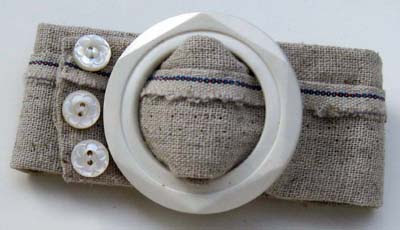
I fell deeply in love with the linen's selvage, which featured an inexplicable navy-blue line of stitching. (Can one of you selvage gurus explain that?) So I displayed it prominently in the first wrist cuff below. That's a vintage mother-of-pearl buckle, along with vintage m-o-p carved buttons.

That one's not quilted, but the next one is. It has a pillowcase finish, low-loft cotton batting inside, and is machine quilted. It turns out that linen takes machine quilting beautifully! 
 The khaki rick-rack is extra-fat (also new from my LQS), and I found an old belt-buckle to stitch to one end.. The metal iron-on triangular embellishments came new from my LQS. 
It has a bit of a steampunk feel. The polka dot yo-yo is green vintage satin, and the brown  tortoise-shell-plastic-and-metal button on top is vintage. 

Finally, I used the linen as a base for a quiltlet that includes a neutral-colored new polka-dot cotton fabric, a large grey m-o-p button, and grey grosgrain ribbons (along the bottom). There are two horizontal lines of quilting along the top.
None of these things look even remotely like what I usually make - too little color, too clean lines!

I made them because I was having a zakka moment. Zakka is a Japanese aesthetic, which, in turn was influenced by modern Scandinavian design. It's all about simplicity and muted (if any) colors. It's one of those things that, when I first saw it, struck me as incredibly boring...but about three minutes later, once it had sunk in, I needed to make some RIGHT NOW. Zakka projects are often precious little objects for the home. Although I now love it, I couldn't take a steady diet of it.

Want to try it but not sure what to make? Do an Amazon search for "zakka sewing" and you'll turn up a half-dozen project books. I own Rashida Coleman-Hales "I Love Patchwork; 21 Irresistible Zakka Projects to Sew;' you can browse inside that book as well as the others on Amazon to find a project that inspires you.

My friend Karen, who alas, is not a quilter, is the queen of linen. She buys linen garments at thrift shops, dyes them, and the results are earthily, mutedly, magnificent. Do a search for "upcycling linen" on Pinterest to see many different ideas for using linen from former garments, or from the LQS.

What have you made from linen?

Monday, August 20, 2012

A Slew of Selvages

People make a lot of things out of selvages, which are the printed edges of fabric; here's my new #1 favorite selvage project:  A cape, http://designerann.blogspot.com/2012/08/selvage-sun-cape.html, made by quilter Ann Ruthsdottir. She calls it a "sun cape", I assume because she wouldn't want to wear it in the rain! So imaginative!

Other interesting selvage projects found around the web include:


Have you worked with selvages? I've used them to crochet with, but haven't made any multi-selvage piecing projects yet.

One of the things that makes the above and other selvage projects wonderful - something I haven't been doing in the past, but will in the future - is that the makers cut off a quarter to a half an inch of the actual fabric design, along with the narrow printed white part. That additional sliver of color and design makes these projects infinitely more interesting. They're not only more colorful, but that sliver brings the viewer in close, to read the title of the fabric, the designer, and/or the year, and see what the fabric actually looked like. That's pretty close to an ecstatic experience for fabric-a-holics like myself.