Showing posts with label EPP. Show all posts

Thursday, November 12, 2020

Almost Ancient: English Paper Pieced Mosaics with Cheryl Lynch's New Fabric

My newest finished piece!
It's a tabletopper or wallhanging, about 20" across, made up of seven English Paper Pieced (EPP) blocks. The faux mosaic fabric - those little pieces aren't separate, they're printed - are from a fascinating new collection by my friend, quilt designer Cheryl Lynch. 

In recent years, Cheryl's been designing mosaic quilt patterns, made by cutting fabrics into small pieces. But even more recently, she designed fabric with the look of complex mosaics - but you can finish in a fraction of the time. 

Cheryl gifted me with these FQs.

First I cut out a bunch of 3.75" equilateral triangles, and moved them around.


For the next test, I pulled a purple floral print from my stash. 
Etcetera. I liked all the options - Facebook and Instagram polls of my friends resulted in no clear winner - so I put those triangles aside and decided to see what this fabric would look like in the smaller, more complicated stars in my EPP book, "Hexagon Star Quilts".

I started by printing seven patterns from the book onto my newest notion, water-soluble "Hugs'n Kisses Applique Paper," by Helen Stubbings. (No affiliation). In the past, when planning to do EPP by machine, I printed designs onto Decor Bond (by Pellon), a medium-weight fusible interfacing, which remains in the project. But I was eager to see how the applique paper would work. Here's one  page printed onto the applique paper - I cut out Star 5 from this page.  
With EPP, each piece is fused to a slighly larger piece of fabric; the fabric is wrapped around it; then everything is sewn together by hand or machine - I used the latter. Here's more or less what Star #5 looked like finished.
I made six more blocks (all 6" high), including the next one which is the centerpiece. This green fabric isn't one of Cheryl's - it's from my stash, and I stitched the white lines to give it a mosaic look. 
The stars surrounding the center include Star 39, below, with the addition of a gold-brown print from my stash:  

Next, Star 56, with my violet print added: 

Star 65: 

Star 28

And last, Star 15

The results are in the photos on top of this post, and the bottom. How did I like the applique paper? Compared to Decor Bond, it's not quite as stiff, and therefore more challenging to fold small sharp-angled pieces accurately.

But I discovered that when I scored the fabric with a sharp-edged piece of plastic - like a credit card - next to the interfacing, it made accurate folding and basting more achievable. The big advantage of applique paper over Decor Bond is that the former will dissolve in the wash, presumably leaving a softer project than the latter. 

Here's the back after all the pieces were sewn together. 
From a distance:
I laid it on batting, traced around the top (with a water soluble marker), then cut out the batting inside the traced line. This results in a slightly smaller piece of batting than the top. 

Next I placed the top on my backing fabric, and cut out the backing fabric about 3/8" larger than the top all the way around. All the concave angles must be clipped, in order to get them to turn under.
Make a sandwich: Backing fabric on the table,  wrong side up;  batting on top of that; and the pieced top on top, right side up. Pin or clamp the edges every few inches. Do a hand whipstitch, stitching the outer folds on the top piece to new folds you create as you go, on the backing fabric. Finally, I stitched around the edges with a machine straight stitch.  You can't see the hand whipstitches in this photo from the back, but you can see the machine straight stitching. 

The entire back:
And the front, all quilted, this time on a white background. 

Very European, esta bien? And thanks to Cheryl's fabric, it took a lot less time to make than, say, Gaudi's Parc Guell in Barcelona. See more of this fabric, and projects made from it, in this excellent new article. It is now available in quilt shops. More information about my EPP book is here. 


Sunday, September 20, 2020

Turning Lines Into Circles for Curved English Paper Piecing

What do these English Paper Pieced blocks from my new book, "Hexagon Star Quilts," have in common? 
Answer: They're all straight lines. I've always been curve-averse, and although I've done plenty of English Paper Piecing in recent years, almost everything I've made with the technique has had straight lines only.

But quarantine is an opportunity to try new things (assuming you don't have an essential job, young children, and/or a sourdough fixation). So a couple of weeks ago, I plunged into curved EPP in a big way. It turned out to be mostly easier than I feared, but with a few trickier situations. 

In fact, I have a new name for curved EPP: Extreme Paper-Assisted Applique. Because using freezer paper and/or cardstock to create and applique curved shapes is almost the same as English Paper Piecing, except the latter is harder to do accurately.

If you're pressed for time, here's my conclusion about curved EPP: It's doable, but recommended only for blocks that have relatively few curves.  

Here's how I did the research that led to this conclusion. I didn't have any curved block patterns, so I picked star patterns from my book to translate into curves, starting with this block, Star #91.  

Here's my original piecing diagram:

I replaced the small central square with a large circle, and turned the outer hexagonal edge into a circle too. Result:


I grew it from 6 to 7", cut out all the pieces, basted fabric around them, and stitched them together. I used the flat-back stitch, which I found quite easy. 
And - ta daa - here's the front. (That wrinkle will go away, it's not an actual pleat.)
It's okay, but far from perfect - especially at the light star points, where dark blue pieces are supposed to meet. If I'd appliqued the green star and red bars on top of a blue circle, it would have been faster and more accurate, and there wouldn't be the tiny, thready gaps and unevenness at the edges.

Next, I printed my pattern for this block from my book, Star #98.
 
I simplified it, replaced the central hexagon with a circle, and also converted the outer edge to a circle I rounded off all the triangle tips. I sewed the basted pieces together by machine, from the top, with monofilament thread. Here's the back:

And the front. 
Could be much better. Once again, the narrow tips of the dark blue pieces - where they curve around the light lavender petals - was challenging, and I didn't entirely succeed. The underside of the blue fabric is showing at the edges. Again, simply using freezer paper or needle-turn applique and layering the pieces on top of a blue circle would have been faster and neater.

Finally, here's a block that started as a straight-line six-pointed star. I deliberately created gentle curves that I thought would be easy to piece. 

And once again, it's okay, but not okay enough. The gaps and bumps at the edges just couldn't be filled.

Summary of findings:

 1. The basting part of curved EPP is just about as easy as straight line basting. You can pretty quickly get the hang of distributing seam allowance pleats neatly around concave curves, and and clipping seam allowances to make smooth convex curves. 

2. Setting shapes around a central circle is much harder than surrounding a straight-edged shape (like a pentagon or hexagon.) Not because of the curve - it's because a circle doesn't show each piece's starting and stopping point. This creates a challenge in deciding what order to join pieces, placing them in exactly the right position, and distributing the fabric evenly with necessary precision. 

 3. The flat-back stitch is ideal for joining curved pieces. In fact, I can't even figure out how you could join curved edges with a traditional EPP right-sides-together whipstitch. Biggest flat-back drawback so far: I have to check the front frequently to make sure I don't accidentally stitch dog ears into the seams. (Which I did, Twice.)

3. A machine zigzag from the top works beautifully with curved piecing. 

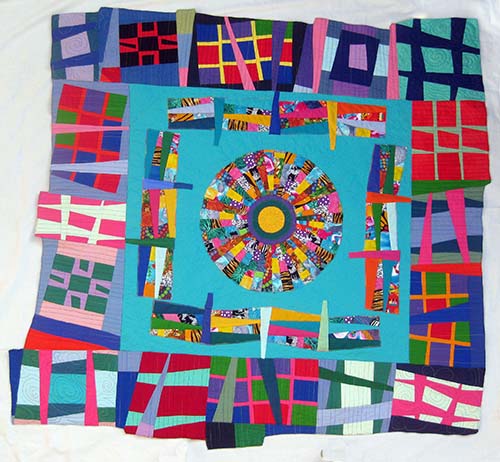
What did I wind up doing with my imperfect curved EPP blocks? I combined them with actual appliqued blocks, and set them into the side borders of this "Frankenquilt" - my oldest UFO, finally finished.
Here are a couple of closeups. For more about this quilt, go to my last post, here.
If  you want to try flat-back stitching and curved paper piecing, Mr. Domestic has a nice tutorial on youtube here

If you're interested in my book with 113 English Paper Pieced stars - all straight lines - find more information on my blog here, or on Amazon, here


Monday, August 17, 2020

Scary Unfinished Quilt, Happy Ending, Don't Look Too Close

This is a mystery quilt adventure. If you hate suspense, scroll to the very bottom of the post to see the finished quilt. If you enjoy mysteries, read from the top. 

I'll begin this story in front of my UFO (unfinished object) cabinet, a terrifying place, in a far corner of my sewing room, under the ironing board, behind/beneath my Featherweight table. 
To open the cabinet's doors, I have to curl myself into in a fetal position - then, the doors open only halfway, before smashing into my knees. Fetal position also describes my emotions, when I look at what's inside.

So I tend to avoid the place, for years on end. But a couple of weeks ago, my quilting friend Joni posted on Facebook that she wanted someone's UFO as a challenge. 

I knew had to move fast or she might not take mine, so I curled myself down, pulled stuff out, and found something almost presentable for her (I'll show you that in a future post). 

I also dragged out what you see below - a partial top, about 4 feet square, my first UFO. (The thing lying on the lower star point isn't attached, I'll explain below). 
I made it in 1991, the year I started quilting. This was perhaps my third quilt attempt, a Mariner's Compass. (My first quilt was Eleanor Burns' "Amish Quilt in a Day," a thrilling beginner's book - Eleanor's new and improved version is HERE).

Mariner's Compasses are challenging for even master quilters, and today, with my 29 years of experience, I would not dream of tackling one without precision foundation-paper pieced (FPP) patterns, ideally vetted by a jury of scrupulous architectural professionals.

But for a beginning quilter, with no knowledge of FPP, a Mariner's Compass is insane. I know it doesn't look too bad from a distance, but let's get closer.

I had created and cut separate templates for each piece. including the eight pieces of the rectangular background. (Today, I would applique the star to the background, which is vastly more fool-proof and stronger.)

In the center, I made 16 points meet. This created concentric ripples in the space-time continuum, dragging me into its vortex and crushing my soul every time I looked at it.
 
Even less forgivable is that many of those fabrics are crap - the yellow is see-through, the pink is too, and the aqua blue might  contain polyester

The star points don't look bad from the front - only one had a hole - but the back, seam allowances flip around like playful sea otters. And speaking of oceans, each seam allowance ebbs and flows between 1/8" and 2". 
Squint, because this could harm your eyes. 
Why so many thread colors? Why do seams stop and start? As a novice, I clearly engaged in magical thinking. 

Also bundled up with the centerpiece were these spare star points. 
Plus eight not-badly-pieced Evening Star blocks.
And a couple of pieces of the fabrics below. If this color scheme looks familiar, it's because it was all the rage in the early 90s. The prints - I think they were the first ones I ever bought - were designed by Mary Ellen Hopkins, a hilarious and brilliant quilter. Sadly for all of us, she's passed away, but her books and spirit live on, except not in this photograph:  
I loved these two colorways. And today, I still like the turquoise one. But the magenta one gives me a headache, and both become excruciating when large quantities are next to each other. 

With all those issues, no wonder I couldn't finish it. But I also couldn't throw it away. So the bundle moved with us to California, where we made babies, had careers, and after several years, I apparently tried to save it by creating this small star, to cover up the central ripples. It's hand needle-turn appliqued, onto a "backing" of ultra thin purple fabric. I still had not learned my lesson about buying the good stuff.   
I obviously decided this wouldn't work, so back in the cabinet it all went, awaiting a new millenium. 

Which brings us to 2020, l'annee terrible. As I laid it out on my floor, I had a new, Covid-esque thought: I could be dead in a month. It's time to finish it, or mail it with lots of cash and a pleading letter to Joni. I decided to rescue it myself.

The first thing I did was relieve the concentric pressure in the middle by cutting out an oval. (I'm not sure if you can see that some of this stitching was by machine, and some by hand.)
I machine stitched the purple-backed central star to the center, using a decorative satin stitch because the purple fabric was too flimsy and narrow to turn under.
When I looked at the back, I realized something else frightening....
In the center back of the star, there was fusible residue. 
I decided to ignore it. Yes, I still engage in magical thinking.

Then I remembered that I might have other discards from this quilt in my scrap stash, aka The Infinity Suitcase, which, like Dr. Who's Tardis, contains multitudes. When opened, the scraps instantly aerate and sproing upwards like a newborn volcano, then spill all over the floor like hot lava. (That's why I rarely open it, and pile things on top, to hold it closed.)
I couldn't find the discards from the same project, but I did find a stack of these paper-pieced sashing units, made for a different quilt, (a Freddie Moran quilt, she's my idol), a mere 23 years ago. They'd wound up the wrong size, so I'd ripped them out of the quilt and crushed them into the Luggage of Doom. 
But wait, there's more! Just before diving into my UFO cabinet, I had decided it was time for me to get more experience doing curved English Paper Piecing (EPP). So I was turning some of the straight line patterns from my EPP book, Hexagon Star Quilts, into curved patterns. Here's one. 

Looks good, until you closely inspect the outer points, some of which have tiny-but-unforgivable gaps. (From these experiments, I learned that curved English Paper Piecing should only be attempted when there are very few curves.)

While playing around with all these components, I also couldn't help noticing colorful little arcs and their templates scattered about on my coffee table, leftover from my recent mask scrap quilt. I hadn't exiled them to the Suitcase of Terror yet.
So, to review, I took my:
  • Unfinished Mariner's Compass quilt, okay from the front, sad from the back, 
  • Eight eye-searing Mary Ellen Hopkins blocks (note how I cleverly shifted the blame to her - she was such a fine person, I'm sure she wouldn't mind), 
  • 30 paper-backed yellow-and-black star points, plus I made some colorful ones for the vertical borders, and a few half-units for the central area,
  • Curved EPP experimental blocks, and
  • Colorful little arcs....
...and sewed them all together. It took me about two weeks. Here's the finished quilt. 
Since the yellow fabric in the central star was so thin, I decided toss some arcs on it. I think they look like festive thumbprints. 

I freemotion quilted the heck out of it. I am currently obsessed with Christina Cameli's approach to FMQ - I love her book, Texture Quilting, no financial affiliation. 


Here's the quilting on the Evening Star blocks.
I quilted eyeballs in each diamond-shaped sashing opening, because eyeballs are always in good taste. 


The (mostly) EPP'd block on the far right, below, reminds me of a bobbin. I didn't notice that until after I made it. 
The block on the lower right is EPP'd and then appliqued to the blue hexagon. The block on the left is regular machine applique. The latter is so much easier, faster, and more accurate.  


And here we are, all done, from a different angle.   

In conclusion, if you, too are haunted by hopeless UFO's here's my best advice:
  • With at least one quilting friend, or a guild, have a UFO swap. Joni's request forced me to open the scary cupboard and seriously reevaluate whether my UFO's could be saved. 
  • When you pull out one UFO, drag out several more and look at them together. This invites serendipity. Given that you made all the components there's a better-than-average chance that they might speak to each other, creating something better than the sum of its parts. Check out my blog post here about another FrankenQuilt made from fragments of different projects.
  • Every quilt doesn't have to make sense. It's okay if the theme is "Play!" The thought of entering my new Mariner's Compass in a show makes me nauseous. But of putting it on my wall, or the wall of someone who is not a quilt show judge, architect, or any kind of perfectionist, makes me very, very happy.