Showing posts with label feathers. Show all posts

Sunday, November 19, 2017

Another Denim & Crochet Purse, made from Freemotion Quilting Practice Pieces

When it comes to freemotion quilting, practice makes not-so-bad. Never perfect - not me - but certainly more tolerable. No matter how eager I am to start FMQing, the more time I take to practice, the better I will like the results.

The downside is that the practice pieces accumulate in towering snowdrifts, looking something like this:

So here's a project that can upcycle some of them! Especially if you practice on denim! With the holidays coming, it's a fun gift. It's a denim and crochet cross-body purse. I showed one off two weeks ago (here), but this one is different because it is made from quilted pieces. Front view:

And back:

The back piece, unfolded below, measures about 5" x 10"  (not including crochet). It's quilted with  experimental vines/feathers, relics of my eternal Sisyphaen quest for a neat, convincing vine.
The smaller front piece is about 5" wide x 6" high, not including crochet: 
Grids compliment vines; and they're a lot easier! Here's the back of the flap. 
 I crocheted the gusset, too...

...but you can improvise a different solution, or skip the gusset completely and sew the front to the back. Go with the flow and see where you wind up! Here's a tutorial/reconstruction of how I made mine.  

DIRECTIONS
1. Practice quilting on a sandwich at least 6" x 18"  if you want to make a purse about the same size as this one. If working with jeans, don't include thick seams, to save yourself aggravation! My backing fabric in the example is white, but on second thought, you should choose something a lot darker and/or busier, so dirt doesn't show.

2. Cut two pieces from the quilted piece: a small front (about 6" high x 5" wide) and a long back-and-flap (about 10" high x 5" wide). Whatever measurements you use, widths should be the same for the two pieces. 

3. Use an "edge skip" rotary cutter blade to cut equidistant holes a generous 3/8ths of an inch or more from each edge of both pieces, all the way around.  ('Edge Perfect' is the brand I've long used, but now there are a lot of similar blades out there.)
4. Do a blanket stitch all the way around both pieces through the holes created by the blade. I used a blue linen yarn. 

5. On the long quilted piece: Crochet all the way around it 2-3 times. For the short edge that will be the bottom of the flap, do a long stitch, like double or treble crochet, so buttons can be buttoned through them, shown in the photo below. With such small buttons, I didn't need extra gaps beyond the hole created by double crochet.
For the remaining three sides, do single crochet.

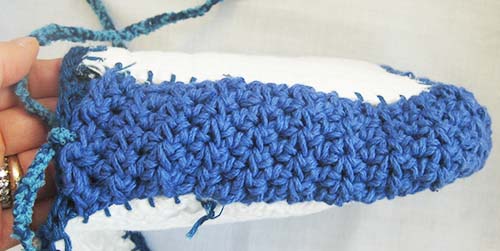
6. Do the same number of rows all the way around the smaller quilted piece. Then, only crochet down one side, across the bottom, and up the second side. Turn and do it again, just those three sides. Make the rows a tight stitch (like single crochet) and DON'T INCREASE. After a few rows, the stitches will start to pull in, creating "fabric" parallel to the piece, which will become the gusset. If the crocheting isn't tight enough for a purse, you can either add a lining later, or add an additional crocheted gusset (the latter is shown below).  

7. Once the gusset is at the width you want, stitch the outer edge of the crochet that's on the smaller quilted rectangle, to the crochet stitches along the sides and bottom of the larger rectangle. 

8. Because my crochet was loose, I crocheted another, tight, gusset strip to the inside, about 2" x 17", with a thicker yarn. I hand-stitched it in place along both edges using yarn. This serves as backup, to keep anything except maybe toothpicks securely in the purse. The neater alternative: install a full fabric lining. 
9. Chain a strap to the width you want (I used three different yarns), and tie it to the gusset. Since this purse will be a gift, I only did a single knot, and will have the recipient retie it to the length they want, with a double knot. 
12. On the front piece, stitch on buttons that will fit through the crochet on the bottom of the flap. I used smallish shank buttons. 
So much fun! Call it done! More projects that upcycle freemotion practice pieces - into Artist Trading Cards, Valentine's Cards, and a purse pocket - are here. My previous denim-and-crochet purse is here

Sunday, March 12, 2017

7 Ways to Use Rickrack, Life's Consolation Prize

People bring me all kinds of things that they think I might put on quilts - fabric, quilt, buttons, faux flowers - and most recently, a friend brought me several hanks (bolts? skeins? murders?) of rickrack.

Not that I needed more rickrack. I already have a little drawer filled with the stuff. (Technically, it's a half-drawer. The left side contains zippers):
Let's face it, rickrack is hilarious. It's like Sisyphus, drunk, zigging and zagging, back and forth, sound and fury, moving forward and signifying nothing but whimsy.

I was about to need hilarious because 1. I was soon to be in mourning, and 2. I was soon to make a bad decision  on one of my pieces involving 1" squares. It was this piece, a block leftover from a large quilt.
One evening, I impulsively decided to do a round of feathers in the border.

Freemotion feathers are hard. My odds improve only if I practice for a substantial amount of time for  weeks, and then again for at least a half-hour IMMEDIATELY before the final feathers, plus marking the quilt. (More feathers advice here.)

It's also a big mistake to make feathers when sad.

My beautiful mother was 90, and she died peacefully at the end of January. Mom had advanced dementia for many years; I believe that her passing was a liberation for her and she is reunited with my dad and with the family she lost in the Holocaust. Even so, it's shocking and miserable. In hindsight, impulse feathers are not good way to distract yourself in the week following a loss of this magnitude.

I know, that doesn't look too bad, but I won't show you the closeups. OK, I will. Some of the details were so awful that I tried to use a black pen on them.  As they said in Watergate, it's not the crime, it's the coverup.
After a minute of coloring, I realized that disaster was only spreading.  I put the whole thing aside.

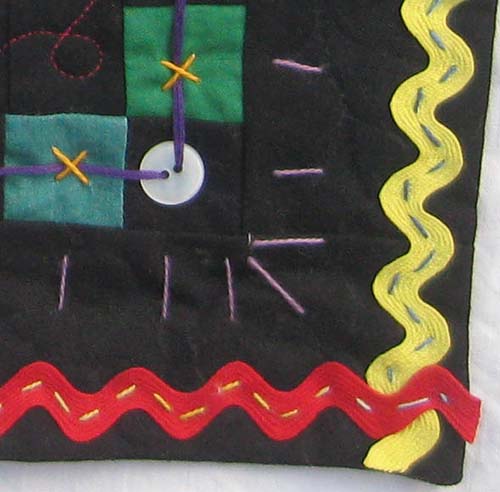
A couple of weeks later, when I was breathing better, I ripped out the feathers. I also cut off the buttons in the central area. Then, I seized my new rickrack, cut little pieces to the same width as the squares (1" finished), applied Fray Check to the cut ends, and glued them onto selected squares. (There are also French knots on the squares).
I added large hand-stitches using embroidery floss, and in the outer borders, ebullient rick rack.
 The border rickrack is held in position with more big hand-stitches.
So it winds up being a happy piece! And there's nothing my mom loved more than happy. Of course, she liked everything I made. I was the luckiest daughter in the world.  I basked in her unconditional love, and still do.

This made me wonder what else I had used rickrack for in past.

I found this mixed media "100 Cups of Coffee on the Wall" quilt (blogged here), onto which I'd dipped lengths of rickrack into fabric stiffener, then stitched them to the left side of the quilt,
They're supposed to be caffeinated radiating energy lines....
I also used stiffened blue-and-silver, gold, and white rickrack as energy lines on this denim valentine brooch....

...and more white rick rack on the next one....

It's right above the silver bugle beads, below, held on with glue and pink transparent beads.
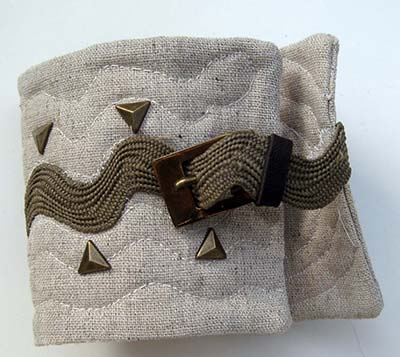
But wait, there's more!  I found this quilted linen cuff bracelet, blogged a couple of years ago, here. I used a huge, chunky rickrack as both embellishment....
 And, with the addition of a buckle, as the closure. I just poked a hole in it for the belt prong.
 The metal diamond embellishments are iron-on. That's a vintage button and polka dot silk in the yo yo, and the bracelet fabric is linen. I love all the textures, including the ridged rickrack.
Here's a denim vessel made from a torn pants leg. I circled the top with a piece of vintage lace that incorporated fancy embroidered twisted rickrack. 
Women of yore were ambitious with their rickrack. Someone crocheted, twisted, and knotted this trim by hand, no? Yes, those pink and white stripes in the middle are rickrack, wound together. 
I did a little more searching, and found that I'd used patriotic red and blue rickrack to embellish  totes that my friend Marian Sunabe and I made as fundraisers for the 2012 election. It works great to accent pockets....


And then, just this week, I happened to visit Quilt'n'Things, a lovely quilt shop in Glendale, and they had a shelf full of rickrack in bright colors and gigantic sizes. But I didn't see any quilts with the rickrack.  

If you're yearning for more  rickrack ideas, here's a link to a Pinterest page full of ideas: https://www.pinterest.com/explore/rickrack/.

What are you doing with rickrack? I'd love to hear about it! 

Friday, June 29, 2012

On Feathers


I recently finished a commissioned chuppah, (a wedding canopy). For this project, a medallion quilt surrounded by a large expanse of white,  I envisioned lots of spectacular quilting. And to me, the ultimate in spectacular quilting is feathers. You know, those long vines with leaves coming off them, which nest against each other, and gloriously twist and turn. (Sometimes I call them feathers, sometimes vines, excuse my inconsistency). 

I knew this leafy vision would be a challenge: In my many years of quilting, I've made wonky, fun, and weird vines, like on the left side of the drawing above, and the corner of a 2010 scrap quilt below (can you see the uneven vine, diagonally crossing the blue and white squares?). (More of this quilt in an earlier post). 
But nothing I sewed looked anything like the lush quilter's feathers I wanted for the formal  chuppah.
Somewhere in my house, there was a 15-year-old magazine with an article about drawing feathers using quarters (25 cent coins, that is, not fat quarters); but I couldn’t find the magazine, plus I wanted feathers  larger than a coin.

I looked through my box of quilting stencils, and found one sad foot-long plastic vine stencil. All feathers were identical and the effect was totally blah.


Fortunately, my quest coincided with a big local quilt show. I hustled from booth to booth, asking the proprietors whether they had a feather stencil, template or book. One offered a unique acrylic template, but when they tried to explain how to angle and trace it, it seemed even trickier than the spare change method! Plus, it  too, could only make feathers in one size.   

Finally, in a book booth, I found a new AQS book called Create Your Own Dream Feathers, by Peggy Holt.  (You can peek inside it at the AQS site.)  Along with plentiful illustrations, there are doable  exercises and lots of explanations and arrows to show stitching order. So I bought it. Wow, was that a good move! Living up to its name, it turned out to be the feather method of my dreams.
Freemotion quilting of feathers on a sewing machine (or longarm) is all about muscle memory, hand-eye coordination, and, especially, backtracking. For most designs, the lines must be travelled more than once. I had been stuck in one particular backtracking route, but this book offered several more.  


I did the exercises, studied the examples, and before long, I started drawing well-fed feathers...everywhere.  Surrounding to-do lists, in corners of newspapers and magazines, backs of envelopes, restaurant placemats, and any other papers that crossed my path. It's a fun and satisfying way to doodle. (There are also sketching apps for tablets, if you’ve moved beyond pencil and paper in your techno-life! I haven’t.)

Here's how my vines came out on the wedding quilt:  (just above the brown triangle points)

And here's where I improvised some feathery pomegranates on the side edges:
OK, so the pomegranates are a little lopsided, but the feathers are plump and juicy! Bethany Pease's book gave me the inspiration to use a little spiral as the smallest feather.
Like everything in freemotion quilting, doing feathers well is a matter of practice, practice, practice.
BTW, here's a picture of the overall wedding quilt. You'll be seeing more pictures of it shortly - it was a learning experience in many ways!