Showing posts with label Mariners Compass. Show all posts

Monday, August 17, 2020

Scary Unfinished Quilt, Happy Ending, Don't Look Too Close

This is a mystery quilt adventure. If you hate suspense, scroll to the very bottom of the post to see the finished quilt. If you enjoy mysteries, read from the top. 

I'll begin this story in front of my UFO (unfinished object) cabinet, a terrifying place, in a far corner of my sewing room, under the ironing board, behind/beneath my Featherweight table. 
To open the cabinet's doors, I have to curl myself into in a fetal position - then, the doors open only halfway, before smashing into my knees. Fetal position also describes my emotions, when I look at what's inside.

So I tend to avoid the place, for years on end. But a couple of weeks ago, my quilting friend Joni posted on Facebook that she wanted someone's UFO as a challenge. 

I knew had to move fast or she might not take mine, so I curled myself down, pulled stuff out, and found something almost presentable for her (I'll show you that in a future post). 

I also dragged out what you see below - a partial top, about 4 feet square, my first UFO. (The thing lying on the lower star point isn't attached, I'll explain below). 
I made it in 1991, the year I started quilting. This was perhaps my third quilt attempt, a Mariner's Compass. (My first quilt was Eleanor Burns' "Amish Quilt in a Day," a thrilling beginner's book - Eleanor's new and improved version is HERE).

Mariner's Compasses are challenging for even master quilters, and today, with my 29 years of experience, I would not dream of tackling one without precision foundation-paper pieced (FPP) patterns, ideally vetted by a jury of scrupulous architectural professionals.

But for a beginning quilter, with no knowledge of FPP, a Mariner's Compass is insane. I know it doesn't look too bad from a distance, but let's get closer.

I had created and cut separate templates for each piece. including the eight pieces of the rectangular background. (Today, I would applique the star to the background, which is vastly more fool-proof and stronger.)

In the center, I made 16 points meet. This created concentric ripples in the space-time continuum, dragging me into its vortex and crushing my soul every time I looked at it.
 
Even less forgivable is that many of those fabrics are crap - the yellow is see-through, the pink is too, and the aqua blue might  contain polyester

The star points don't look bad from the front - only one had a hole - but the back, seam allowances flip around like playful sea otters. And speaking of oceans, each seam allowance ebbs and flows between 1/8" and 2". 
Squint, because this could harm your eyes. 
Why so many thread colors? Why do seams stop and start? As a novice, I clearly engaged in magical thinking. 

Also bundled up with the centerpiece were these spare star points. 
Plus eight not-badly-pieced Evening Star blocks.
And a couple of pieces of the fabrics below. If this color scheme looks familiar, it's because it was all the rage in the early 90s. The prints - I think they were the first ones I ever bought - were designed by Mary Ellen Hopkins, a hilarious and brilliant quilter. Sadly for all of us, she's passed away, but her books and spirit live on, except not in this photograph:  
I loved these two colorways. And today, I still like the turquoise one. But the magenta one gives me a headache, and both become excruciating when large quantities are next to each other. 

With all those issues, no wonder I couldn't finish it. But I also couldn't throw it away. So the bundle moved with us to California, where we made babies, had careers, and after several years, I apparently tried to save it by creating this small star, to cover up the central ripples. It's hand needle-turn appliqued, onto a "backing" of ultra thin purple fabric. I still had not learned my lesson about buying the good stuff.   
I obviously decided this wouldn't work, so back in the cabinet it all went, awaiting a new millenium. 

Which brings us to 2020, l'annee terrible. As I laid it out on my floor, I had a new, Covid-esque thought: I could be dead in a month. It's time to finish it, or mail it with lots of cash and a pleading letter to Joni. I decided to rescue it myself.

The first thing I did was relieve the concentric pressure in the middle by cutting out an oval. (I'm not sure if you can see that some of this stitching was by machine, and some by hand.)
I machine stitched the purple-backed central star to the center, using a decorative satin stitch because the purple fabric was too flimsy and narrow to turn under.
When I looked at the back, I realized something else frightening....
In the center back of the star, there was fusible residue. 
I decided to ignore it. Yes, I still engage in magical thinking.

Then I remembered that I might have other discards from this quilt in my scrap stash, aka The Infinity Suitcase, which, like Dr. Who's Tardis, contains multitudes. When opened, the scraps instantly aerate and sproing upwards like a newborn volcano, then spill all over the floor like hot lava. (That's why I rarely open it, and pile things on top, to hold it closed.)
I couldn't find the discards from the same project, but I did find a stack of these paper-pieced sashing units, made for a different quilt, (a Freddie Moran quilt, she's my idol), a mere 23 years ago. They'd wound up the wrong size, so I'd ripped them out of the quilt and crushed them into the Luggage of Doom. 
But wait, there's more! Just before diving into my UFO cabinet, I had decided it was time for me to get more experience doing curved English Paper Piecing (EPP). So I was turning some of the straight line patterns from my EPP book, Hexagon Star Quilts, into curved patterns. Here's one. 

Looks good, until you closely inspect the outer points, some of which have tiny-but-unforgivable gaps. (From these experiments, I learned that curved English Paper Piecing should only be attempted when there are very few curves.)

While playing around with all these components, I also couldn't help noticing colorful little arcs and their templates scattered about on my coffee table, leftover from my recent mask scrap quilt. I hadn't exiled them to the Suitcase of Terror yet.
So, to review, I took my:
  • Unfinished Mariner's Compass quilt, okay from the front, sad from the back, 
  • Eight eye-searing Mary Ellen Hopkins blocks (note how I cleverly shifted the blame to her - she was such a fine person, I'm sure she wouldn't mind), 
  • 30 paper-backed yellow-and-black star points, plus I made some colorful ones for the vertical borders, and a few half-units for the central area,
  • Curved EPP experimental blocks, and
  • Colorful little arcs....
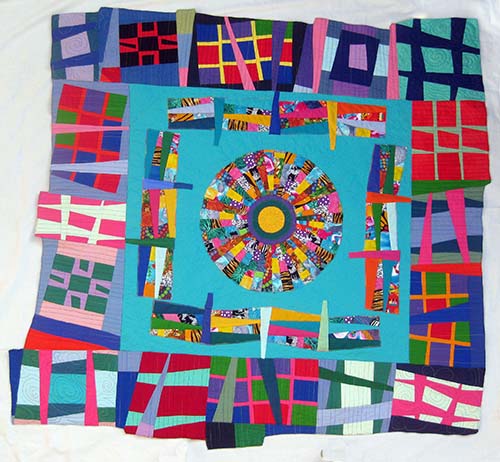
...and sewed them all together. It took me about two weeks. Here's the finished quilt. 
Since the yellow fabric in the central star was so thin, I decided toss some arcs on it. I think they look like festive thumbprints. 

I freemotion quilted the heck out of it. I am currently obsessed with Christina Cameli's approach to FMQ - I love her book, Texture Quilting, no financial affiliation. 


Here's the quilting on the Evening Star blocks.
I quilted eyeballs in each diamond-shaped sashing opening, because eyeballs are always in good taste. 


The (mostly) EPP'd block on the far right, below, reminds me of a bobbin. I didn't notice that until after I made it. 
The block on the lower right is EPP'd and then appliqued to the blue hexagon. The block on the left is regular machine applique. The latter is so much easier, faster, and more accurate.  


And here we are, all done, from a different angle.   

In conclusion, if you, too are haunted by hopeless UFO's here's my best advice:
  • With at least one quilting friend, or a guild, have a UFO swap. Joni's request forced me to open the scary cupboard and seriously reevaluate whether my UFO's could be saved. 
  • When you pull out one UFO, drag out several more and look at them together. This invites serendipity. Given that you made all the components there's a better-than-average chance that they might speak to each other, creating something better than the sum of its parts. Check out my blog post here about another FrankenQuilt made from fragments of different projects.
  • Every quilt doesn't have to make sense. It's okay if the theme is "Play!" The thought of entering my new Mariner's Compass in a show makes me nauseous. But of putting it on my wall, or the wall of someone who is not a quilt show judge, architect, or any kind of perfectionist, makes me very, very happy. 

Monday, January 27, 2020

Road to California 2020, Part I: The Quilt Show

Road to California, a terrific quilt show, took place last week, ending on Sunday. There was something for everyone - traditional, art, modern, and group quilts; challenges, guild raffle quilts, and more than a dozen wildly diverse special exhibits. Great classes. Hallway massage. Polite Boy Scouts who, for a small donation, watch your bags while you shop. Tons of vendors.

Also, it's next to a mellow, convenient little airport - you could walk from the Ontario, California airport to the convention center. So it's not surprising that this warm and welcoming show attracts 50,000 viewers, plus entrants and vendors from around the world.

I have loved 'Road,' (as we locals refer to it) for many years, even before they started accepting my quilts! On the latter achievement, I'm still in happy shock. One of my quilts was juried in last year, and one more this year. This feat took merely 30 years of intensive practice.

The quality and passion of the quilts at Road always blows me away. For this blog post, I will focus on a few of the many spectacular non-award-winners. You can easily look at great photos of the award winners on the show's website, here. Some of the quilts below did win awards, however - I just couldn't resist posting them.

Quilts shows are an out-of-body experience for me - I'm in a tizzy - so I can't take pictures of every quilt I adore. If your quilt isn't here, there's a 99.99% chance that I loved it. If your quilt is here and you wish it weren't, I will remove it (email me at cathy.perlmutter@gmail.com).

I welcome corrections, clarifications, etc. Some of the labels are at a distance from the quilts, and I get confused - write to me and I will correct any errors. I have no financial affiliation with any of these quilters (except me, at the end.) Let's go!

THE CHUTZPAH AWARDS

I'm going to start out by presenting my own personal 'courage-in-artistry' award to the two most out-of-the box quilts at the show that I just loved. First, Steph Skardal of Dublin, Ohio, made "Fish Scale, Chain Mail." The loops you are seeing are all quilted. Steph writes, "I was inspired to bring elements of crocheting and knitting into quilting...I took inspiration from metal chain mail formations to determine how to weave individual quilted rings together....Half-rings were individually quilted and joined together via hand stitching."
Another stunningly unique piece was this interactive quilt by Flora Joy of Johnson City, TN, whose  work I first encountered at last year's Road. It's called "Pop-Up Stories". Viewers -  especially schoolkids - are encouraged to open the flaps one by one and use what pops out to tell a story.

Closeup. Along with fun and imaginative, Flora's craftswomanship is perfection.

See more of Flora's innovative quilts on her website, at http://www.storytellingworld.com/13974/. I wrote about two more of them in last year's Road to California report, here

RELATIVELY ABSTRACT WALL QUILTS
I photographed the next quilt, by Roberta Lagomarsini of Bishop, California just because I thought it was beautiful. When I read the label, I learned it was much more. Her description of "Old Town Street View - Syria" reads, "Freeform squares of whites, blues and greys laid under and over each other represent city walls: ink, red, teal & orange - hanging laundry and the greens the meager plants growing in the dark passageway. Black squares represent the desperation of war, Orange the firefight. White Light shines through giving hope that peace will prevail."  
Also addressing important issues: "Global Warming" by Zina Clark of Long Beach, CA. 

Michelle Cain of Groton, MA, made, "47XY+21" Explanation: "When our son was 10 hours old, my husband and I learned our baby has Down syndrome. 47XY+21 is an abstract rendering of our son's ...chromosomes...including the extra chromosome on the 21st pair that causes Down syndrome. As the heart surrounding that trio suggests, we feel nothing but love for our son's bonus chromosome. We can't imagine him without it. We wouldn't want him any other way."
 
Here's "Mesmerizing" by Jodi Robinson of Enon Valley, PA.  She calls it "My modern spin on a spiral quilt."
The colors and quilting in "Antelope Canyon Mosaic" by Kimberly Lacy of Colorado Springs, CO, made me swoon. (The judges swooned too.)
Next, "Kaleidoscope Quilt" by Gail Weiss of Portland, Oregon, quilted by Nancy Stovall. It's English Paper Pieced, with 3,113 pieces. It took her 10 months. When I got home, I discovered she sells this pattern and other very unique designs from her blog, GailLizette.com.
Kathy McNeil of Arlington, Washington made "Bliss," which is what it induced in me.
Cindy Seitz-Krug of Overgaard, AZ, says that with the quilt, "Alternative Grids," below, she wanted lots of negative space to show off grid-based quilting designs in her books and Youtube tutorials. Learn more at her website, https://www.quintessentialquilting.com/about-cindy.html.
Next, "Lotus" by another well-known designer, Karen K. Stone of Dallas. (I took pictures before I noticed each artists' names!)
Beth Nufer of Brookings, OR made this flawless and unusual quilt, "Cody's Cubes," quilted by Clem Buzick.  "I wanted to make a modern design quilt with a 3-D effect...I love tumbling blocks, so that worked out for this quilt." I can only dream of achieving this level of perfection when I grow up. 
Closer:
Maureen Wood, from Rosedale, BC Canada, made "Imagine," from a pattern by Jacqueline de Jonge.
Nearby, another rainbow/mariner's masterpiece, "Mardi Gras" by Marlene Speed of  Victoria, BC, Canada. My photo doesn't show the thousands of Swarovski crystals on this quilt.
Here's "Ballet," English Paper Pieced by Alice Ikenberry, of Richland, WA, quilted by Teresa Silva, and designed by  Willyne Hammerstein.
"Starcrazy" by Catherine Butterworth of Lindfield, NSW, Australia was another jawdropper (and award-winner). "I used what I call quilted trapunto. This is where elements of the stars are quilted and then padded before the quilt is sandwiched."
Those round forms you see poke out a couple of inches! They're kind of bosomy, in a wonderful way!

HUMAN IMAGE QUILTS
Deb Hyde from West Bloomfield, Michigan made "Persephone," a portrait of the Greek goddess. The closer you get, the more astonished you are, as you realize that it's entirely pieced from 1" squares - arranged in the traditional  Amish 'sunshine and shadow" concentric diamond pattern! To me, it's staggering.

"Darshan of the Deities," was made by Mellisa Sobotka of Richardson, TX. "In Indian philosophy and religion, Darshan refers to the beholding of a holy person, sacred object or deity, especially in image form. The experience is considered to be reciprocal and results in the human viewer receiving a blessing." 
Rhonda Denney of Emporia, KS, was inspired by a sepia photograph to create "Lunchtime Secrets."  It's whole-cloth and dye-painted to look like a page from a photo album. You can see most clearly on the lower right that it even has faux photo corners! 
Also based on an old photo, Jan Hutchison of Sedgwick KS made "The Gault Family Band." Her grandfather is the trombone player in the original photo, taken around 1900. Music still runs in her family; Jan and her sister are musicians. She wrote, "This quilt combines three important parts of my life: family, music and quilting."
Cindy Stohn of Chandler AZ, made "My Big Face. She wrote, "As a study in color, I created this self-portrait inspired by the painting style of Chuck Close. I first created the image using paint chips on a 1/2" grid, then I transferred the concept into fabric. Free-motion quilting using multiple layers of thread rings adheres the circles to the pieced square top. Over 120 colors of fabric and 56 colors of thread were used...No software, paint, or fusible products were used." 
To honor military women, Penni Barger of Ripon, CA made "Those Who Serve." It's also inspired by the Women's Vietnam War Memorial in DC. 
There was a series of stunning quilts by renowned quilter Jenny Bowker, which included this important quilt, "After the Last Sky." 
A better picture, and an explanation is on Jenny's website, at   http://www.jennybowker.com/postcards/2018/6/18/after-the-last-sky.html.

THE ANIMAL DEPARTMENT
I have a weakness for jellyfish (but not too close), and I loved "Dance Around the Moon," by Clare Marks and Carole Crist of Bremerton WA. "My mom and I live near a beautiful inlet in Washington. On a full moon you can kayak out into the bay and see beautiful jellyfish floating just below the surface....with my Mom's wonderful painting, and some quilting we brought it to life on fabric." 
A different watery world is depicted in "Messengers," by Kathy McNeil (who also made "Bliss," above.) These are Spotted Eagle rays, and she didn't use spotted fabric - "There are 1,658 turned edge, hand-appliqued spots," she wrote. The rays, she added, "are messengers reminding us to protect our coral reefs."

"Ms. Secretary Bird" by Sharon Wiley Hightower was partially inspired by a photo by Keven Law. "She is a feminized version of a ferocious five-foot tall bird that lives in the African Savannah," Sharon writes. "The actual bird was named for the quill feathers on its head, reminiscent of old time secretaries with quill pens stuck in their hair."

"Everything is Rosie," a delightful giraffe, was made by Margaret De Palma of Bishop CA, a student of Susan Carlson, whose approach to fabric collage is spreading rapidly throughout the quilt world, for good reason!
Here's "Seahorse Carousal" by Robin Long of Poulsbo, WA, quilted by Wanda Rains. 
In an endangered species challenge, I found this dimensional coelacanth by Kim Gibson of Burke, Virginia
Luana Rubin of Boulder, Colorado made this spectacular polar bear. 
The "Giant Clam" below oozes rick rack, lace, and fabulous contemporary fabric - that's my kind of clam! It was made by a quilter whose first name is Willa - unfortunately, the glare from the sign obstructed my photo of her full name - so if you know Willa's full name, or you ARE Willa,  my apologies - I love your quilt, please send me the information and I will add it! 
Another special exhibit honored the Road to California show. Debbie Nussbaum of Los Angeles made these wonderful trees, incorporating Australian and Kaffe fat-quarters purchased at shows. The quilting includes squirrels, foxes, birds and three owls! 
The Bob Ross Cherrywood challenge included had entries inspired by the iconic big-haired, big-hearted artist's belief that anyone can paint. If you're a Ross fan, it's too late to do the challenge, but I just discovered you can buy a poster of the entries at http://cherrywoodfabrics.bigcartel.com/product/bob-ross-poster. While you're at it, order some of their trademark, luscious, hand-dyed fabric. And find the rules for their next challenge - Lady Di - here. (No financial affiliation).
Another special exhibit was "Stitch Like an Egyptian - Tentmakers of Cairo". I could devote dozens more blog posts to their glorious, dense work. (Not surprisingly, books have been written about them.)


And finally, here's a photo of me in front of my pieced and appliqued quilt, "Multigenerational Luncheon Linens.
I happen to own a much better picture of this quilt.
If there were a hoarder's award at this show, I'd be a contender. It took me years to collect the linens. The central area is a tablecloth, I'm guessing from the 1950s, with illustrations of mysterious globes on pedestals. (One person theorizes that these are old-fashioned stoves, but I couldn't find any antique stoves like this on the Internet! If you have a theory, please share!)
The borders contain more vintage linens - quilt blocks, hankies, napkins, aprons, placemats, etc. And floating on top, I set twenty new English Paper Pieced hexagonal blocks. I think of them as young guests at their elderly relatives' luncheon table. If you're interested in making a quilt like this, directions are in my new English Paper Piecing book, "Hexagon Star Quilts," it's available on Amazon, here.

So that's Part I! The next installment is now up: Shopping at Road 2020!

More information about the Road to California show is here, and their great pictures of the award-winners are here.


UPDATE: A fabulous walk-through of the show is now on youtube, here: https://www.youtube.com/watch?v=u0L1ldJUcW4&fbclid=IwAR2-jlFH0m0JpmgnhB4wdQgaW_naZNZTyhIqSD95d0kZtcWAphPn8K5DqdQ.