Showing posts with label reverse applique. Show all posts

Sunday, August 5, 2018

Artsy Chair Quilt Inspiration from Europe

Are chairs evil? That's the health buzz - sitting around all day is killing us. Maybe in 25 years everyone will work standing up, and  chairs will only reside in museums.

I love interesting chair design, and making an art quilt depicting chairs has been on my bucket list forever. (But buying a bucket chair has never been on any of my lists.)

So during our July week in France and Switzerland, I photographed chairs with quilt potential. We spent the first part of our trip in the Alps, where magnificent mountains dwarfed spidery lifts like this: 
They're so scant that they would be difficult to replicate in fabric. Maybe with bias tape? Or thick black embroidery thread?

One of the most astonishing tourist attractions of the Alps  - and the world - is the Mer de Glace, a mountain pass with a massive but rapidly-melting glacier that you can walk on - and in. From afar, it looks like a river of gravel, but there's a glacier down under that grey stuff.

The glacier is still large enough to host a human-built tunnel. Inside, it is the most incredible shade of blue; plus it has items carved (with hot water?) from the ice, including a statue, a bar, and this throne: 

And here it is occupied by royalty (DH is a prince among men.)

After the Alps, we tackled the rolling hills of Lausanne, Switzerland. Last week I talked about its mind-boggling outsider art museum.  Another fantastic place is Mudoc, the Museum of Contemporary Design and Applied Arts, which is hosting a show about design and weaponry called "Line of Sight." From the catalog:
"Designers play a central role in the development of firearms....Guns are required to be reliable, compact, ergonomic, durable, adaptable, attractive - even aesthetically pleasing....In general, discussing the relationship between design and violence is often taboo." 
A highlight was this chair by Goncalo Mabunda, an African artist and anti-war activist. It's the outcome of an effort to disarm Mozambique - a campaign that has collected over 800,000 weapons, and distributed some parts to artists to upcycle - read the story here.
The black-and-white catalog photo provides a clearer view of the piece's beautiful silhouette: 
And speaking of the Bible (beating swords into plowshares), at St. Francois church in Lausanne, we found these 14th century choir stalls: 
Love the quilting designs on top, but the seating doesn't look comfortable. Fortunately there's distraction from hard surfaces: One set had carved figures on the arms - a mermaid on one side....
And someone who has lost his nose on the other. 
Voldemort? Is that you?
Tourism makes one hungry, so we ate at a cafe with these: 
They're remniscent of lace....brains...Swiss cheese?!
Here's how the auto-trace function in my graphics program (CorelDraw) traced it:
It would be fun to simplify and arrange in fabric. There are so many possible technologies - Bias tape? Applique? Reverse applique, cutting holes from a single bright red piece of fabric? 

I also loved these asymmetric branches...
...and the black-and-pink color scheme. (Note the ubiquitous ashtrays. Unlike California, Switzerland allows smoking in outdoor restaurants. Which makes sitting outside breathing mountain air in beautifully designed Euro-chairs not quite as intoxicating as it should be.)

And speaking of bucket chairs, this green one was in an architectural firm's window: 
 
I traced it by hand in my computer program. It's so helpful to sketch and/or trace chairs to understand the perspective. The back legs are  always shorter than you think. 
And finally, the piece, er, chair de resistance. At the end of our trip, waiting for the airport train in the Lausanne station, I spied this on the opposite platform. 
Only when I examined it closely in Photoshop, was I able to discern that it's an ad for an exhibit by Rasheed Araeen, a London-based Pakistani-born artist who creates luminous geometric painted quilts (including the one above), and complex 3D architectural sculptures. See plenty of his work here.

Here's my first sketch that came out of all this inspiration. 
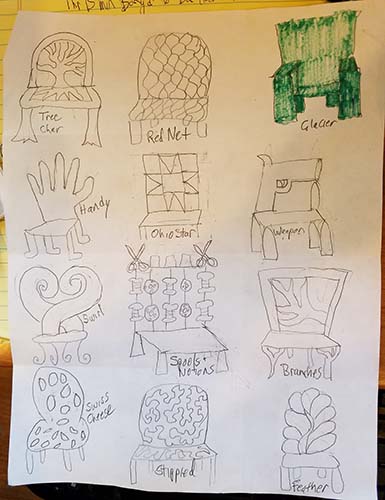
Top row: Tree chair, red mesh chair, glacier throne.
2nd Row: Hand, Ohio Star, handgun.
3rd Row: Swirl, spools & notions, branch;
4th row: Swiss cheese, stippled, and feathered.

UPDATE: Here's the chair quilt I finally made from all this inspiration. Read about it here. 

Note on copyright: I would not create a replica or tracing of any designer chair without the artist or copyright holder's permission. As general inspiration, like the adaptations in the sketch above, I don't think there's a problem. 

Feel free to borrow my photos for inspiration, and if you need more, try googling "chair quilt." When I did, I found:  
  • A whole lot of chairs with quilts thrown upon  them; 
  • Chairs upholstered with quilts (especially 1930's quilts); 
  • Designer chairs that are puffy in quilt-like ways (like this by Ronan Bouroullec), 
  • A gorgeous 2011 book by Alethea Ballard with collage chair quilt blocks (no financial affiliation). It's a fun way to use up large-scale novelty prints (Look inside here): 
  • And a few more quilts that depict chairs. Here's a Pinterest page with about twenty. And here are three-and-a-half more. 
I would love to see/hear about your artistic chair quilt! 

More quilt inspiration from Europe is in my last three blog posts: 1, 2, 3.

UPDATE: Wonderful little chair quilts by art quilter Terry Grant are here. The way they're hung is also enchanting. 


Sunday, December 29, 2013

Swimming Pool Quilts II: Serendipity and a Tutorial

 
After finishing the small pool things in the previous post, I was contemplating a larger quilt with multiple pools. By astonishing serendipity, on Monday December 2, as I was eating breakfast, I found a front page article in my Los Angeles Times about - swimming pools?! 

It seems that a young German designer named Benedikt Gross, flying into LA, was fascinated by the glittering landscape of pools below. He partnered with Massachusetts Institute of Technology scientist Joseph Lee, to map some 43,000 local pools (and hot tubs); they analyzed the data using cutting-edge methods, correlated it with public databases (including the child molester's registry, and people who donated money to defeat same-sex marriage!?) I cannot adequately describe this projects's complexity, so here's Gross's summary.
The project attempts to highlight on one hand the emerging and powerful role of non-domain experts in the discovery of scientifically and socially relevant information, and on the other hand seeks to emphasize the darker, creepier, and more contentious issues surrounding data processing and exploration.
Got that? They wound up with a 6,000 page 74 volume set of results. And here's one of the creepy parts: they produced a voyeuristic silent video called The LA Swimmer which takes you on a Google rover tour through back alleys, peeping over fences at pools. Gross describes it more poetically:
Imagine swimming across Los Angeles as if pool-by-pool they form a river through the city; 43,123 oases stitched together in a desert of hyper-urban reality. You float unabashed down your unmapped highway of water, but are confronted very quickly by the fact that you are not welcome in this realm of kidney and clover bowls, Olympic-sized parallelograms, and hot tubs. Threatened by an unforgiving obstacle course of disgruntled homeowners and an impending court order you continue from pool to pool, your reconciliation awaiting you in the next chlorinated ecosystem.
And speaking of kidneys and clovers (hey, that's an old song! sort of), one more interesting result of their study (that I am capable of comprehending) is how irregular most of the shapes are. You'd think most pools would be perfect ovals, rectangles, and kidneys, but in fact most appear to be quite asymmetric and quirky. 

So I gave myself artistic liberty in imagining various pool shapes. From a quilter's and a viewer's perspective, the most important (and fun) aspect of translating pools into fiber is creating a ridge and a height difference between the water on the lower level and the what I'll call the "patio"fabric above. You can see it in the shadowed outlines:
 
For the patio level, I mostly used  novelty fabrics that resemble flooring - bricks and planks. Quilting along the texture lines of these fabric make touching the quilt irresistable.

The technique I used has a name, reverse applique. I also added a layer of a fusible interfacing called Decor-Bond (thin fusible fleece works too), to raise the ground level above the water. 

To make one block:
1. Cut a square or rectangle of  patio fabric (something that resembles outdoor flooring) the size you want the block (plus a half-inch for seam allowances.) 
2. Cut a piece of Decor Bond or fusible fleece to the same size.
3. Do a few sketches on paper  until you have a pool shape you like. The pool's edges should be at least an inch from any outer edge. For shape inspiration, along with the Gross/Lee study above, I also looked at aerial Google satellite pictures of pool-ridden neighborhoods near my corner of southern California; and at swimming pool builder websites. You will also be struck by how assymetrical many are. For ease of turning under, avoid sharp corners in your pool design.
4. Trace the pool shape onto the interfacing, and cut out it. (We won't need the center for this project.) 
5. Fuse the outer area of the interfacing to the back of the patio fabric. 
6. Cut away the patio fabric inside the hole, leaving just a quarter inch showing all the way around.
7. Clip valley curves only, perpendicular and close to but not touching the edges of the interfacing. Don't clip curves that jut into the space. 
8, Turn the unbacked edges inside and to the back of the interfacing. Glue-stick in place. 
Here's what the back of each block looked like after I'd cut and turned in the edges, and stitched several blocks together, but before I added the blue backing: (Ignore the blue in this picture; it just happened to be resting on that fabric; the idea is that these are holes.)

8. Turn the windowed block over, and lay it on your pressed pool fabric. Pin the pool fabric place around the pool edges (about an inch out), inserting the pins through the patio fabric. 
9. Stitch in place by doing a straight topstitch 1/8" onto the patio fabric,  all the way around the edges. 

When you have enough, sew the blocks together. Assembled, my large quilt looked like this.  
I really liked it undecorated. But since I suffer from chronic horror vacui, I thought: Maybe it needs more? Diving boards; slides; umbrellas? (The satellite imagery that I looked at showed LOTS of umbrellas. Fewer diving boards, and I couldn't identify any slides). I gave some of them white and dark grey diving boards, plus some medium grey slides and colorful pool umbrellas. 
I can't decide which way I like this quilt, naked or loaded, and I would be very grateful for your vote in the comments. 

Meanwhile, here are some more individual pools. I quilted the water in Sulky holographic thread, which gives them a shimmer as you walk by (just like flying over LA). Alas, the shimmer doesn't much show in the pictures. 
The next pool inspired by Las Vegas', maybe the world's most expensive private pool (to the tune of $7 million):
More, 


The slides have Sulky holographic thread strands stitched down them, and  over the edge into the air above the pool (I did that part with wash-away stabilizer).  The pool umbrellas are mounted on shank buttons,so they jut upwards and lean over a bit.

If you're inspired to make a pool quilt, you can consider adding even more features: Water-loving creatures, beach balls, people, palm trees, etc., from novelty fabric, or scan them from copyright free art and print onto fabric sheets run them through your printer. Applique in place with invisible thread. (That's what I did in the previous post.) Send me pictures!

Sunday, December 22, 2013

Quilted Pools, Part I

Lately, I've been obsessed with swimming pools. I crocheted a bunch, and then I started making small pool quilts. For the first, I added cutout dogs, a novelty fabric fish, a hot tub, a diving board and a slide. 
 Next, the Gaugin pool, named after the style of the novelty fabric on the lower left. The duck is from a non-Gauginesque pool, and the diver came from a copyright-friendly Dover book.
 And finally, we have a mermaid and her pet goldfish contemplating....a manatee, of course.
Closer:
She's doing the Vulcan mind meld on him. Or maybe it's a love triangle?
I used Sulky's glistening flat holographic thread to make the watery lines. Reverse applique with substantial interfacing (I used 'Decor-Bond') or thin fusible fleece makes the pool sit at a lower level than the surrounding 'patio.' The lines in the brick are quilted, which give them a wonderful texture. The figures are appliqued with a zig-zag stitch with invisible thread.

Want to make your own swimming pool quilt? Stay tuned. Next week, I'll show a larger, multiple-pool quilt, with detailed directions. UPDATE: The next post with directions is here.

Wishing you and your family happy holidays!