Showing posts with label coasters. Show all posts

Thursday, October 15, 2020

English Paper Pieced Coaster Tutorial: Finish a Block, Enjoy a Fantasy Euro-Vacation!

Are you a wannabe traveler, sitting at home, while your muscles and your miles (frequent flier) stagnate? 

This project can brighten your days and remind you of better times and more interesting places. 

It's an English Paper Pieced Euro-coaster, upon which we can place our demitasse of home-brewed espresso, or perhaps a pot of Earl Grey. 

Put another way, this tutorial shows how I used fabric from Paris, and one of the blocks in my new English Paper Piecing book, "Hexagon Star Quilts," to make a coaster. It would also work as a hanging ornament. You can adapt this technique to finish any EPP block. 

By the way, English Paper Piecing really does come from England, and has always been very popular there. Right now, it's enjoying a huge resurgence around the world, for good reason - it's portable, easy, relaxing and addictive. 

This particular project started with a pile of fat quarters I was lucky enough to buy in France two years ago (my fabric-related adventures there are blogged here).

French Frou Frou, looks similar to Liberty of London; it's lightweight and often floral, but not as expensive. Frou Frou is easy to find in US shops, with a little help from the Internet. (William Morris fabrics have a similar look.) 

I chose Star 83 because the central piece is large enough to highlight an interesting print. If you have my book, find the star on page 115. 
If you don't have my book, you can download Star 83 for free from Dropbox, using the link HERE. (If that doesn't work, email me at cathydotperlmutteratgmaildotcom). It looks like this: 

INSTRUCTIONS

1. Choose three fabrics with varying values and hues. 

2. If you own my book, photocopy or scan Star 83 onto cardstock. In the photo, the book is on the left, and the scanned cardstock version on the right. 


If you don't own my book, use the pink Dropbox link above to download the pattern and print it onto cardstock.

3. Cut around the outline. 

4. Don't cut it apart yet! First we'll create a full-size backing with turned edges. For the back, I suggest you use a fabric that won't show cappuccino, croissant, or french fry stains. Lay the entire hexagon on the wrong side of your  backing fabric. 
5. Cut around the edges, leaving at least 3/8" seam allowance. 
6. Bring fabric and the template to the ironing board. Center the paper on top. Press all six edges firmly inward. 

Here's the reverse side with all edges pressed in. 
6. Remove the cardstock and press the edges inward one more time, to get the folds sharp. 
7. Don't cut up the pattern yet! We need it for one more thing - to cut the batting to size. Place it on a batting scrap.  
8. Trace around it.  
9. Cut just inside the line you drew.
Now it's all cut out, leaving the drawn line behind. 
10. Cut apart the cardstock pattern, and baste fabric to all its pieces, using your favorite English Paper Piecing techniques. If you are a beginner, my book has extensive explanation of different ways to baste, with thread or glue.  

11. Sew the pieces together, by hand or machine - again, beginners can find methods and tips in my book. Piecing order: First sew each A piece between two B pieces. Then sew each BAB unit to one side of the central triangle. 
12. Now you have three components: The assembled top, the batting, and the backing. 
13. Tuck the batting into the backing. Press the flaps over each edge. (Iron again, if you like.)
14. Remove all papers (right) from the back of the pieced block. (You may be able to reuse them to make more coasters!) 
15. Place the top over the batting and backing. 
16. Use pins or sewing clips to align the outer folds on top and bottom, and tuck seam allowances and tails inside the sandwich. 
(Some of my clips are plastic - some are metal binder clips. I find the silver binder clips easier to open than black binder clips; the plastic ones are easiest of all on the hands.)
This is also an opportunity to baste one long edge of trim - like rick-rack - between the layers, extending beyond the edge. 

17. Hand sew the edges shut - by hand, with a ladder or whipstich. By machine, you can use a straight stitch, with monofilament thread, or thread that matches the fabric (I used white here so you can see it.) An open-toe foot helps, and a sharp awl (or seam ripper) is a necessity, to tuck bits inside and do last-minute adjustments of folds. You can see my metal awl on the right below - there's a pink sewing clip on it permanently, which keeps the awl from rolling away!   
Here's the block with machine straight stitching (white). 
If you like, go around again, with a decorative stitch and contrasting thread. You could even couch a decorative cord or yarn there.

18. Just for looks, and to ensure the batting stays in place when laundered, do some quilting. I stitched all the way around the inner angle of each background diamond, which makes them pop forward (I used dark thread that's hard to see in the picture.) 
 My last step was to quilt three straight lines on each red triangle, extending inward from each outer point. 
Back: 
Now heat up the espresso machine (or locate your can of instant cappuccino powder), and you're ready for your Zoom cafe, perhaps with a virtual background of the Eiffel Tower. It's not the same as being there - but look on the bright side - you don't have to inhale other peoples' cigarette smoke!?

And hopefully, the sun will metaphorically rise again, our country will get its act together, and surely, one day, we will again be welcomed in places far beyond the front porch.


Sunday, February 5, 2017

Quick Cat Hat Quilt Block

There are a lot of cat quilt projects and patterns out there, but I never made one - I'm more of a dog person. But that whole pink #pussyhat project (blogged here and here), got me thinking about cat quilts and forbidden words.

Last week, after thinking about this for couple of hours, I stood up and made this.
Yes, it's a worried cat quilt block ornament. It's 3 1/2" square, the ears are flaps (known as "prairie points"), and it's literally a one-hour project. 

(Unless you add whiskers and a keychain, in which case it's a 1.25 hour project:
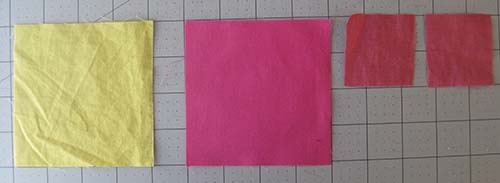
Start by cutting four squares: 
  • One 4" background square (yellow in this case, I didn't iron enough, but you should) 
  • One 4" head color (bright pink)
  • Two 2" squares for the ears (I used a pink print) 
    Fold each of the 2" squares in half down across the horizontal fold; and then bring the corners into the center. Press shut and dab the flaps with a glue stick to hold the inner flap corners down.
Trim a quarter-inch from each side of each ear:
Fold the head color square down, at least an 1.5" or more. (If you're making more than one block, you can vary the fold to vary the head size.)  Press with an iron to make a clear crease.
Lay the head, raw folded edge down, directly on top of the background square. Bottom corners should match.
Insert ears at least 1/4 inch under the folded head edge, and at least 3/8" in from each side.
A dab from a glue stick under the ears is helpful.

Now you have a choice - either topstitch straight across that fold, 1/8" below it, from one side of the head to the other. (The white dotted line shows where your stitching should go.)
Or, flip the head fabric up temporarily, and sew across the line you pressed in with an iron. You'll be going through the bottom horizontal edges of the ears, to hold them in place permanently.
Trim the seam allowance on the head fabric down to 1/4". Fold the flap back down. Everything's in place.
 This can be pieced into a quilt, with other blocks. Or, to make a hanging ornament, (like mine), cut a piece of quilt batting to the same 4" size (Here I used the top as my template for cutting batting).
Cut a 4" backing:
Stack as follows: Batting on bottom; backing, face up; cat's head, face down.  If you've stacked it correctl7y, you should be looking at the horizontal seam that holds the cat's head to the ears.
Sew 1/4 " in from each raw edge, all the way around, leaving a gap of at least 2" along one side. The gap should not incorporate a corner.
(In this picture, I didn't leave a large enough gap, and had to pull some of the stitching out to make it big enough to turn.) Trim the corners at an angle, and don't cut through the line of stitching.
Turn right side out.
There's still that gap on the side. If you're going to machine-embroider all the features, you can hand-sew the hole shut now.
But if you're going to hand-sew embellishments, leave it open for now. The hole will make it easier to hide starting knots.

I drew the features on with a  water soluble marker, but wasn't crazy about my first draft...
Nasty needed to shift a bit to the right. I tried to correct for that when I sewed over them with straight and backstitches. I hid the starting knot between the layers, using the hole on the side.
The ending knot was buried in the back. (Here's a tutorial on how to do that.)
Almost done. Two green buttons make the cat look startled. (But don't use buttons if this is going to serve as a coaster.)
The outer eye lines took my cat from stunned to world-weary.
 What else can you do with this idea?
  • If you want to add rick-rack whiskers, like in the second photo down from the top of this post, cut the rickrack to the width you want, and drip a fray-checking liquid or glue on either end.
  • Make angled heads. (But do these look more like roosters?
  • Make a bunch of blocks, with different colors, head sizes and angles, and turn it into a signature quilt - have friends sign and/or embellish it. 
  • Embroider a political statement.

(Now that I look at this drawing, it looks more like pyramids, or maybe pointy bosoms?)
  • Beanbag
  • Pincushion
  • Coaster
  • Pin (brooch)
  • A nap quilt for a small child. Go wild with colors and prints.
  • Make it 14" square background, and sew it into a pillow.
  • Make it 18" square and turn it into a tote bag.
  • Have fun! Send pictures!
To see the #pussyhats I made, check out this post and this one. To see this idea turned into a card holder, check out my next post, here.