Showing posts with label Hebrew. Show all posts

Sunday, April 8, 2018

Freemotion Quilted Hebrew Alphabet Postcard Tutorial

How's your Hebrew? Mine could be much better, but that didn't stop me from making thirteen 4" x 6" quilted Hebrew alphabet postcards for a recent exchange.
A little closer: 


One example: This is the first letter of the Hebrew alphabet, 'aleph.' 
Mystics saw its structure as a ladder between heaven and earth (Can you see the ladder on the far left?) The rest of the background is freemotion quilted with objects that begin with aleph, including pears, pineapple, ears, fire, and lion. OK, they're very sketchy, but they're there! 

These cards were made for my Jewish quilting group's "People of the Book"-themed postcard exchange. I was particularly excited about this theme because of my fondness for fonts. New, old, I can't get enough, in any language. The Hebrew alphabet is particularly gorgeous, whether ancient Torah calligraphy, or art-deco influenced mid-20th century. A favorite book on my shelf is this 1950 tome called "Hebrew Alphabets," by 20th century Judaic graphic designer Reuben Leaf. The book offers dozens, and even the cover is a treat: 
For the postcard exchange, I paged through it for ideas, and was stopped in my tracks by this: 
At the bottom, it says it was designed by Siegmund Forst, a groundbreaking mid-20th century artist and graphic designer from Vienna; and the letters were based on the Kafra Haggadah, a lavish 1947 illuminated Haggadah.

The first thing I did was scan the page; then in a graphics program, I resized the letters to about 2" x 3", so they would fit comfortably on a 4" x 6" postcard. 


Since I was swapping with 12 people (plus one more card for me), I cut 13 pieces of stiff double-sided fusible interfacing to 4" x 6". I cut a long strip of a mottled batik fabric and pressed each rectangle onto the fabric (using a non-stick press sheet on bottom to prevent the other side of the fusible from sticking to the ironing board.) 
 Cut back the excess fabric to the same size as the interfacing.
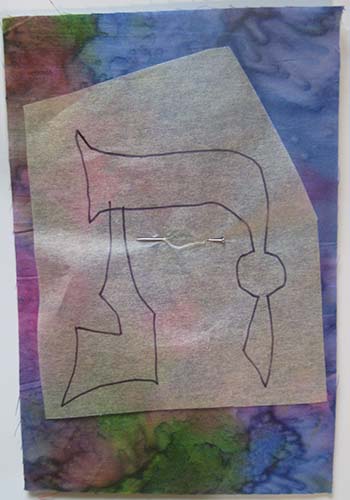
I used Golden Threads tracing paper to trace the outline of the 13 letters I selected for this project. 
 Then I pinned the outline to the center of each postcard.
 Next, I stitched along the edges with gold metallic thread and an open-toe freemotion quilting foot.
After stitching:
 Tearing away the tracing paper was next. First I ripped away the outside.
I liked how it looked with the paper inside, but obviously that's not a long-term solution.  I ripped away the inside, and then went after the little bits. With Golden paper, they're easy to dislodge. (That's not the case for other kinds of paper.)
I wasn't wild about the lack of contrast when the letter outlines were empty - so I filled them in with gold metallic paint. They are all painted by hand, with a small brush, and of course I always wear my magnifying headgear to do this as neatly as I can. 

Next came the research part: I dug up my Hebrew-English dictionary, and also opened a translator online. I looked up Hebrew words that began with that particular letter, that would be relatively easy to freemotion quilt.

I grabbed my tracing paper again, and pinned fresh 4" x 6" pieces of it to each card again. This time, I focused on doodling designs representing Hebrew words that begin with that letter, in the space around the letter. 

For example, the card below shows the letter peh. The sketch shows my brainstorms for the surroundings. Peh has a numerical value of 80, and peh words depicted include bell, skeleton key, unlock, brook, mouth, face, mushrooms, flower, coffee pot, and fruit. 
In order to get the design onto the card, I did NOT stitch through the tracing paper. I needed to see exactly where I was gong, and the tracing paper would obstruct the view.  So I put the sketch next to my sewing machine, and referred to it when freemotioning on the actual card. I ended up doing many things differently from the original! 

Next, the letter 'bet', the second letter of the alphabet, is associated with the number two, and it’s said to be pointing to heaven. Bet nouns on this card include egg; home; banana; peanuts; thumb; and balloons.
This one's 'ayin'. The words I depicted include tree, grass, eye, grapes, clouds, and maybe cookies. 
 And so forth.


After the quilting was finished, the reverse side of these cards was still blank - just fusible interfacing. In my graphics program, I wrote a little essay for each card, explaining each letters and its words, plus the address of each recipient. I could fit three custom 4" x 6" labels like these per page. 
I ironed five 8 1/2" x 11" pieces of plain white fabric onto freezer paper. Then I printed the labels onto the fabric. I cut each one out, fused it to the back of each card, and did a zigzag stitch with invisible thread around the edges to hold the three layers together. They were ready to go! 

If you love fonts - in any language - you can easily do a project like this. Quilted postcards are a great way to exercise creative muscles between large projects, plus they work as fun group activity for farflung people. They're also good mini-presents for all occasions - the recipients can hang them on the wall, or use them as bookmarks or coasters. For much more fun with fiber art postcards, click "Postcards" in the word cloud on the right. 


Sunday, October 9, 2016

Kvelling Over Hat and Hebrew Quilt "Grandbabies"

Every so often, I get an email with the subject line "Your newest grandchild!" These announcements don't come from my own kids, which is a probably a relief, because they're 18-to-23 and single.

Instead they come from my friend Linda Horowitz, a businesswoman and humorist, who loves making over-the-top kippot from the patterns in my yarmulke how-to book.  She especially likes to make personalized, reversible lined kippot with 12 fabrics (plus buttons and charms.)  A couple of months ago, she made the hat below for a friend's rabbinical ordination. There are six panels on the outside....


And six more on the inside....

Her giftee is involved in Jewish summer camp (so there's a camp fabric); "edible Judaism" (pumpkins); sun-and-wheat for counting the omer; a dove of peace button on a Jerusalem fabric; a tree fabric (Tree of Life/Tree of Knowledge - both work), with an apple button, which, she notes, could also be a teacher's apple; a G-clef charm; and much more. The binding is black denim with gold musical notes.  

I thought I couldn't be prouder, but shortly afterwards, Linda sent me another baby picture! It was for the following 4-panel kippah she made for her son, who is starting freshman year at Butler University in Indiana. The school mascot is a bulldog.
This hat didn't come as a total surprise - Linda had visited my home to print a bunch of bulldogs onto a pretreated sheet of fusible-backed printer fabric. Our printout looked like this:


She then cut out two of the dog heads, and fused them to a satin white fabric. She hired a professional machine embroiderer to spell out "Butler" in Hebrew (under the dog's head), her son's Hebrew name, and "Go Dawgs!" (The embroideries cost her $10/panel.) She cut the fabric into four panels, and stitched them together to make the kippah.

But wait,  there are more new grandbabies! They're not hats; they're quilts, and they're Canadian! (so I may need to move in with them after the election.) A couple of weeks ago, I received an email from my friend Susan Podlog, who lives in Calgary - and it contained this photo:
Left to right: Leslie Levant, Nadine Waldman, Deb FinklemanCarolyn Devins, Polina Ersh, Myrna Ichelson holding a challah cover by Lily Joffe
This group of women - members of the Alberta-based Rimon Calgary chapter of the Pomegranate Guild of Judaic Needlework -  made quilts from my Hebrew Aleph Bet pattern. Their finished projects range from simple alphabets to challah (bread) covers to a "welcome" sign for a synagogue office.

What makes this astonishing to me is that some of these ladies were beginners to paper piecing and even to machine sewing! Tackling my paper piecing patterns without a little experience can be daunting. For example, here's the letter Aleph:

It makes this:

... Fortunately, this group of stitchers includes Polina Ersh, "a phenomenal quilter and paper piecing maven," explains chapter member Susan Podlog. "Polina has the patience of Job, and was so gracious in sharing her knowledge. We so appreciated her willingness to be a teacher!"

One of the Polina's most helpful tips, Susan reports: Use the "Add a Quarter" ruler to trim seam allowances as you go. My pattern does not include information about this tool, but I just found a very clear tutorial here. (This tutorial is from the ruler's inventor, Carolyn Cullinan McCormick. No financial affiliation!)

The group also gave me some very lovely feedback on the patterns. One of the women wrote,
"I do remember thinking it was good that I'd done a previous paper-piecing project. I guess I'd say it might be tough for novices without some guidance.  But I'm very pleased with how it turned out, and very glad that Cathy made this pattern. It's something the world needed!
What more could a grandmother ask for?  Well, a human grandchild would be nice, eventually....meanwhile, I'll just sit here in the dark.

A blog post with more about aleph bet quilts is here.  Patterns are on my Judaiquilt website, here. and my Etsy shop.  If you make something from one of my patterns, please send a birth announcement! We will both kvell!

P.S. Many more Judaica patterns, in many different mediums are available to members of the Pomegranate Guild of Judaic Needlework. You'll make new friends and learn new techniques - it's all good!


Saturday, November 22, 2014

Orphan Paper-Pieced Blocks

Back in the 2000's, I designed a foundation paper pieced Aleph Bet (Hebrew alphabet), based on calligraphy principles, and made a couple of quilts from it, like this one wallhanging (about 34" x 28"):
I put the e-pattern for sale on my website, and have received images of quilts made from it, including this one by a wonderful quilter named Wayne:
I also used the pattern to spell out 'Shalom': 
Very gratifying! Designing such a complex quilt meant lots of experimenting and discards. I wound up with a stack of leftovers, including these:  
Here's a closer look at the aleph (first letter of the Hebrew alphabet), front: 
And the back, with most of the paper pattern still in place, 
I stuffed the orphaned blocks in a file, where they sat for about six years, until this week, when I decided to participate in a Hanukah boutique at a local temple.

I took two orphan hamsa blocks that were not fails, added borders, quilted them, put on a hanging loop or sleeve (respectively), and voila! 
 The second one has a button eye in the center:
They're quilted with gold metalic thread, and are about 10" square. 

Here's what the hamsa pattern looks like. It's one of the most complicated patterns in the set. 
That's 22 pieces! Most of the letter patterns have far less!

(If you're interested in making your own, the epattern is sold in my Etsy shop,  as well as from my Judaiquilt shop, here.)

Thursday, October 18, 2012

Say 'Yes' to the Wedding Quilt, Part II: Blood, Fonts, and Tears

(In  Part I, we embarked on a  quilt-making adventure that morphed into an episode of reality TV's 'Say Yes to the Dress.' Here we find more eerie parallels.)

4. Count on the bride's taste being different from  yours. On The Show, the salesperson quickly learns to subsume her or his tastes to the bride's. Similarly, for quilters, taste in fonts. The Hebrew quotation that the couple wanted, from the Song of Songs, means ' This is my lover, this my friend, O daughters of Jerusalem.' I have dozens of Hebrew fonts, many of which came installed with my computer, some of which I bought from a font company (Davka.com). I sent my bride four typeface alternatives, two curvy and traditional #1 and #4), two cleaner, and more linear (#2 and #3). I chose only chunky fonts, with no skinny bits, since I was planning to machine applique each letter.


Personally, I like #1 and #4 best – I’m showing my age! But, hands down, The Bride and Groom liked #3. I was very glad that I asked! (Hebrew students: Line 4 is nonsense Hebrew. I hope.)

5. Let her wear cowboy boots. Some brides on The Show are quirky. At their weddings, they plan to wear a red petticoat, a turtleneck collar, or in several cases, cowboy boots. The sales associate might raise an eyebrow, but she keeps her mouth shut.

My bride was actually not asking for anything wacky. But I wanted her to, in the sense that I wanted her to be personally invested in this chuppah. She had asked for collaboration, and that’s what I hoped to achieve. She’s an architect, so I asked her if she would be willing to design the central Jerusalem scene. In fact, I hired her to do it - I told her I’d reduce the price if she designed it. Urban landscapes aren’t my forte, and heck, as an architect, I knew she had to be a lot more building-sensitive than me. She accepted the challenge, and did a beautiful job, as I had suspected she would.


6. Jack things up. On The Show, when the bride likes a dress a lot, but isn’t quite ready to seal the deal, the sales associate will “jack her up” (!) with a jeweled belt, “hair jewelry”(never heard that term before), chandelier earrings, and, of course, a tiara and veil. Everyone is blown away, waterworks ensue, and the dress is sold! Similarly, I decided to jack up the Jerusalem scene. I added a ray of light, with lighter-value fabrics in a swath that goes diagonally across the medallion, to correspond with the ray of light going through two corners of the quilt. It gave the scene a lot more drama.


7.  If there are no blood spots and everyone cries (with happiness), you've done your job. This quilt took four months of hard work, and I loved nearly every single minute of it. My bride was a joy - encouraging, helpful, and appreciative at every turn. She was truly a dream client, and I felt honored to work with her. 

The only thing I didn’t love was my ever-mounting terror that I might somehow stain the bright white expanses. I became afraid to bring coffee or chocolate into the same room as it – quel sacrifice! While hand-sewing the binding, I actually did poke myself with a pin and shed a drop of blood on it, but managed to wash it out immediately. (And guess what? The same exact thing once happened in The Show, except worse, when the alterations lady poked the poor bride’s ribcage with pins, leaving several bloodspots down the sides of the dress. They got ‘em out, though, regrettably, they didn’t show us how…. did they hold the dress under a bathroom faucet, like I did with the quilt? But I digress.)

When it was done, I took a picture. 


Next, I brought the quilt to the mailing center, and watched with mixed emotions as the clerk carefully packed it up. I wanted to cry. It was like sending a puppy to a shelter. On the upside, I wouldn’t have to worry about drinking coffee or eating dark chocolate in my sewing room, anymore.

When the bride’s family received it, she, her groom, and her family, opened the box together. And, they told me later, they were overjoyed, and tears were shed. In a good  way. I was ecstatic.  I was even happier when they sent me pictures of the chuppah in action, during the wedding ceremony. 


I had had no idea that they'd be standing in front of a stained glass window with similar colors - and, what's really eerie, a ray of light coming from the upper right, just like my chuppah's central design. 

Hang on a second! I’m hearing a voice! Who’s talking?

CONFIDENT-AND HAPPY-SOUNDING MALE VOICE:  “When a bride gets the dream wedding quilt that she helped design, the bride, groom, and quiltmaker will all feel fine.”   

(Or “will walk in the sunshine,  Or, “will have no reason to whine.”)

Or something like that. 

(Note: If you missed Part I, it's here: http://gefiltequilt.blogspot.com/2012/10/say-yes-to-wedding-quilt-part-i.html

(For a discussion of the feather quilting on this quilt, go here: http://gefiltequilt.blogspot.com/search/label/feathers.)