Friday, January 11, 2013

Apron Quilt Inspiration

This is the interactive 3-D apron quilt which hangs above my kitchen sink:
It's about 14" x 20". Each miniature apron (about 4" wide) hangs free from a white square of fabric; the white square is itself a pocket. The pockets are filled with kitchen implements and funny postcards. You can see my favorite postcard displayed in this shot, but you don't need to squint to read it because... 
 
Here's a closeup. The lady has an important message:
That's an Asian stew implement sharing the pocket.

For Baby Boomers like moi, aprons evoke the 1950's and 60's. I rarely wear them (pretty much only on Passover), but my yiddishe Bubbie (grandmother) sure did, and I have a collection of real vintage aprons, plus images of vintage apron patterns. These all helped inspired the tiny aprons I created for the quilt above.

For example, here's a vintage apron pattern with a curly-tailed bird/rooster (?) pocket: 
Which inspired my bird-pocket mini-apron: 

Here's a cascading flouncy apron: 
Mine has a simplified flouncy shape. I went wild with the dreadful shamrock fabric and tiny green rick rack:
Here are two vintage aprons with heart themes, the first with a heart-and-dove pocket, 
And the one on the right below has two hearty pockets, a sweetheart neckline, and bow-tied shoulder straps.  Is that not deeply adorable?
My heart apron is below, right. It has only one heart pocket.
And speaking of dreadful fabric, with the red apron on the left above,  I made maximal use of watermelon print fabric. (The black shapes are watermelon seeds) I gave it a green rind waistband. Let's face it, aprons don't get much tackier than that! 

Or do they? Here are some more vintage apron images from my files that perhaps will inspire a sequel to this quilt (by you or me). 

There's a kitties-peeking-out apron: 
Awwww. My teenager would have loved that when she was 4. I believe the top pocket kitty is an applique, and the bottom pocket contains a kitty-shaped potholder. 

There's the Mexican hat apron: 
Which may or may not cross the line into objectionable ethnic stereotyping.

There's the layered upside-down tulip skirt apron, 
(or is that a crocus?)


And finally, giant happy head aprons: 
(With matching decapitated potholders). 

Except for the white pockets, the whole quilt was made with vintage print fabrics that I couldn't possibly use anywhere else. (Like that shamrock fabric). The rick-rack is also vintage. 

Feel free to use the comments to tell your apron stories!

[Update: I am delighted to share this link on the awesome Nina Marie Sayre's Off the Wall Friday project, at http://ninamariesayre.blogspot.com/. ]

[Update, 1-21-13: If this post makes you want to make a full size apron, here's a long list of free patterns online: http://tipnut.com/free-apron-patterns-tutorials/

And booklets of downloadable patterns can be found at:  http://tipnut.com/56-free-apron-patterns-you-can-make/]

Tuesday, January 8, 2013

Prisoners of Jail, Prisoners of Life

The Rajah Quilt, a 2815-piece quilt made in 1841 by female prisoners en route via ship from England to Australia
A couple of weeks ago, I wrote a tongue-in-cheek post about fabric thieves, prisons, and a prisoner who quilts.

Well, it turns out I could have written a book. That blog entry triggered emails from quilters who described prison quilting projects across the US and elsewhere, today and in history. I was very surprised to learn that hundreds of quilts are being created in prisons every year.


I learned that prisoners of jail make quilts for the same reasons that all of us prisoners of life make quilts - for personal expression and healing, as gifts for loved ones and needy people, to get into the "zone" of intense focus on an enthralling task, which helps pass the time during long prison sentences. (Those of us not in prison must also pass the time during our hopefully long life sentences.) 


What's remarkable is that quilting programs can only exist when brave and compassionate quilters overcome all kinds of barriers - physical and mental - to enter a prison to teach. Here are some tips from a remarkable 'how to' document put out by the Coffee Creek Quilters of Oregon, who for ten years have run a successful prison quilting project:

  • Don't wear an underwire bra. All metal objects are prohibited, except that you may carry one key, your car key. (Purses and everything else can be locked in your car.)
  • Don't wear jeans, blue pants, and/or a lime green shirt (those are the prisoner inmate clothes colors at their facility.)
  • Before class starts, carefully count out the number of straight pins and safety pins each prisoner receives (40 straight pins is suggested). No one leaves the classroom until every single pin is accounted for.
  • Wear a pouch containing rotary cutter blades, machine and hand sewing needles. If a student borrows one, say a hand-sewing needle, her identification badge is put into the pouch until the needle is returned. 
On top of all that, the volunteer should have a non-judgmental attitude, and not share personal details about her life. And more. (Find the entire PDF document by pasting this into your browser window:  http://coffeecreekquilters.org/wp-content/uploads/2012/02/Coffee_Creek_Quilters_Guide.pdf .)

In short, volunteering in a prison is heroic, and there are many heroes out there. 
Here's a quick summary of six projects I learned about: 

1. The Columbia Fiber Arts Guild's program at the women's Coffee Creek Correctional Facility in Oregon. (They published the guidelines above.) Twenty volunteers teach four quilting classes a week to inmates nearing their release date. Some 300 prisoners have participated in the ten-year-old program that inmates describe as life-changing. Prison recidivism rate among the finishers is very low. More than 700 quilts have been made for hospitals, terminally-ill patients, nursing homes, low-income medical centers, and other charities. Each student is also able to make one personal quilt for herself or for a loved one. The program has received a grant from IBM. More information here and here. 


2. Fine Cell Work. British art quilter Margaret Cooler wrote from the UK, to tell me about this program, founded in 1997. It now involves 60 volunteers, working in 29 prisons, with male and female prisoners. Four hundred prisoners do needlepoint and quilting, and in some cases, are paid for their work. The needlework is "undertaken  in the long hours spent in their cells to foster hope, discipline and self-esteem." Moving prisoner testimonials are here.  


3. Beyond the Barrier. Quilters Karen Musgrave and Lisa Quintana pointed me to a recent art quilting project at the Ohio Reformatory for Women in Marysville, Ohio. The program was launched in 2008 by renowned quilter Vikki Pignatelli and a prison chaplain.  The prisoners made art quilts;  fascinating, heartbreaking self-expression,working through grief, confusion, and tragic personal history. Results are here and here, and there's more about the project from Karen, who interviewed seven of the participants, ("I cried during almost all of the interviews"), here. Interviews are posted at the Alliance for American Quilts, here. The prisoners' quilts were included in Pignatelli's famed Sacred Threads exhibition  in 2009. Quilting still goes on at the prison - paid work for making charity quilts - but unfortunately, the art quilt project is over. Karen is hoping to revive it. "I am convinced that having these kinds of projects in prisons changes lives," she says.


4. Purdy Project. Quilter Heidi Lund wrote to tell me that the Purdy Womens Correctional Facility in Gig Harbor, Washington has a large quilting group. "They make quilts for charities. The local guild (Kitsap Quilters) helped them purchase a long arm and supplies batting, fabric etc. They even do embroidery & screen printing." For more information, contact the Kitsap Quilters. 

5. Bedford Babies. Quilter Jeri Riggs, told me about the Village Squares Quilters of Scarsdale, N.Y., which runs the Bedford Babies project at the Bedford Hills Correctional Facility. New mothers with less serious crimes are taught by guild volunteers to make quilts for their babies. Many of the women become avid quilters and go on to create more complex quilts. Fabric must be precut by guild members, because scissors aren't permitted in the facility. Imprisoned mothers have made more than 1,000 quilts since 1997. More information here. 

6. Minnesota prison quilts. Inmates in three Minnesota prisons - including hardcore criminals and murderers - are avid charity quilters and knitters, according to this article in the Winona Daily News. The best part: "At least 15 hours in the weekly quilting circles are mandatory for St. Cloud prisoners under 18" !!!  (I could use 15 mandatory quilting hours!)


Several readers wrote to remind me of  two renowned prisoner quilts from Australian history. The best known is the Rajah Quilt, made in 1841 by 180 female convicts from England travelling by ship to serve 7-year sentences in Hobart, Australia. (It's the quilt at the top of this post). The voyage took three months, and, on landing, the  pieced, embroidered, and appliqued coverlet was presented to the wife of the governor. A cross-stitched inscription on the bottom center of the quilt reads: 
"TO THE LADIES/of the /Convict ship Committee/This quilt worked by the convicts/of the the Ship Rajah during their voyage/to van Diemans Land is presented as a/testimony of the gratitude with which/they remember their exertions for their/welfare while in England and during/their passage and also as a proof that/they have not neglected the Ladies/kind admonitions of being industrious/June 1841"
Learn more about the Rajah quilt here. Singing quilter Cathy Miller of Vancouver, Canada, has composed a song about it and has a Facebook page for it. 

Then there are the Changi quilts were made by Australian women taken prisoner by the Japanese when Singapore fell to the Japanese in fall of 1942. A summary, pictures, and links to further information are here. 

Got more prison projects, past, present, or future? I'd love to hear about them!


[Note: My previous piece on prison quilts is here.]

Tuesday, January 1, 2013

Quiltlet #7: Fabric that Rocks

Northcott's vast Stonehenge fabric line includes prints that look a whole lot like...well, like stone. Beautiful stone, some shot through with mineralesque veins of different colors and shades: 
 
The line must be very popular, because lately, my LQS (local quilt shop) is looking a lot like the Grand Canyon. On first viewing the Stonehenge landscape, I knew I had to use it in a quiltlet. I picked a favorite, and then went wild by buying an entire 1/4 yard!  (That's the great thing about quiltlets. You can be cheap.) 

Here's what I made: 
It's three layers, 8 1/4" x 3 1/4" finished size, with batting on the inside, and a pillowcase finish on three sides (fold on the fourth side). Once the three layers were together and turned right side out, I let the fabric tell me how to embellish it. After several false starts, I figured out what it wanted: 

Buttons. 
Specifically, mother-of-pearl buttons in whites, beiges, greys, silvers and tans. Vintage metal buttons in silver and rust, to match the faux rust of the fabric. There's also a wooden cube bead that looks like copper. The whole thing has a Steampunk feel. 

After the buttons were attached (through all three layers), I did a bunch of hand-quilting with brown thread. Of course, the quilting thread kept catching on various buttons. The large quilting stitches went in circles around the buttons, and in waves across the length, following the mineral vein lines. (If I had to do it over, I'd do hand-quilting BEFORE attaching the buttons.)
I wear this a lot, as a bracelet. It would also work as a bookmark (with the loftier buttons only on one end,  hanging outside of the book). It's an interesting textured wall hanging too. Just hang it from the loops.  

By the way, my LQS won't go out of business because I only bought a quarter yard of Stonehenge for my quiltlet. I also bought 5 or so yards of  extra-wide Stonehenge fabric, to back my recently completed Jerusalem themed chuppah (wedding canopy). The stoney (stoned?) look on back went beautifully with the cityscape on the front. 

So what are you supposed to do with Stonehenge?  Designers are combining the prints in geometrical ways, for results that look like ancient tiled European marble floors. This one, called Pisa, is from Mountain Creek Creations by Kari Nichols:
And here's Moroccan Tile, by Cheryl Phillips
(note: Phillips' wedge tools are also needed to make the latter pattern).

There's a quarry full of Stonehenge fabrics and patterns (including Pisa, above), all on one page, at  http://www.ericas.com/fabric/stonehenge.htm. (I've never shopped at Erica's personally.) Of course, you should check your LQS before buying online - you might get to fondle the merchandise and skip the shipping charge. My LQS carries several Stonehenge patterns, and precut packs, as well as regular-width and extra-wide yardage. (No financial affiliation with Stonehenge/Northcott! Really! I just really like the fabric!)

Have you made anything from Stonehenge?

Wednesday, December 26, 2012

Prisoners of Quilting

Three days ago, on December 23, a woman walked into a Virginia quilt store and stole a large pile of fabrics. The security cameras took a picture of her with a sizable bundle, here. She hasn't been caught, yet.

The article floored me. Who would rob their LQS? [local quilt shop?] Rather than taking things from them, we should all be lining up to give them money, because they are at the heart of quilting, and they struggle for survival with so many online fabric vendors.

Madame Burglar, if you happen to be reading this:

Return that fabric! Don’t try it again! Think of the consequences! If you're caught, there will be a tedious trial, and no matter how addicted to English paper pieced hexagons you might be, the courtroom judge probably won’t let you do it during the trial!  Not even with luscious modern fabrics! 

What’s more, the prison warden will almost certainly prohibit you from keeping your Featherweight in your cell!
[Dramatic enactment of the heartbreaking view from inside your prison cell.]

On the other hand, there have been many prison quilters.

For example, North Idaho Correctional Institution prisoner John Gout, a prolific and altruistic quilter. His quilts were made from prison jeans (blue) and jumpsuits (orange), for a serendipitous complementary color scheme.

Not only do colors on opposite sides of the color wheel make each other sizzle, but blue and orange also happen to be colors of nearby Boise State University. Below is a spectacular BSU quilt that Gout made.  It was autographed by the school's football players and auctioned to raise money for a Ronald McDonald house.

All Gout's prison quilts were made on a 1938 industrial Brother machine. The prison provided batting, and for backing, he used old twin sheets.

Here's the really good part: While serving time, he was permitted to quilt for two or three hours a day! (I'm jealous.)

By now, Gout's out of jail, having served a decade until 2011 for burglary (Unfortunately, the articles don't say what he initially stole). But he's apparently passed the craft to fellow Northern Idaho inmates, who now are also enthusiastically churning out charity quilts. It's win-win, for prisoners and charities. (Incidentally, you can donate fabric to help them out of the blue-and-orange rut. Find the phone number for donations at the bottom of this article.)

 Here are some more ways to obtain fabric that are more sensible than crime and punishment:
  • Scour Craig's lists for ads like these**. [**People selling massive fabric stashes.]
  • Sign up for your local Freecycle email list. Ask for fabric. People are constantly giving away and;/or searching for fabric on my area Freecycle. 
  • Stalk yard sales and thrift shops. Genius quilter Jimmy McBride, a non-prisoner who probably can afford new fabrics, makes a policy of using thrift shop fabrics anyway for his fantastic cosmic quilts.
One of Jimmy McBride's astronomical thrift shop garment quilts. See all his artwork  at http://jimmymcbride.com
If at all possible, resolve to visit your LQS early in the New Year, and then, often. Pay happily. Thank them for existing. On the drive home, wave at the local jail as you fly by, go into your home,  lock yourself in your sewing room, turn on the Les Miz soundtrack, and stitch.

Finding the time to sew is a little more challenging. Contrary to the implications of this article, you don't have to be a prisoner to find time to quilt. You simply have to create prison conditions in your home. Inform your spouse and offspring that they may deliver hot meals thrice a day to your door, which you'll open only wide enough to import the tray. Plus an occasional chocolate snack.  Every four hours, you and the whole family should break for calisthenics in the yard. The longer your sentence, the happier you'll be.

Wishing you a happy, healthy, creative, quilty and above all, perfectly legal New Year.
[Update, 1/9/13: A sequel to this post can be found here.]


Friday, December 21, 2012

50 Shades of Purple

I have a confession to make. Sometimes I'm unfaithful to quilting. I sneak behind its back, and fool around with crochet.
Especially when stressed; when taking octogenarian parents to neurologists and urologists, or teenage offspring to orthodontists and dermatologists.

The way I crochet is this: I collect small amounts of colorful interesting yarns. No more than one skein of anything. I'm a sucker for purple, blue, green or variegated. Gold and silver, too. I combine them, using mostly single crochet stitches, to create unintentionally off-kilter bracelets. Color and texture decisions are profoundly pleasurable. I am sure, medically speaking, that they release powerful color and texture endorphins in the brain. Counting is not pleasurable. It inhibits endorphin release. So I rarely count, and things do tend to wander sideways.

Once crocheted,I embellish these with vintage buttons, or vintage earrings, or vintage anything else, which  releases even more of my own vintage endorphins.
Don't worry, I pay for all this pleasurable infidelity. Crochet is a cruel mistress (master?), much crueler than quilting, my rock-steady life partner. When I quilt too much, I wind up with too many quilts. When I crochet too much - like more than 20 minutes at a time - my arms ache, and the next morning I  wake up with numb arms,  93% sure it's carpal tunnel but 7% worried it might be a stroke.

Continuing this masochistic affair will one day bring me back to my internist,  meaning yet another medical waiting room, meaning more crochet.

Let's face it, I'm hooked.
(Sorry.)

(More crocheted cuffs, with descriptions, here.)

UPDATE:  The hook above is a trigger grip crochet hook, very comfy, and I love it, though it doesn't prevent carpal tunnel. Abstaining from crochet prevents carpal tunnel.
UPDATE: My friend Robin recommends Handeze gloves. Haven't tried them yet, but I will.

Monday, December 17, 2012

Enduring the unendurable

(NOTE: This article was updated on 12-28-12, 8:10 am Pacific time]

I've been tracking ways to help the people of Newtown, Connecticut, scene of the school shooting. Here's what I've learned:
  • Funds are needed more than anything else. A long list of Newtown-area charities that need money: http://newlondon.patch.com/articles/how-to-help-families-affected-by-newtown-school-shooting-26246878 . 
  • Another list is on this CNN page. 
  • Plus, the Western Connecticut United Way.
  • Scholarships in the names of several victims are listed here. On the same page are family assistance funds.
  • The Connecticut PTA (parent teacher group) is collecting monetary donations for Sandy Hook. 
  • The Connecticut PTA is also collecting snowflakes, made from any material (paper is fine) to decorate the new building that the Sandy Hook Elementary children will be moving into after winter break. Info here. Free snowflake patterns in honor of Sandy Hook are offered by Embroidery Library Inc, here,  and by Sarah Vedeler designs, here. UPDATE 12/28: There are rumors that there are more than enough snowflakes, but the local PTA hasn't removed its call for them yet. 
  • Project Linus, the international charity quilt project, is sending 700 completed quilts to Sandy Hook. They don't need you to make another quilt, but are accepting donations to cover shipping.
  • A Connecticut quilter named Paula DeSilva is organizing a quiltmaking campaign at https://www.facebook.com/quilt2heal. Fabric as well as monetary donations are welcomed. 
  • Quilts for Sandy Hook Elementary children are being collected by craft publisher Taunton Press, which is located in Newtown. Info: http://scrap-therapy-quilts.blogspot.com/2012/12/a-request-for-hugs.html . 
  • The mother of Noah Pozner, 6, who died in the massacre has asked that trees be planted in Israel in his name, and in memory of all the deceased. Hadassah, the Jewish women's organization, has set up a page where people can purchase trees for $18 each. 
  • The project I know the most about is a pillowcase project, launched by Becky Frazer, the owner of the Quilter's Corner shop in New Milford, Connecticut, about 15 minutes from Newtown.  Becky is hoping to collect 600 kid-friendly-fabric pillowcases to give to the children of Sandy Hook Elementary School. Since announcing the effort Saturday, she's had calls from all over the country, and even from Spain, pledging pillowcases. Find updates at https://www.facebook.com/pages/QUILTERS-CORNER/182422601980 . Or contact Becky at quilterscorner@charter.net, phone 860-355-4516.  
Someone wrote to ask me a very good question - what's so great about pillowcases?

Answer:

(This is a child model, from the Million Pillowcase Challenge - see below).

Basically, it's a hug. From a distance.

Quilters' pillowcases aren't like the plain shmatas that you find in, say, my bedroom. Quilters make them from top-quality fun fabrics - two or more - plus, often, a decorative trim - piping, rickrack, etc. There's the main part of the pillowcase; a wide cuff; and then, optionally, a trim between them. They're quick to make, and, along with grieving for lost children, you're also thinking about color and pattern and combinations that might delight a traumatized child who could use something to smile about.

Becky suggested I make a "tube" pillowcase. Have you heard of that? Me neither. She promised me that it's easy, I'd enjoy it, and that there are lots of directions on the web.

Google found an excellent how-to video at  http://www.youtube.com/watch?v=MrYWCma9wgM. It's from the Missouri Star Quilt Company, who posted it to encourage stitchers to participate in a different charity, the monumental American Patchwork and Quilting 1 Million Pillowcase Challenge.

The directions are crystal clear, and, and as Barbara suggested, unexpected - there's a counter-intuitive roll-into-a-tube-and-stitch inside-out-maneuver that magically hides all the cuff seams. (The pillowcase doesn't come out like a tube - it's the rolling action that's tubular).

The video project requires three fabrics:
  • Main fabric - 27" (= 3/4 yard) x fabric width, selvage to selvage (around 44")
  • Cuff fabric - 9" x  fabric width (= 1/4 yard - NOT a fat quarter)
  • Trim  - 2" x  fabric width.  
The video was made before the Newtown tragedy, but the instructor points out, "When you have people who are suffering, to have something that somebody made for you, it's really a sweet gesture."

If you prefer written directions, try these: http://blog.contemporarycloth.com/pillowcase-tutorial-by-jane-skoch-of-maiden-jane-for-remember-september/ . These directions are almost exactly the same as the method on the video, with the same fabric requirements (except the trim is cut to 3" instead of 2").

Becky said that she will personally bring all the donated pillowcases directly to the school. "If you want to send a quilt, I'll bring that, too," she added.

POSTSCRIPT I (12/19): It's been pointed out that there are now so many quilt-type projects that the people of Newtown won't know what to do with them. So contact and/or check the Facebook page of the Newtown sewing charity you want to give to and make sure they still need your handcrafted item. If they don't, donate the item to a charity in your area, and/or to the Hurricane Sandy quilt projects. There are still many people suffering in the cold from Sandy's damage.
POSTSCRIPT II (12/20): From a Connecticut reader who today attended a meeting of Newtown-area clergy: "The community of Newtown is COMPLETELY OVERWHELMED by the overabundance of attention...If you can continue to pray for the community and encourage the media to let them go on with their lives that would be great." 
POSTSCRIPT III (12/23): (From an AP story about how much the people of Newtown appreciate the gifts pouring in): "There were nine minutes of evil, and an infinity of goodness after that," Stratford said, sitting on a forklift loaded with gifts. "This is therapy for me."

Friday, December 14, 2012

Quiltlet #6: Burlap & Old Lace

What do a burlap bag, old lace, beige silk dupioni, blue denim, an unevenly stained old metal shank button, old loopy navy trim, and new off-white embroidery floss have in common?

Not much, but they all made it into this quiltlet.
The denim is the background, the navy trim is around the edges, the upcycled burlap bag is stitched to the front, and the lace is appliqued on top by machine, with invisible nylon thread in a zig zag along the edges. A dupioni silk button  loop is on the upper left, and the metal shank button is on the upper right.

 It has a cousin:
The vintage blue-and-white lace along the bottom edge, and the crocheted white trim on top, are from someone else's scrap bag. There's a dupioni covered button, plus a dupioni loop. The burlap is cut to incorporate its fringed selvage. The base, again, is denim

What strange bedfellows have you brought together lately?

Sunday, December 9, 2012

Dreidel, Dreidel, Dreidel, Japan


If you happen to be a Jewish quilter, or are a quilter with Jewish friends, you may already know that there are lots of Chanukah fabrics out there.  It's harder to find Passover fabric, and forget about Rosh Hashanah, or - what a concept! - Yom Kippur. (Atonement fabric?) 

Many Chanukah fabrics involve dreidels. As a result, Jewishly-interested quilters have waaaayyy too many dreidels. We're always looking for ways to use them up. 

Super-quilter Cheryl Lynch did a brilliant job reducing her stash by making fabric-intensive table runners, here. The blues look so wonderful together. 

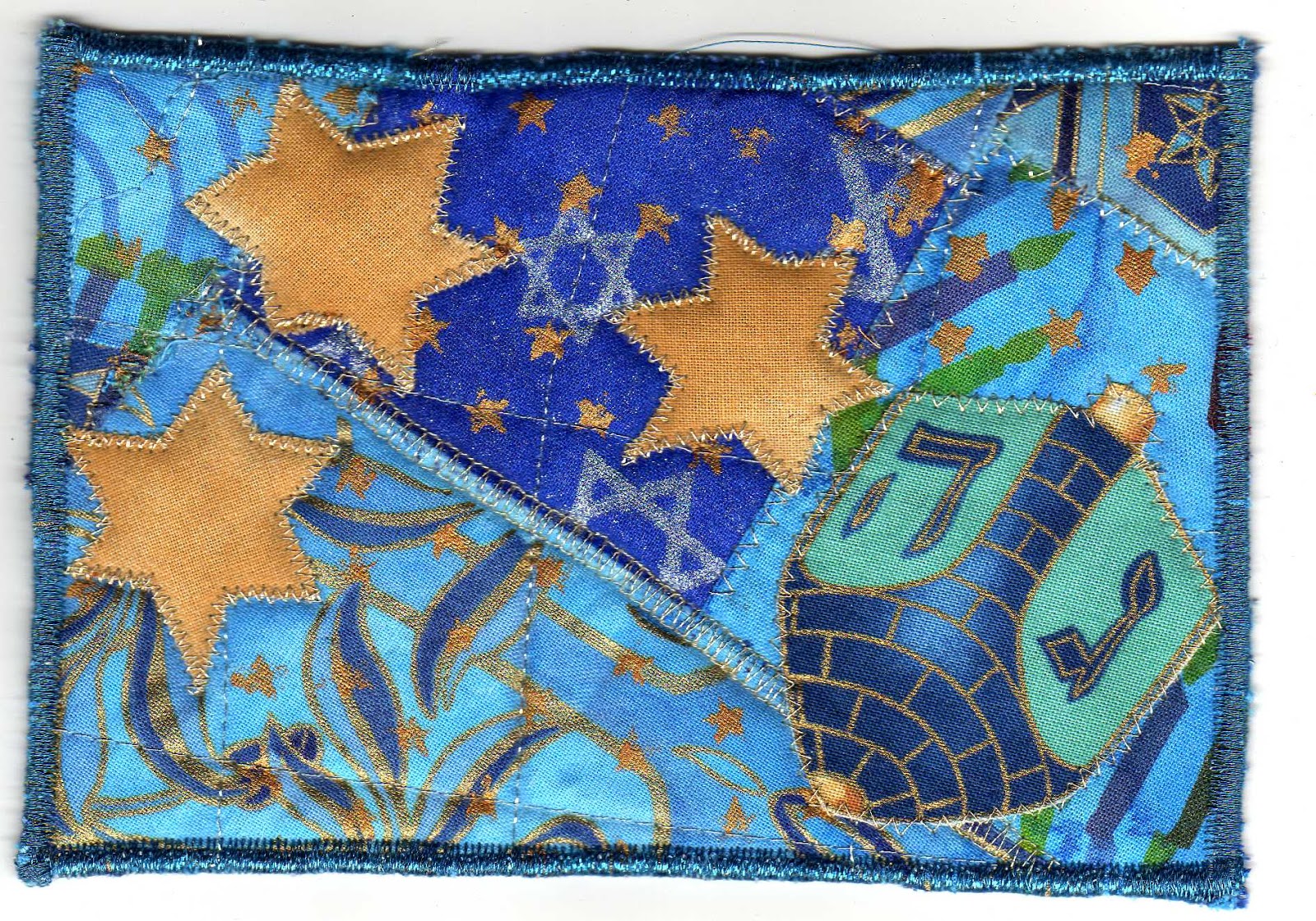
Above and below are some fabric postcards I made for an online exchange a few years ago. It was not only a lot of fun, but also a tremendous dreidel-reduction opportunity. 

I started by making a large background of crazy-pieced Chanukah fabrics. Once all the pieces were joined, I painted them with a translucent Setacolor blue paint, so they all became a similar dark blue tone.

Then I cut the backgrounds into postcard sized pieces - just a little larger than 4" x 6"

Fused the background pieces onto a strong, thick, craft stabilizer, like Peltex, again cut slightly larger than 4" x 6". 

From unpainted Chanukah fabric, I cut out the dreidels, backed them with paper-backed fusible web, then fused and stitched them to the painted fabric rectangles.  Cut the cards to exact 4" x 6" size. Added embellishments. In the card above, on top of this article, I stenciled spirals, and stitched on small metal coins. 

The card below also features stenciled spirals and a crazy-pieced painted background. 

For the next card, I criss-crossed a translucent ribbon on the card, and stitched that dreidel smack-dab on the intersection.

Here, I appliqued three large stars, and stenciled small stars around them. 
After a bunch of cards like that, I needed something different. 

So I played around with foiling. In this card, the dreidel is created with a variegated silver foil. The message ('Hanukah sameach' = Happy Chanukah) is stenciled, as are the hands; there's a coin embellishment on the lower right.  
Foiling involves stenciling or painting a special glue onto the fabric, then ironing or rubbing a sheet of shiny colored foil to the sticky glue area. It's easy and a lot of fun, though, with a non-variegated foil, I can't say the effect is wildly different from using metallic paints. (Learn more about foiling here. No financial affiliation. I use Jones Tones foil paper and glue.)

Finally, I made a one-off. I had printed the lyrics to 'Rock of Ages' on fabric, for a different project, and didn't end up using it. I combined the lyrics with a sincere little guy from fabric I'd bought in Japan many years ago: 
I strongly suspect he's a marcher in a traditional Japanese festival. But he looks like he's as impressed by these lyrics as I am. Alternatively, he's eager to mop dreidel scuffs and chocolate gelt crumbs from the floor. 

Making fabric postcards is fun and addictive.  And they can serve as holiday decor/ornaments.  Tutorials abound, and I liked these two, at: 
  • http://www.patchworkposse.com/blog/2009/08/lets-talkfabric-postcard-tutorial/
  • http://needledmom.blogspot.com/2008/04/fabric-postcard-tutorial.html
If you're longing for your own dreidel fabrics, or other Jewish fabrics, my Judaiquilt.com website has a list of shops that carry them. Start searching at http://judaiquilt.com/Shopping.html.

And, whatever you celebrate, may most of your dreidels (fabric, spiritual, or real), come up gimel (winner takes all!).


Friday, December 7, 2012

How You Look vs. How You See

Chanukah is coming up fast, Christmas isn't far behind, but maybe you still don't know what you want for a present (or what your favorite quilter wants.)

Assuming you don't have thousands of dollars to spend (if you do, a longarm quilting machine 

with a house big enough to hold it,

are always appreciated).

But if you can't afford those, here's something almost as good: 'MagEyes, the Hands-Free Magnifier,'  for around $35-$40. (No financial affiliation).

Is this an exciting look or what?
That's not me in the picture, but it hardly matters, because when you walk around with this thing parked on your head, you are making an important statement. It's not really a hot, sexy statement. It's a geeky, nerdy statement. It says:

I care a lot more about how my quilts look than how I look.

To backtrack a bit: I discovered quilting in my late thirties, just around the time I was prescribed my first pair of glasses. Year after year, my vision got incrementally worse. Every year or two, I needed a stronger prescription.

But even with new glasses, after a couple of months, I still couldn't thread a needle in less than 5 progressively more frenzied minutes.

At a quilt show, a vendor was selling MagEyes, and I decided to invest.

My gosh. What a difference. I could not be a credible quilter without this thing. It allows me to thread needles in seconds, and, most important, see where I'm going when stitching, especially during machine applique and stitch-in-the-ditch, when precision placement counts.

The downsides: When I'm not using them to see closeup, I push the lens part up high, above my forehead. Eventually, I forget whether I'm wearing them. Then, when I want to see something closeup again, I start clawing at my forehead to bring down the magnifying glass section, which may or may not be there. People think I have head lice, or am genuflecting (odd for a Jewish person)[Update: I messed up on the genuflection analogy - see reader comments below], when I'm basically feeling around my forehead in order to see better. It's difficult to explain, and confuses even me.

When the doorbell rings, I  may have still forgotten that they're there, or I'm too lazy to take them off, and so I terrify Boy Scouts collecting canned foods. If I see that my husband is at the door, and I open it for him wearing this contraption - well, let's just say it doesn't rise to the standards of romantic authorities' marital door-greeting recommendations.

So release your inner watchmaker or your inner railroad model builder, or, above all, your inner Geordi La Forge....
You will thank me!

 (More info about MagEyes is on their official site, here. I notice they have come out with an even stronger one. Hmmm, I may need that one too.)

Also, let me know if you use and like a different magnifying system! There are several out there.

UPDATE: Here's a variation that will give you a forest view, no matter where you look. 

Monday, December 3, 2012

Quiltlet #4: Pledge Allegiance to Steampunk Nation

Presenting Quiltlet #4!  [What's a quiltlet? Explanation here.]
Before I show you the whole thing, here's a detail:
Are you up on Steampunk? It's a Jules Verne dark-visionary-retro-futuristic look, involving gadgets, gears, and rust. At first Steampunk didn't do much for me, but then - as with millennium quilts and even  Sunbonnet Sue  - it started to intrigue, and finally, obsess me.

Unfortunately, the fever coincided with a visit to a bead show, where I passed by innumerable shiny brand-new beads, to hand over ten bucks (!) for the rusty watch innard above.

I combined it with a bunch of other elements, old and faux old, to make this cuff:
See how it vaguely resembles an American flag?

Can you guess what's new and what's not? In the closeup below: the round buttons in the upper right, lower right, and lower left corner are vintage. The "gear" in the upper left corner of the brown square is a new scrapbooking tchotchke. The bronze arrowheads are new, iron-on embellishments, from my LQS (local quilt shop).  The brass chain and the jump rings are new, and the hanging metal key is old.

They're stitched and glued to a  2 1/2" brown leather square, cut from an old men's jacket (acquired from the thrift shop).

Also on the front of this quiltlet, there's a large oversized brass eye,  new from the sewing store notions department. It's about 3/4" square.

Corresponding to an oversized hook on the back of the bracelet, sewn on thusly with brown embroidery thread: 
The two pieces of homespun fabric, in coordinated colors, came in a fat quarter pack from a quilt shop, quite a while ago. The colors are way more rustic than I'm used to working with, but perfect for the gloomy Steampunk atmosphere.

Homespun also frequently has stable fringed selvages, and I placed those edges for maximum effect, to create a fringe along the bottom and one short end. Here's the back:
This thing is a bit heavy, so I think I like it better as a horizontal wallhanging than a cuff. In a pinch, if there's no American flag in sight, I can pledge allegiance to it.

It's constructed in such a quirky way that I don't even think I can or should repeat the directions. If anyone wants directions badly, please email me, and I'll make up a more efficient route.

The cuff isn't my only Steampunk creation. Several months ago, as part of a Fiber Arts Trader swap, with a 'Steampunk Ice Queen' theme, I made these three things: (Brooches/Pendants/Wallhangings!):

Here's the third one closeup:
Clockwise from the top: Broken bobbin, perforated rusty street find (maybe the top of an old salt shaker?), metal snap half, tree-branch shaped silver plate bead, gear from the same source as above, vintage metal button, dead sewing machine bulb. The 'Grow' message, admittedly, is excessively cheerful for the dark and broken Steampunk mood.

Steampunk brooches or quiltlets make unique holiday gifts. But beware: you  and/or your giftee may become addicted, and find yourselves pledging allegiance to Steampunk Nation.

Have you made a Steampunk quilt/wallhanging/anything else?

P.S. I was delighted to be able to share this project on Nina-Marie Sayre's weekly creativity compendium, Off the Wall Fridays. Check it out!